
Worsening air, water and land pollution in Gauteng prompted the Gauteng Legislature to convene a summit to find solutions to these challenges.
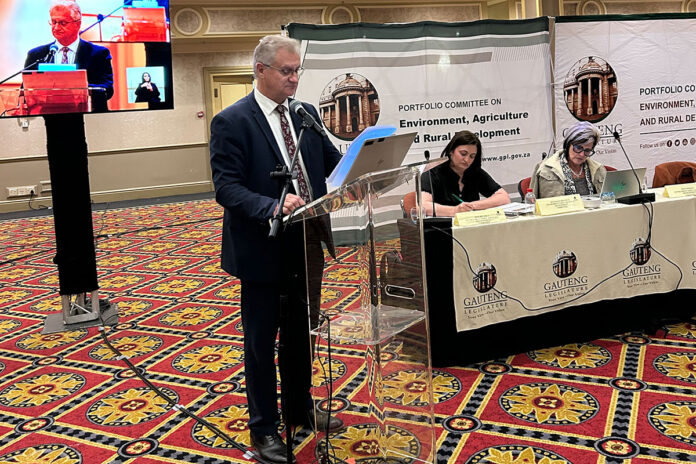
The Pollution Summit, held in the City of Ekurhuleni on 19 and 20 September 2026, brought together government departments, municipalities, scientists, farmers’ associations, environmental organisations and community representatives to consider Gauteng’s pollution challenges under the theme, ‘Restoring Air, Water and Environmental Integrity in Gauteng: From Oversight to Action’.
The programme examined a range of pollution challenges, from the legacy of abandoned gold mines and acid mine drainage to failing wastewater treatment plants, vehicle emissions and unplanned urbanisation, and their impacts on air, water and soil quality. It also explored potential solutions, including strengthening municipal capacity, enforcing existing environmental laws and improving environmental monitoring.
Jaco Mulder, chairperson of the Environment, Agriculture and Rural Development Portfolio Committee at the Gauteng Provincial Legislature, said the expansion of housing developments and informal settlements into rural areas was affecting farming communities.
“Because of the housing that is expanding in our rural areas, we are also seeing an impact on farming communities, with water, ground and air pollution,” he said.
Farmers feel the impact
Responding to presentations on the state of air pollution in Gauteng’s metropolitan municipalities, Johannesburg, Tshwane and Ekurhuleni, Lesedi Masebe, a grains, vegetables and livestock farmer, from Sedibeng, whom was representing the African Farmers’ Association of South Africa’s youth chapter, said air pollution was an “everyday reality”.
“Even at night sometimes, it looks like a grey cloud hanging over the Sasol and Vaal area,” Masebe said.
She added that persistent environmental problems such as dust, smoke, ammonia and other airborne pollutants can irritate animals’ respiratory systems, contributing towards veterinary, medication and treatment costs.
Speaking to Farmer’s Weekly, Katlego Kgopotse, a farmer from Akasia in the City of Tshwane Metropolitan Municipality, said a clean and healthy environment was integral to farming.
“There is no healthy food without clean water, clean air and healthy soil,” Kgopotse said.
He produces indigenous plants, medicinal herbs and industrial hemp, as well as vegetables on his 2ha farm.
Located close to an informal settlement, the farm is affected by waste dumping, raising concerns about potential contamination of the underground water supplying its boreholes.
Kgopotse said smoke from fires made by residents for cooking and heating water also affected the farming environment, particularly because the farm produces crops on open lands.
He added that farmers could not address these challenges on their own, and called for greater support from municipalities and government,” he said.
“We need the municipality and government to support us by making sure that we have mitigation strategies,” he said.
From oversight to action
The summit also highlighted challenges around enforcement and the capacity of municipalities and line departments to respond to pollution.
Mulder said the legislature’s role was to ensure that oversight went beyond an “administrative exercise”.
“When a department says a wastewater plant is working, we must be prepared to go there and see it [for ourselves],” he said.
He added that the committee intended to change how it approached oversight following the summit.
“It’s going to be a bit different from the past, so there will be priority interventions, measurable targets, reporting timelines, and budget and institutional recommendations.”
Going forward, Mulder said the summit’s input would inform a strategic workshop aimed at developing an action plan for a more integrated approach to managing pollution.
“We want to develop one integrated provincial framework covering water, air, land and waste pollution, with clear targets, responsible institutions and implementation deadlines,” he said.