

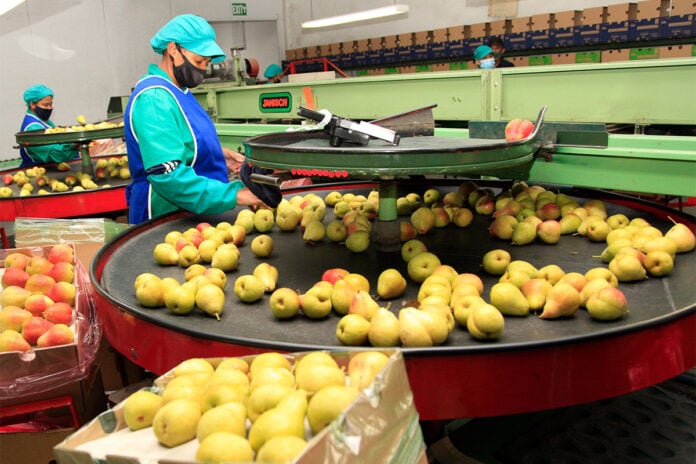
Norman Nieder-Heitmann, director of Gossamer Packaging Machinery, and Fred Albrecht, CEO of Logistics Systems Engineering, addressed these challenges at the Packhouse Trade, Tariffs & Investment Conference, held in Paarl, Western Cape, from 26 to 27 November.
Both speakers emphasised the importance of understanding how products move through a facility before deciding where to invest. Nieder-Heitmann focused on balancing the packing process, while Albrecht addressed storage, internal movement and planning for future growth.
Find what limits output
Nieder-Heitmann explained that the rated capacity of an individual machine did not necessarily translate into equivalent output from the packhouse. Variations in incoming fruit, operating procedures, and interruptions can affect performance, as can the capacity of equipment further along the line.
Drawing on the theory of constraints, he explained that a bottleneck limits the entire system’s throughput, so improving other stages will not increase overall output.
“It doesn’t matter how hard you work outside of the constraints; you’ll get nothing more through the system,” Nieder-Heitmann added.
Addressing the bottleneck would allow more fruit to move through the operation, but another stage would then become the limiting factor.
“There will always be a constraint somewhere in the system. The key is to identify it, manage it effectively, and coordinate the other stages around it to achieve the highest possible throughput,” he said.
For example, increasing packing capacity could expose a bottleneck at palletising if that stage could not handle the additional cartons. Operators therefore need to reassess the process after each improvement, identify the new constraint, and organise the rest of the operation around it to maximise throughput.
Support continuous flow
Keeping fruit moving also depends on the timely supply of packaging materials and information.
Nieder-Heitmann said constraints could involve space, time, or information that was unavailable where and when it was needed. Carton bases, lids, and other materials consequently have to be included in the planning of the production line.
He described an application in which operators could feed fruit into automatic packing equipment separately from the sizer’s immediate output. This provides greater flexibility to keep the packing equipment productive as the fruit mix and operating conditions change.
Further along the line, the number of products and destinations being handled could complicate palletising.
In one system Nieder-Heitmann outlined, cartons from slower-moving product lines were accumulated until enough were available to complete a pallet. This prevented incomplete pallets from occupying positions needed by faster-moving products.
Accurate carton identification and tracking support the process by directing each carton to the appropriate destination.
Use storage space effectively
Once fruit has been packed and palletised, storage could become the next constraint if products cannot be retrieved and dispatched quickly enough.
Albrecht urged operators to assess how effectively they use the full volume of their buildings, including the available height, before considering expansion. This is particularly important in refrigerated facilities, where unused space still has to be cooled.
However, increasing storage density needs to be balanced with access to stock. A facility’s capacity depends not only on how many pallets it can hold but also on how efficiently the required products can move through it.
The choice of storage system and layout should therefore reflect the operation’s requirements, with attention given to shortening travel distances, reducing unnecessary handling, and limiting waiting times. These improvements can help operators make better use of both space and equipment while keeping dispatch on schedule.
Efficient handling also depends on knowing what stock is available, where it is stored, and where it comes from.
“If you don’t have a proper warehouse management system, you’re going to lose control over your stock, where it is, and where it comes from,” Albrecht said.
Reliable stock information gives managers a clearer view of the work ahead, helping them plan retrieval and dispatch, allocate staff and equipment, and reduce last-minute disruptions.
Plan investment in stages
Albrecht recommended addressing clearly defined operational problems through a phased approach to automation.
“We don’t focus on doing everything at once because, first of all, it would be expensive, and secondly, because of the time it would take,” he said.
Operators could tackle a priority constraint and build on that improvement as resources and requirements allow. However, individual upgrades need to fit into a longer-term plan so that the layout and equipment can accommodate future changes.
Smoother operations also have implications for staff. Albrecht explained that the aim of these improvements was to help staff work more productively, rather than replace them. Better planning and smoother operations can create a calmer working environment, reducing the pressure to rush and enabling employees to work more safely and consistently.
Albrecht said that for growers considering a packhouse upgrade, the starting point is to follow the fruit from intake through to dispatch and establish where movement slows or stops. Understanding the cause will help determine whether the most useful investment is additional machinery, a revised layout, better information, or the better use of existing equipment.