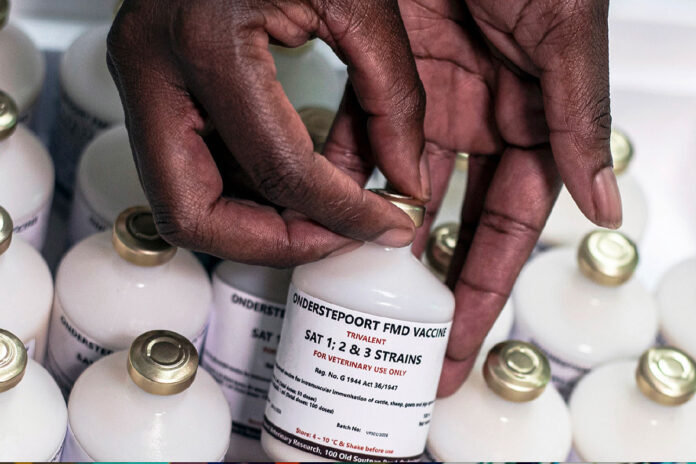
Private companies could be brought into the production of South Africa’s locally developed foot-and-mouth disease (FMD) vaccine after the Agricultural Research Council (ARC) and its board unanimously approved a proposal by Willie Aucamp, minister of the Department of Agriculture, to license the council’s intellectual property to qualifying manufacturers at a meeting on 21 September. Aucamp announced the decision in a media statement dated 22 September.
The decision is intended to address the ARC’s limited manufacturing capacity while it continues rebuilding its own facilities. Local or international companies will be allowed to manufacture the ARC vaccine under conditional intellectual-property licensing agreements.
Aucamp described the agreement as a breakthrough for livestock production and national biosecurity. “I’ve listened to the concerns of farmers and other stakeholders in the sector, and I appreciate that they want swift action to deal with this foot-and-mouth disease outbreak,” he said.
He cautioned that implementation would not happen ‘overnight’, but said the parties had committed themselves to implementing the decision without delay. Income earned by the ARC from the licensing agreements would be ringfenced to expand its own FMD vaccine manufacturing capacity, according to Aucamp’s statement.
No implementation date yet
The ARC told Farmer’s Weekly that it had begun the technical and administrative due diligence needed to define the process. The details would be submitted to Aucamp for review before the process could advance.
No date has yet been given for the appointment of private manufacturers or the release of the first vaccine doses produced under the proposed partnerships.
The ARC said it was obliged, as a public entity, to follow public-procurement requirements to ensure fairness, transparency and compliance with legislation. This was particularly important because the intellectual property resulted from publicly funded research.
The highly infectious nature of the FMD virus meant that compliance with international biosafety standards would also be a central consideration. The council said due diligence and consultation with the relevant authorities had to be completed, and that further information would be provided as the process progressed.
ARC targets major production increase
The ARC put its current output at about 20 000 doses of trivalent vaccine per production cycle (roughly once a month). The vaccine covers the SAT1, SAT2 and SAT3 serotypes.
Production capacity has been rebuilt from a limited 20ℓ pilot operation to an interim 200ℓ capability. The council released 12 900 locally produced doses in February 2026 and said capacity had subsequently increased to 20 000 doses of SAT2 monovalent vaccine a week and 20 000 doses of trivalent vaccine by June.
A 1 000ℓ system and related infrastructure are expected to lift the ARC’s own output to about 240 000 trivalent doses a month during 2027. The private-sector initiative is intended to add enough production to meet the national herd’s vaccine requirements, but the ARC did not quantify the expected contribution from private manufacturers.
Protection and vaccine matching
The ministerial statement described the ARC vaccine as effective against domestic FMD strains and requiring a single annual administration. The ARC said registration data and peer-reviewed research supported the duration-of-protection claim, with vaccinated cattle remaining protected when challenged 12 months after vaccination.
“The 12-month protection claim should not be interpreted as meaning that every animal in every epidemiological circumstance will necessarily require exactly one vaccination per year,” the ARC said.
Vaccination intervals could differ according to vaccine potency and antigenic match, the circulating virus, the animal’s age and maternal immunity, epidemiological risk and the national vaccination strategy.
Representative South African field isolates are due to be sent to the Pirbright Institute in the UK in October 2026 for a second round of vaccine-matching tests. The ARC said this assessment was intended primarily to provide independent evidence on the suitability of available imported vaccines against viruses circulating in South Africa.
Earlier samples submitted to Pirbright had produced results comparable with those of the ARC’s Onderstepoort Veterinary Research facility, according to the council. Both facilities are World Organisation for Animal Health and Food and Agriculture Organization of the United Nations reference laboratories for FMD.
Industry welcomes move
Industry representatives broadly welcomed the opening of local vaccine production to the private sector, while emphasising the importance of selecting capable manufacturers and running a transparent process.
Bennie van Zyl, CEO of TAU SA, described the decision as “a very positive step”, but said its success would depend partly on whether private companies had the capacity to manufacture the vaccine in approved laboratories that met the required standards. Increased production could improve vaccine availability and support more competitive pricing, he said.
Van Zyl said the ARC’s intellectual property had to be properly regulated and managed, but stressed that it had been developed with public money. “It was the South African taxpayer who paid for the development and establishment of this vaccine. Ultimately, this intellectual capital belongs to the South African taxpayer,” he told Farmer’s Weekly. He also welcomed the planned Pirbright tests as a means of confirming that available vaccines continued to protect against the FMD viruses circulating in the country.
Dr David Gerber, founder and CEO of Dunevax Biotech, said making ARC virus strains available to suitably equipped manufacturers could be more practical than relying only on state production capacity. He argued that established facilities with appropriate good manufacturing practice certification should be considered. He also called for transparent decision-making.
Gerber added that long-term investment decisions should take account of the possible move towards newer technologies, including subunit vaccines.
Karen Nel, a co-founder and owner of Design Biologix, said the company welcomed Aucamp’s move to involve the private sector in the national FMD response.
“We hope that Design Biologix will be permitted to do what we do best: high-quality local products for national problems,” she said.
Nel said the ultimate aim should be the eradication of FMD and the restoration of South Africa’s World Organisation for Animal Health status as free from FMD without vaccination.