
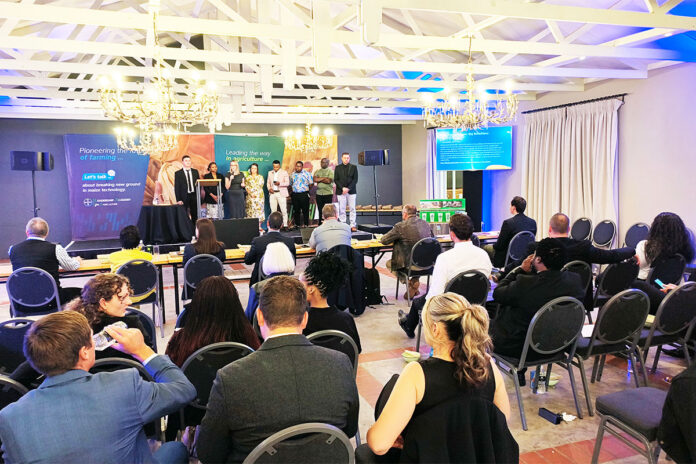
These challenges were brought into focus by the 2026 Bayer Leadership Academy for Agriculture, which concluded in North West in September. The initiative was sponsored by Bayer and presented in partnership with Grain SA, North-West University Business School and Thinking Fusion AFRICA.
The programme, which began in April, brought together people from across the agriculture sector for several months of leadership development, peer collaboration, and practical problem-solving.
Rather than treating leadership as an abstract management concept, participants were challenged to apply what they had learnt to what the programme described as agriculture’s “messy problems” – complex issues that cannot be addressed by farmers, agribusinesses, or institutions working in isolation.
The result was three group projects dealing with issues that have direct implications for the competitiveness and resilience of South African farming.
Beyond the farm gate
The Pipeline Protectors group investigated the effect of deteriorating infrastructure and inefficient logistics on the agricultural value chain.
Roads, railways, and ports influence the cost and profitability of grain production, yet many of these factors lie outside producers’ control. The group considered the additional costs created by infrastructure deterioration as well as fragmented coordination between government institutions and private-sector stakeholders. Its task was to explore collaborative interventions that could improve logistics and reduce cost leakage across the system.
A second group, the Wild Oaks, turned its attention to producers’ access to agricultural innovation.
Improved genetics, crop protection products, digital technology, and mechanisation can help producers improve efficiency and manage risk. However, the project identified regulatory processes, limited coordination, and slow adoption pathways as factors that can delay South African farmers’ access to new technologies compared with international competitors.
The group examined how policy, institutional and market-based approaches could enable faster access to productivity-enhancing technology while retaining appropriate regulatory oversight.
Turning global risk into farm decisions
The Sustainable Solutions Squad investigated a different challenge: how farmers can make better decisions when developments thousands of kilometres away rapidly affect conditions at home.
Energy-market disruptions, fertiliser supply shocks, and instability in international trade can quickly reach farm level. While producers are accustomed to managing climatic and market cycles, the group identified the speed and complexity of current global volatility as an additional challenge.
Its project therefore considered ways of helping the agricultural sector anticipate and interpret international developments and translate global risk into information that can support practical decisions on farms.

Leadership remains a people business
Speaking at the course completion ceremony at Pecan Manor, Grain SA chairperson Richard Krige emphasised the human element of agricultural leadership. “Plans and strategies ultimately depend on the people working on farms and throughout the value chain,” he said, adding that leadership was important in keeping teams motivated and working towards the sector’s success.
Maria Vnuchkova, Bayer value proposition lead for commercial farmers, similarly linked technological progress with the ability of people to put it into practice.
“Technology can open doors, but people lead the way through them. Data can inform decisions, but leaders turn insight into action,” she said.
The academy is intended to develop leaders who are able to think beyond their own farms, businesses and organisations, engage with different stakeholders, and contribute to broader agricultural solutions.
For the 2026 participants, the end of the programme was consequently framed less as the completion of a course and more as an expectation that its lessons would be taken back into their businesses, farms, and communities.
Vnuchkova encouraged graduates to use what they had learnt to ask better questions, listen more closely, and develop stronger partnerships.
In a sector where a failing road, delayed technology approval or geopolitical disruption can ultimately influence decisions made on an individual farm, the projects demonstrated why agricultural leadership increasingly extends well beyond managing what happens inside the farm gate.