
According to Statistics South Africa’s (Stats SA) latest Quarterly Labour Force Survey (QLFS), released on 11 August, agricultural employment decreased by approximately 16 000 jobs from 960 000 in the first quarter (Q1) of the year to 944 000 in Q2. Despite this, the sector recorded a year-on-year increase of 39 000 jobs, or 4,3%, for the period ended 30 June 2026.
The broader labour market also weakened during the quarter, with the number of employed people falling by 16 000 to 16,7 million, and the official unemployment rate increasing from 32,7% in Q1 to 33,6% in Q2.
Employment shaped by seasonality and input costs
Speaking to Farmer’s Weekly, Marguerite Pienaar, agricultural economist at Grain SA, said the quarterly decline in agricultural employment needed to be considered within the context of the grain industry’s production cycle.
“In the grain industry, permanent employment makes up approximately 5% to 10% of input costs, depending on the area of production, and not taking into account seasonal workers,” she explained.
Pienaar said the harvesting period often resulted in increased demand for seasonal labour.
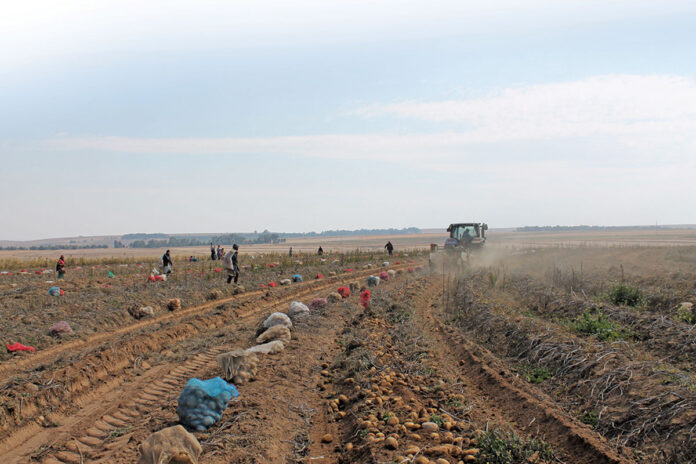
“From April to June, summer grain farmers are harvesting their crops, so they usually employ additional labour in the form of seasonal workers.”
However, she said grain and oilseed producers remained in a low-price cycle because of ample stocks and low international commodity prices.
“Higher fuel prices and increased fertiliser costs during critical times in the production cycles have added further economic pressures on grain producers,” she said.
Against this backdrop, Thapelo Machaba, agricultural economist and policy analyst at Agbiz, said the latest agricultural employment figures did not point to an employment crisis.
“We lost about 16 000 jobs in Q2, but the numbers are still above the 799 000 long-term average. The Q2 decline should not be seen as an employment crisis. In fact, it’s a modest decline, and this is obviously because of the sector’s seasonal nature or production activities,” he explained.
He added that agricultural employment was closely linked to farm profitability.
“Farmers employ labour when expected returns justify the cost of production.”
Machaba noted that elevated fuel, fertiliser, and electricity costs, as well as weak international prices for some commodities, were placing pressure on producers.
However, a strong production year in fruit, vegetables, and field crops, which were relatively labour-intensive, had helped support the year-on-year employment gains.
Effect on rural households
Pienaar said the year-on-year increase in agricultural employment was therefore a positive sign for rural communities.
“Looking at the year-on-year statistics, it’s clear that there has been growth in sector employment, which contributes to the livelihoods of rural communities,” she said.
Machaba added, however, that a sustained decline in agricultural employment could have wider consequences.
“Agricultural employment remains an important source of income for many rural households, so a sustained decline in jobs could put pressure on household incomes and spending, as well as on rural businesses that depend on agricultural communities.”
Profitability key to employment
Machaba said the sector’s ability to create and sustain employment would ultimately depend on whether farming remained sufficiently profitable to encourage investment and expansion.
He added that producers were increasingly turning to mechanisation to improve productivity and manage rising expenses.
“However, it would be too simplistic to attribute employment changes to mechanisation alone. Producers continue to invest in tractors and other equipment, even amid weaker business confidence, suggesting that mechanisation is primarily a productivity response rather than simply a replacement for labour,” he said.
“Ultimately, the key is whether the sector remains profitable enough to support continued investment and expansion, particularly in labour-intensive areas such as horticulture and agro-processing.”
Infrastructure and policy certainty critical
According to Machaba, policy certainty and infrastructure investment were also necessary to support sustainable employment.
“Sustainable agricultural employment depends on a growing and profitable sector. This requires policy certainty, including labour legislation that recognises the seasonal and regional nature of agricultural work, while avoiding unintended constraints on access to labour,” he explained.