
The memorandum, backed by a petition signed by more than 960 Grain SA members, calls for fair, transparent, and evidence-based price discovery that reflects actual grain flows and physical market realities.
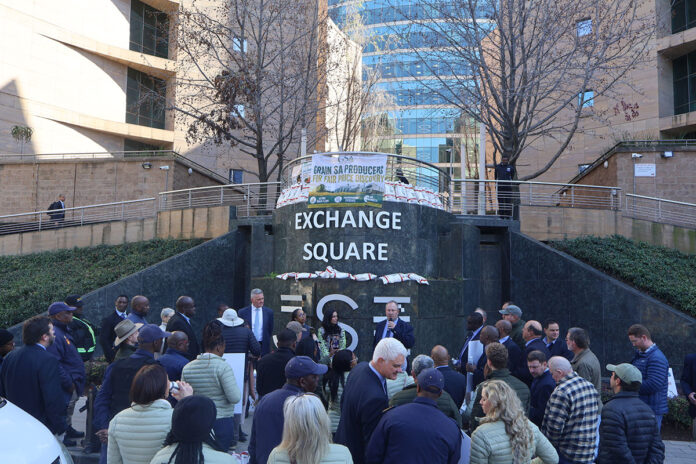
The procession, led by Grain SA CEO Tobias Doyer and Chairperson Richard Krige, gathered at Sandton Central Park and marched to the JSE offices to meet with the exchange’s leadership.
Chanting ‘listen to the farmers’ as they peacefully marched, the farmers expressed their displeasure with the JSE’s decision to abandon its pilot multiple reference point (MRP) model, announced on 20 July 2026.
Speaking to Farmer’s Weekly, Corné Louw, applied economics and member services lead at Grain SA, said the organisation was demanding that the JSE hear its grievances.
“We need to be taken seriously because farmers are at the heart of the food chain. Farmers feel the injustice of the recent decision, and we demand a fairer market. In the last two years, we tested the MRP model, and then suddenly another decision for the single reference point [SRP] system was made. Farmers feel the JSE didn’t sufficiently consult with them.
“As things stand right now, all grain is considered to be from Randfontein, but the reality is that not all grain is from Randfontein,” Louw said.
Doyer, meanwhile, urged the JSE to reconsider its decision.
“The JSE is a custodian of the trading market that must widely consult and operate a fair dispensation system. In this case, they didn’t listen to the actual farmers. We need more transparency, and farmers deserve clarity.
“The current assumption that all grain moves to one point is incorrect, and the current [SRP] system reduces the total cost of transportation, which is not fair,” he said.
Summing up these remarks, Krige asked for fairness and transparency.
“We have spent the last 20 years negotiating, but nothing has happened. A technical committee was set up to establish five parameters to evaluate success, but the process was abandoned. The current model does not reflect market reality and, ultimately, it’s the producers and consumers who carry the cost. The current pricing model doesn’t even match the best international standards. We want to open the [negotiation] process again,” he said.
Receiving the memorandum on behalf of the JSE, Valdene Reddy, group CEO, acknowledged the seriousness of the matter.
“This is a serious situation because farming represents the real economy. We understand the impact of our decision, and we have a commitment to uphold a fair, transparent, and efficient market system. We are happy to engage. We are also conscious of the fact that this matter is sub judice because it’s before the courts, so we will briefly sit with the leadership inside our offices,” she said.
The march ended with farmers expressing optimism that the memorandum would be seriously considered for the good of the agriculture sector and the entire South African economy.
“The differential work is not fair for many regions and for all the producers who are in far-flung areas. It would be better [for the JSE] to consider all the producers who are far away and to brainstorm and consult [with farmers] in the wheat-producing areas, specifically the Cape, who have to travel longer distances,” Ebert du Plessis, who farms near Standerton in Mpumalanga, said.
Lionel Cass, who farms in Middelburg, Mpumalanga, criticised the JSE for the manner in which it took its decision.
“The JSE unilaterally decided to keep the transport fees for both the millers and the farmers, and farmers are under enormous financial pressure. We cannot afford to have any more costs being recovered from the farmer. If the transportation fee is to be paid, then at least it should be split between the buyer and the seller. Then it would be fair,” he said.