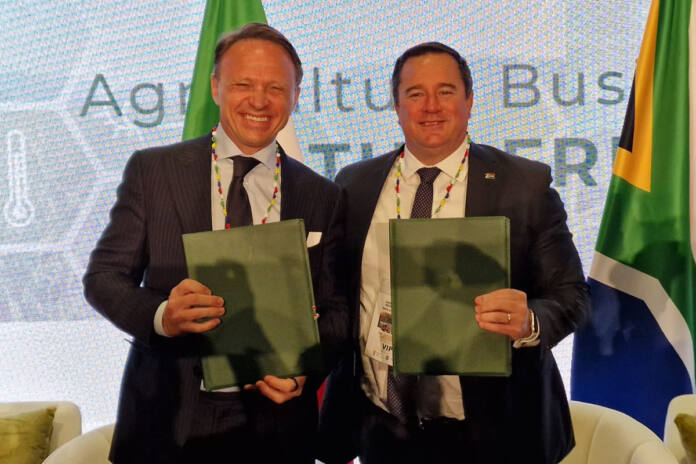
The signing of a memorandum of understanding (MoU) on 9 June 2026 between South Africa’s Agriculture Minister John Steenhuisen and Italy’s Minister of Agriculture, Food Sovereignty and Forestry Francesco Lollobrigida marks a continuation of engagements between the two countries following last year’s G20 Agriculture Ministers’ meetings hosted in South Africa.
Speaking at the opening of the forum held in Cape Town, Steenhuisen said the agreement reflects a strategic shift in how both countries view their agricultural relationship.
“This is more than an event. It marks the beginning of what can become one of the most dynamic agricultural partnerships between South Africa and a leading European agricultural nation,” he said.
While trade between the two countries has steadily increased in recent years, both sides made it clear that export volumes alone are no longer the primary focus. Two-way agricultural trade between South Africa and Italy now exceeds R650 million a year, with horticultural exports valued at about R190 million.
Steenhuisen said the current trade between the two counties is “only scratching the surface”. He further said that the emphasis is on linking South Africa’s production capacity with Italy’s strengths in processing, technology, packaging innovation and global market positioning.
“The opportunity is not simply to export more primary products. It is to create value across the entire chain, from production through processing to final markets,” said Steenhuisen.
That sentiment was echoed by Lollobrigida, who stressed that the partnership is built on complementarity.
“Our countries are geographically distant, but complementary in many productive aspects,” he said.
Business delegation and regional linkages
Italy brought a delegation of around 40 officials and business representatives from more than 30 companies, who spent two days in meetings with South African counterparts during the agribusiness forum held in Cape Town.
These engagements focused on identifying practical areas for collaboration across production, processing, technology and trade, and provided early momentum for deal-making on the ground. These deals will be supported with most of the funding coming from Italian institutions according to delegation members.
Steenhuisen also pointed to strong potential for region-to-region partnerships, noting that South Africa’s provincial production strengths align closely with those found in Italy’s agricultural regions.
He said there are “many bridges of opportunity” between South Africa’s key producing provinces, particularly in avocados, citrus, deciduous fruit and meat, and their Italian counterparts, where regional specialisation has long driven value addition and export success.
Africa as the strategic hinge
Lollobrigida described South Africa as “a market of great interest”, not only in its own right, but as a gateway to the wider African continent.
For South Africa, the relationship works in the opposite direction as well.
Italy is not only a destination market, but a gateway into high-value European value chains, particularly in segments where processing, branding and product differentiation determine returns, noted Steenhuisen.
The partnership effectively creates a dual corridor: Italy accesses African markets via South Africa, while South Africa accesses European value chains via Italy.
Lollobrigida highlighted the complementarity between the two countries’ production cycles, with South African fruit exports supplying European markets during their off-season.
That counter-seasonal advantage supports continuous supply, but both ministers indicated that the next phase must go further towards integration across processing, logistics and distribution.
Lollobrigida said Italy is ready to support South Africa through its expertise in mechanisation, precision agriculture and irrigation.
“Technical and scientific co-operation is essential. Italy has advanced capabilities that can support sustainable growth,” said Lollobrigida.
Steenhuisen linked this directly to South Africa’s own priorities.
“We have to produce more food using fewer resources while building resilience into our farming systems,” he said.
To drive implementation, a joint working group will be established, with exchange visits already planned. South African delegations are expected to travel to Italy, with Italian technical and business teams visiting South Africa in return to accelerate collaboration.
Research collaboration already underway
At research level, co-operation is already advancing, primarily driven through the prominent research organisations of both countries. The Agricultural Research Council (ARC) in South Africa and Italy’s Council for Agricultural Research and Economics (CREA) will continue and deepen their scientific research and training noted Dr Litha Magingxa, CEO and president of the ARC.
Prof Andrea Rocchi, president of CREA, told Farmer’s Weekly that joint postgraduate work between Italian and South African institutions has recently been completed.
“We have just finalised joint PhD-level research and would like to continue this collaboration in the near future,” he said.
Practical trade issues remain key to unlocking the partnership’s potential, noted Lollobrigida. He confirmed progress on addressing barriers, including work on the table grape protocol between South Africa and Italy.
In follow-up media engagements, both ministers clarified that current efforts relate primarily to Italian table grape exports into South Africa during the local off-season.
Steenhuisen said that “the remaining legal and administrative steps on South Africa’s side now need to be finalised, with further details on the table grape protocol expected soon”.
The MoU between the two countries does not include a set amount of funding allocation; instead, it creates a platform for future projects and investment, said Steenhuisen. However, the agreement sits within a broader funding landscape. Italy’s Africa-focused Mattei Plan provides around €5,5 billion (around R110bn) in financing instruments.
While South Africa is not yet a direct recipient, the partnership positions it within these emerging funding corridors, said members of the Italian delegation.
Steenhuisen indicated that the economic upside could be substantial for South Africa.
“We have our internal targets, but this co-operation with Italy will lead to hundreds of millions of rand in income. The aim is that producers at farm level must and will feel the benefits,” noted Steenhuisen.