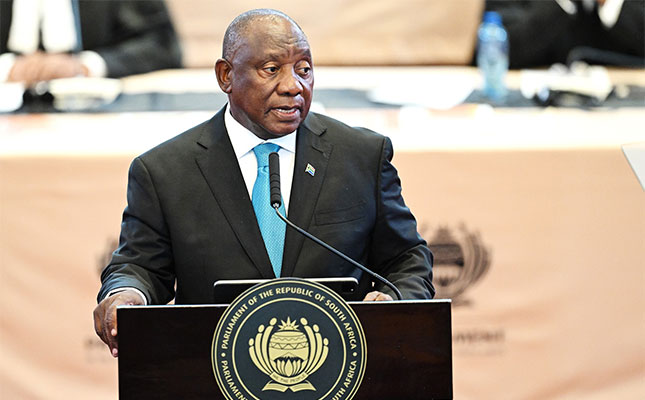
While Ramaphosa acknowledged the challenges and even provided solutions, scepticism over implementation prevailed.
Last night, he pointed to four consecutive quarters of GDP growth, two primary budget surpluses, and declining borrowing costs.
“Our economy is growing again, and this growth is gathering pace. Our credit rating has improved, interest rates are coming down, and inflation is at its lowest level in 20 years. We are on a clear path to stabilising our national debt.”
He noted that government has committed more than R1 trillion to public investment over three years, the largest infrastructure allocation in the country’s history, targeting energy, logistics, water, and digital infrastructure.
Ramaphosa added that government remained focused on sectors that will drive future growth, including agriculture, mining, the green economy, and digital services.
Despite the gains, he was unequivocal that South Africa faces serious internal threats, including organised crime, a water crisis, and unemployment.
To tackle the water crisis and coordinate a focused response, the president announced the establishment of a National Water Crisis Committee, which he would chair.
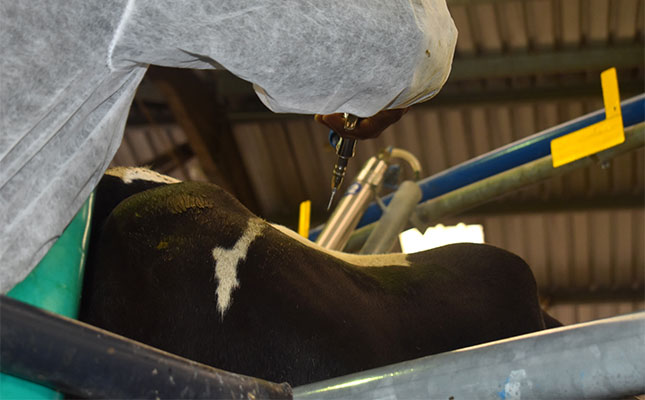
He also declared the ongoing foot-and-mouth disease (FMD) outbreak a national disaster. Ramaphosa confirmed that at least 14 million cattle will be vaccinated, with an estimated 28 million vaccine doses required over the next 12 months. He added that government will centrally facilitate the acquisition of vaccines to ensure the correct strain-specific vaccines were secured.
Agbiz CEO Theo Boshoff said in a statement that he would have liked to have seen more details about how FMD will be combatted, and for government to extend an olive branch to the private sector to assist.
“While we recognise that the state must play the central role in eradicating a controlled disease, the state’s efforts must be complemented by pre-emptive, voluntary vaccination by the sector as soon as sufficient vaccines are available for purchase.
“The focus must surely now be to vaccinate as many animals as possible in the shortest possible time. For this to work, we need to collaborate in the same manner as we did during the COVID-19 vaccine rollout,” he explained.
Speaking to Farmer’s Weekly, Dr Piet Croucamp, a political analyst at North-West University, said Ramaphosa is adept at creating the impression that he fully understands the problems and has all the solutions.
“While this may be true, the implementation of the solutions is where he fails.
“There are three critical factors needed to implement the solutions: time, money, and infrastructure. We don’t have the luxury of any of those three. The infrastructure has been so decimated that we can’t fix it within the current budget, and we don’t have the time before complete collapse.
“Furthermore, while listing solutions, Ramaphosa does not give any timelines. There is no urgency, which is why we don’t see any progress year after year,” he explained.
Agbiz Chairperson Sean Walsh echoed Croucamp’s sentiments, stressing the need to follow up commitments with real action.
“There are several positives that we have to recognise: South Africa’s removal from the [Financial Action Task Force] grey list, the disbursements towards blended finance, and the classification of FMD as a national disaster.
“While the commitments regarding local government reform and infrastructure spending are encouraging, we will hold off on celebrating until we witness tangible implementation of these reforms,” he said.
Government collapse impedes progress
Commenting on the challenges faced by agribusinesses in rural towns, Walsh said interruptions in water and electricity supply and neglected infrastructure, such as roads and rail, represent the single biggest challenge to doing business.
“[Agbiz is] actively participating in the White Paper on Local Government, but there must be financial consequences for municipalities that don’t perform.”
Croucamp noted that the ‘elephant in the room’ was not addressed in SONA 2026: cadre deployment.
“Ramaphosa implied that we needed to bring skilled people on board to fix the problems and said that government appointments would be done on merit, but he did not say that cadre deployment would be eliminated.
“For the ANC, cadre deployment is merit-based because the candidate has political merit. This is crony capitalism that is costing our country dearly. Ramaphosa speaks as if he doesn’t realise that the interests of the country and that of the ANC are incongruent,” he said.
Boshoff called on government to protect critical industries that drive inclusive growth, pointing to both opportunities and policy concerns affecting the sector.
“From an agribusiness point of view, it was good to hear the president emphasise the contribution that the agricultural value chain makes to inclusive growth and employment in the country. But it cannot be taken for granted that the sector will always be competitive in the face of serious challenges.
“Reference to increased excise and restrictions on advertising in the liquor industry is a case in point. On the one hand, a new structure is being created to investigate illicit trade, but on the other hand, we are making policy pronouncements that make it near-impossible for the legitimate industry to compete with the illicit economy. A dose of realism and pragmatism is sorely needed,” he concluded.