
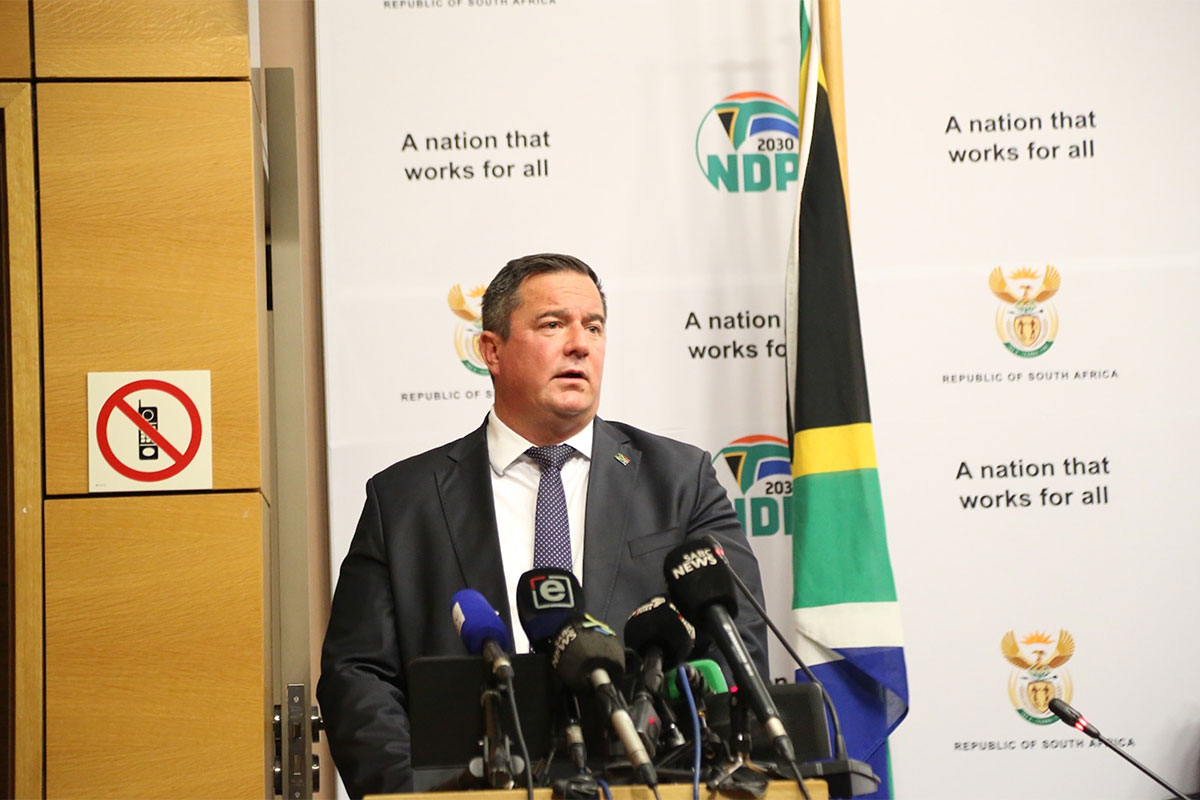
At a media briefing held yesterday at the Imbizo Media Centre in Parliament, Cape Town, Minister of Agriculture John Steenhuisen provided an update on South Africa’s response to the FMD outbreak, vaccine procurement efforts, and progress towards restoring the country’s FMD-free status.
“We are moving away from isolated, reactive measures towards a strategic, science-based approach,” he said.
“This is not just about managing an outbreak; we are building a competitive, resilient agriculture sector that can regain access to international markets.”
Fast-tracked vaccination option for farmers
Central to the announcement was the gazetting of the final Routine Vaccination Scheme for Foot and Mouth Disease under Section 10 of the Animal Diseases Act (No. 35 of 1984) on 4 May, allowing farmers to immediately begin vaccinating their herds under veterinary supervision.
“This voluntary Section 10 scheme is essentially a fast-track option. It allows farmers to take the lead in their own biosecurity without having to wait for the national [vaccination] rollout,” Steenhuisen explained.
Under the scheme, farmers must ensure full traceability of animals, carry out vaccinations under the supervision of authorised veterinarians, and digitally record vaccination data, including batch numbers and storage conditions.
Steenhuisen stressed that a structured approach is critical: “Vaccines are only as effective as the traceability and surveillance systems that support them. Without that, you are wasting time and resources.”
No ‘free-for-all’ in vaccine rollout
Drawing on recent engagements with Brazil and Argentina, Steenhuisen dismissed calls for unrestricted access to vaccines.
“There is no vaccine free-for-all anywhere in the world. Vaccines are not just handed out to farmers. They are administered within controlled programmes under state oversight,” he said.
He added that South Africa’s model aligns with global best practice, with government maintaining central coordination while enabling private-sector participation.
Supply constraints are easing
Steenhuisen addressed criticism around vaccine availability, emphasising that supply challenges stem from the need to match vaccines to specific local virus strains.
“There is no stockpile of ready-made vaccines sitting anywhere in the world. Every vaccine must be matched to the field strains circulating in South Africa,” he explained.
To date, six million doses have been secured, a total of 15 million doses are expected to have been procured by the end of May, and further shipments are in transit from international suppliers.
“We have secured every available vaccine globally that matches our strains. There is not a single supplier sitting with stock that we could have accessed and didn’t,” he added.
Progress and targets
Since last year, more than 4,5 million cattle have been vaccinated, with upwards of 2,5 million animals vaccinated in the past three months alone. Government is targeting the vaccination of 80% of the national herd by December.
“The constraint has always been vaccine supply. That constraint is now being addressed, and you will see vaccination numbers increase exponentially,” Steenhuisen said.
Kwazulu-Natal restrictions lifted
In a significant policy shift, Steenhuisen announced the lifting of the FMD restrictions in the KwaZulu-Natal disease management area.
“The reality on the ground has changed. It is no longer scientifically or ethically justifiable to impose stricter restrictions on one part of the province when the disease is more widely distributed,” he said.
The move forms part of a broader transition towards a unified national disease management strategy, including new countrywide movement control measures.
Local production ramping up
Efforts to rebuild domestic vaccine production capacity are also under way, with the Agricultural Research Council scaling up output.
“This is about ensuring that South Africa is never left vulnerable again,” Steenhuisen said.
Long-term goal: market access
Ultimately, government’s strategy aims to restore South Africa’s FMD-free status and reopen export markets for red meat.
“For the first time in over 20 years, we have a clear, scientifically grounded plan. Our goal is to regain FMD-free status and unlock global markets that have been closed to our red meat industry for decades,” Steenhuisen said.
“If we want to grow the red meat industry and bring in new entrants, especially small-scale farmers, access to international markets is essential.”
He emphasised that success will depend on collaboration across the industry: “This is a shared responsibility. Government, private veterinarians, and farmers must work together. If we do, we will beat FMD and position South Africa’s red meat industry as a global competitor.”