In a world where farmers are constantly juggling between producing food and having to mitigate and balance many environmental, financial, and societal challenges, precision agriculture has emerged as a promising solution to many of the complex challenges farmers are facing.
“Farmers are forced to be more efficient. By leveraging precision agriculture that aims to optimise crop yields on every production unit, farmers can simultaneously address profitability and sustainability. But this will only materialise if the technology is used purposefully and optimally,” says Corné Louw, applied economics and member services lead at Grain SA.
One of the innovations within the science of precision agriculture is variable rate technology (VRT).
VRT implies that inputs are applied at variable rates according to the circumstances in the field. “VRT uses data-driven tools like sensors, GPS, and maps to optimise the use of seed, fertilisers, crop protection chemicals and also irrigation. This allows farmers to tailor their approach to each part of the field, maximising yield, reducing waste, and optimising all input use,” says Esmond Coen, head at Ag Solutions at Case IH Southern Africa.
VRT uses GPS (Global Positioning System) and GIS (Geographic Information System) technology to apply specific input rates in various locations in a field. Data collected over time informs a VRT-enabled piece of equipment, such as a planter, sprayer, or fertiliser spreader, exactly where and at what rates to apply products, Coen explains.
But to fully benefit from precision agriculture and VRT, farmers need data, Louw emphasises. “Data is needed to enable the optimal use of these new technology options. Farmers should not only obtain the newest technologies just as a nice-to-have but also as a necessity. They should do proper research and use the technology as intended, for precision farming through optimising their efforts and inputs.”
Louw adds that the power of VRT lies in the fact that decisions are data-driven. “Using information from sensors and satellite imagery, farmers can make informed choices about input application, planting, and other farming practices. This leads to more effective and efficient farming in general.”
On-farm data has become one of a farmer’s most valuable assets. “Data is not only used to plan for the coming season, but also to customise input recommendations. Cultivars can now be recommended not only in certain areas, but also for specific soil types and fields on a farm. All this is meant to drive on-farm productivity on every square metre of land,” says Louw.
“A one-size-fits-all approach no longer addresses the range of challenges farmers face on-farm. We need tailored solutions that respond to in-field variability, an unpredictable climate, crop-specific requirements, and market and societal demands,” says Petri van Walt, director of grain crops at Walt Landgoed in the Settlers area.
Soil analysis
To implement VRA effectively, it is essential to assess soil health across the field. “Soil analysis is the crucial step in the VRT process,” says Charles Basson, portfolio and technical marketing manager for row crops at Syngenta Seed South Africa.
“Soil testing and analysis are critical for understanding your soil’s physical, chemical, and biological properties. Soil analysis can provide information on soil pH and nutrient levels, texture and structure, organic matter, and carbon content as well as soil microbial activity and diversity,” adds Basson.
According to him, the data collected helps with creating a detailed map of each field’s soil character. “A soil health map can be created by integrating soil analysis data with other spatial data, such as topography, soil type, and land use history. This map can be used to identify areas that require different management strategies. Soil analysis is essential for developing targeted application plans,” Basson argues.
In addition, he adds, soil testing and analysis can also help identify areas of soil degradation, such as compaction, nutrient deficiencies or imbalances or reduced microbial activity.
ABC of VRT
According to Jaco Minnaar, a Free State farmer from Hennenman and former Grain SA chairperson and AgriSA president, VRT enables a farmer to maintain farm profitability while increasing the sustainability of farm management programmes and practices.
Minnaar is a prominent advocate for the Data Intensive Farm Management (DIFM) project, a precision agriculture initiative by the Bureau for Food and Agricultural Policy (BFAP). Launched by BFAP in 2019, the DIFM project is a collaboration with the University of Illinois Chicago, Stellenbosch University, the Protein Research Foundation, Grain SA, the Sasol Agricultural Trust, and John Deere. This programme integrates on-farm data to optimise variable rate technology for seeds and fertilisers.
“One must recognise that spatial variability on a farm is a reality. Within a single field, soils can differ substantially in depth, texture, structure, and water-holding capacity. These differences are not necessarily visible to the naked eye yet play a decisive role in how crops respond to rainfall and inputs.”
Minnaar explains that in traditional farming practices, inputs are applied uniformly across an entire field without considering soil variations or crop requirements. This, he says, often leads to inefficient use of resources, as some areas received excess inputs while others may have received insufficient amounts.
“Uniform management assumes that all parts of the field will respond similarly to fertiliser or that seed will respond similarly across a field. In practice, this assumption rarely holds true, as some areas may respond strongly to additional input applications while others will show little response regardless of how much is applied. This mismatch can result in wasted inputs in some areas and unrealised yield potential in others. This may also lead to funds not used optimally.”
Van der Walt agrees. “Treating a farm or field as homogeneous prevents farmers from unlocking the full potential of every hectare. Our goal is to produce grain on each available hectare as profitably and sustainably as possible. Data now drives farming, helping us understand our fields in detail and make precise, informed decisions. It means that we manage our field metre by metre.”
Minnaar notes; “VRT addresses these limitations by adopting a site-specific management approach. We use multiple data accumulated over years to determine variable rate applications for fertiliser, crop protection products, and seed. This allows me to tailor my approach to various sections of a field.” notes.
He further points out that seeding rate recommendations should not be treated as fixed rules but should be seen as recommendations to start off with. “Use seeding rate recommendations as a starting point but realise that it may need to be adjusted according to on-farm soil and climate conditions.”
VRT methods
There are two fundamental methods for site-specific on-farm management for variable rate application of fertilisers, chemicals, and seeds. Each type offers distinct advantages and innovative approaches to enhance farming efficiency and sustainability.
- Map-based VRT
Map-based VRT leverages accumulated data to strategically apply inputs and uses detailed, personalised maps of the farm and fields. These maps are created using data collected over time, such as soil samples, crop yields, and topographical features.
Once the map is established, it guides agricultural machinery to apply seeds, fertilisers, agricultural chemicals, and water precisely where they are needed most. In general, using maps ensures that every part of the field receives the optimal amount of resources, reducing waste and increasing productivity.
According to Coen, a positioning system is used throughout the soils chemical and physical surveys and application process to continuously track and record the vehicle location in the field. Differential Global Positioning System (DGPS) receivers are the most commonly used positioning devices to achieve high locational accuracy.
- Sensor-based VRT
Sensor-Based VRT, on the other hand, employs real-time monitoring to manage crop needs dynamically. Sensors are attached to equipment or placed in the field to continuously measure conditions such as soil moisture, nutrient levels, and plant health.
Real-time data is sent to control systems, which immediately adjust application rates according to current field conditions. This allows farmers using sensor-based VRT to respond quickly to crop needs, apply resources more efficiently and improve overall crop management.
Management zones
The first step in VRT is to create farmer-developed management zones Minnaar explains. These zones are typically mapped by looking at the uniformity of certain characteristics as determined by soil analysis, yield monitoring results, and other data such as remote sensing imagery. A standard management zone in a VRT system would map high, medium, and low-productivity areas within a field.
Equipment
The VRT market is divided into three main components: hardware, services, and software and encompasses equipment such as GPS/DGPS receivers, portable computers, sensors, yield monitors, fertiliser spreaders, planters, and sprayers. Mechanical systems are integrated with digital technologies enabling farmers to manage their fields and crops optimally.
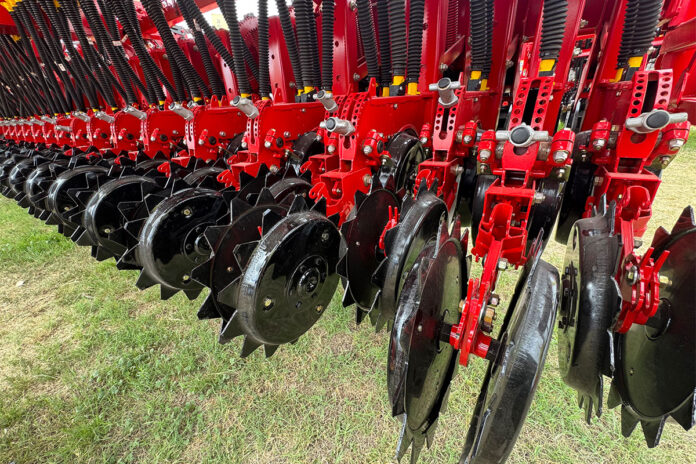
Mechanisation equipment such as seed drills or planters, fertiliser spreaders, and sprayers is equipped with advanced control systems and GPS technology to implement VRT. “These machines and equipment can automatically adjust the application rate in real time as they move across the field according to prescription maps or VRT sensors. For example, in areas with high soil fertility, the machine may reduce fertiliser applications, while in other zones, the rate may be increased. This ensures that the crop receives the optimal amount of inputs required for healthy growth,” says Coen.
According to Coen, when farmers acquire new planters, seeders, or precision drills, it is important that they look for variable‐rate seeding capability to optimise seed placement. “It is also important to check seed singulation metrics and to aim for >95% accuracy.”
Variable rate fertilisation can be done using spreaders for granular products or sprayers for liquid products.
Variable rate fertiliser applications
VRF systems allow growers to vary the amount of fertiliser applied through a field, responding to specific soil conditions and crop needs.
The amount of lime needed by soil for specific crops to flourish depends on its cation exchange capacity (CEC).” The CEC of soil is related to factors such as soil texture, content of organic matter, and the type and percentage of clay content in the soil,” Coen clarifies.
According to Coen, when starting with VRT, the first step should be to do variable rate lime applications. “Different soil types across and within fields will require different liming applications due to different textures, organic matter, and soil ph. Of all VRT uses, this is the one I would recommend starting with.”
While variable-rate spreaders are most commonly used for lime, they can also be used for nitrogen fertiliser or other macronutrients such as phosphorous or potassium applications.
Coen says that to develop a variable rate fertiliser application plan in a specific field, it is important to systematically sample the soil in a field on a specific grid size, followed by soil analysis. The results should be used to generate site-specific soil maps and fertiliser application maps.
According to Van der Walt, the variable fertiliser applications script for crops will depend on the soil analyses. In addition, he says, they take leaf samples throughout the season, sending those to SGS laboratories for analysis. Foliar feeding is then applied according to each fields and crop’s need.
“We apply most of our fertiliser before planting with variable pre-planters and spreaders. During planting we do variable in-furrow fertiliser applications if needed. After harvesting we will do a variable lime and gypsum application.”

Variable rate planting
Variable rate seeding or planting is a precision agriculture technique that adjusts the number of seeds planted per area based on soil type and conditions, historical data, weather predictions, and yield potential. The aim is to optimise resource use and maximise crop yields.
The process will start with making a cultivar choice for a field. “Cultivar choice is an important production decision and could contribute to optimising yields and reducing risk. The selection of a cultivar is principally an economic decision, where the farmer must find a balance between risk and yield potential. The yield potential of a cultivar in combination with the production area, climate, and soil type is as important as the management of input and production costs,” Basson stresses.
“Cultivars differ in characteristics, such as area adaptability, yield potential and stability, agronomic characteristics and in terms of tolerance to diseases and pests. New cultivars are frequently released, and it is important to understand their characteristics and how they fit into your cropping system,” he adds.
“Variable rate planting is a precision agriculture technique that involves adjusting the seeding rate of a cultivar product across a field based on soil characteristics, nutrient levels, and other factors that influence yield potential,” explains Basson.
Minnaar adds that in simple terms it means that as a farmer you acknowledge that not all parts of a field are the same. “Some areas may have richer or healthier soils or better drainage, while others may be more prone to drought or nutrient deficiencies. By tailoring the seeding rate to these varying conditions, you are able to optimise plant density.”
In practice, areas of a field with good soils can support higher plant densities, while sections with poorer fertility are often more profitable when seeded at lower rates. “The optimal seeding rate may vary depending on the crop or variety planted,” says Basson.
Variable hybrid placement
The following step related to seeding rate is to consider variable hybrid placement, or as it is also referred to, a multi-hybrid planting strategy to provide a yield advantage. Basson points out that there must be significant within-field soil and landscape variation that affects yield. “The idea is to look at specific cultivars or hybrids’ response to within-field environmental variation. You would then choose the most suitable cultivar to plant in a specific area in a field. Zone mapping is crucial in this regard, as you have to place the right hybrid in the most suitable area of the field,” he explains.
According to him, this means that a farmer will pair a product with high yield potential and one with a lower yield potential but a higher level of tolerance to a yield-limiting stress factor expected to be present within the field. “These are often called “race-horse” and “work-horse” cultivars.”
Variable rate weed control
Another application of VRT is in the area of weed control. Weeds can be more precisely controlled using variable rate applications of herbicides, saving farmers money by reducing the overall amount of herbicides applied and improving yield outcomes by giving crops the best chance to compete for water and nutrients without weed pressure.
Breaking down the technicalities, Coen notes that in a pre-emergence application, a map-based VRT system is used based on historical data on weed infestation and soil clay percentage in the field by management zone. Post-emergence variable weed control is enabled with real-time sprayer-equipped multispectral cameras and remote sensing data, such as satellite or drone imagery, which can identify areas of weed pressure as occurring throughout the season.
Using drones for variable rate herbicide applications
Drones are revolutionising the application of crop protection chemicals in agriculture. They are particularly suited to doing variable rate application in crops. Drones equipped with multispectral cameras and AI algorithms can map fields, identify variability in crop health in a field and apply chemical in optimised applications to different areas, rows and even individual plants in a field or orchard.
Using drones in variable rate application strategies is based on the use of the Normalised Difference Vegetation Index (NDVI), multispectral data, and high-resolution field insights. NDVI is a common remote sensing measure that assesses vegetation health and greenness by comparing near-infrared (NIR) and red light reflectance.
By using drones, chemical usage can be reduced, as just specific areas can be covered during an application reducing wastage.
Variable rate irrigation
Variable rate irrigation is the most recent development in VRT. According to Charl van Reenen, Agronomy manager at Netafim, Orbia Precision Agriculture (Netafim), oil’s physical properties determine water infiltration rate and also the amount of water required.
In a variable-rate irrigation system, irrigation infrastructure is enabled with automation capabilities. Real-time data from remote sensing can be used, allowing the irrigation system to automatically apply more or less water depending upon the moisture levels at specific field areas.
The most common variable rate irrigation can be found in centre pivot irrigation but can be used in micro-sprinkler and drip irrigation systems.
“By making use of centralised low-flow drip irrigation systems, irrigation and management are optimised, and the crop receives exactly the right amount of water at exactly the right time, according to the orchards growth stage, making use of technology like in-field weather stations and probes,” Van Reenen points out.
Conclusion
“By precisely applying inputs such as fertilisers and pesticides based on soil and crop conditions, it is possible to optimise available resources and reduce the impact on the environment. This targeted approach helps to manage costs because inputs are used more efficiently,” says Minnaar.
Regular monitoring and evaluation are, however, a critical part of the entire system, Van der Walt points out. “The use of historical yield data from combine yield charts will confirm whether the planter and spreader’s precision scripts were correctly interpreted and applied. These charts will guide the necessary adjustments that needs to be made.”
Ultimately, VRT can improve crop quality by matching inputs more closely to each crop’s specific needs. By creating better growing conditions, it can support higher yields and help farmers use resources more efficiently. It represents an important advancement in modern agriculture, combining practical innovation with benefits for both farmers and the environment.