
As a multi-utility vehicle (MUV), which basically means an SUV with additional practicality, the Kia Carens has a much better chance at success than trying to fight the people-moving commercial stigma associated with a multipurpose vehicle (MPV). And, as a seven-seater, it has only a small group of direct rivals, which include the Jetour X70, the Mitsubishi Destinator, and the Hyundai Alcazar.
Making the Carens even more appealing is its diesel powertrain, a trait only the Alcazar can rival, and starting at R399 995, it undercuts Hyundai’s most affordable seven-seater by a cool R99 905.
We sampled the Kia Carens SX which, at R599 900, is the top-of-the-range offering. While this flagship comes with a world of goodies to justify the R200 000 premium over the base model, what remains is the oil-burner, the range’s sole choice of engine.
Trusty diesel power
The Carens’s 1,5ℓ turbo-diesel mill produces 85kW of power and 250Nm of torque. It sends the power to the front wheels via a six-speed automatic transmission, which is the only box offered on all the derivatives bar the six-speed manual base model.
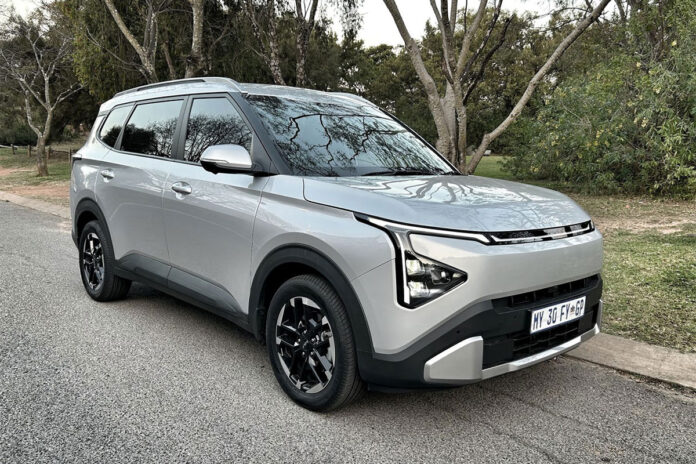
A dead giveaway that the Carens can no longer be considered an MPV, or in fact a garden variety SUV, is its futuristic styling, which follows the same design language as the manufacturer’s electric vehicles. The front features slimline LED headlights and a prominent body-colour panel between the horizontal light bar and grille.
The rear is more in the mould of a traditional Kia SUV, featuring what the carmaker calls ‘star map tail lamps’ connected with a full-width horizontal light bar.
Creature comforts
The futuristic styling continues in the cabin with a 12,3” infotainment screen, 12” digital instrument cluster, and flat-bottom steering wheel, all set in a love-it-or-hate-it black-and-beige finish.
What we really like is the fact that Kia still sticks to physical buttons. These include the row of buttons underneath the infotainment system, which toggles between climate control and the audio system, and the turning knobs flanking them.
The Kia Carens SX comes standard with full imitation leather seats, wireless Apple CarPlay and Android Auto, a wireless charger, eight-speaker Bose sound system, heated front seats, ambient lighting, and a 360° camera system.
Loads of space
Space is ample in the second row, where sliding and folding seats make accessing the third row easier. Leg space in the third row isn’t great, but children should have little to complain about.
The boot holds 216ℓ with all seven seats up, increasing to 645ℓ with the third-row seats lying flat.
In addition to the six airbags, rear parking sensors, electronic stability control, and hill-start assist, the SX also features a range of comprehensive driver assistance systems, including adaptive cruise control, lane-keep assist, and blind-spot warning.
Smooth drive
Don’t underestimate the 85kW of power, because where the Kia Carens really shines is out on the drive. This refined little oil-burner is an absolute gem. It might not shoot off the line, but once on the move, it’s a super-slick mill perfectly matched to the six-speed box.
As we’ve been overly exposed to the throttle calibration issues evident on almost every non-hybridised Chinese car, it was pure bliss to return to a well-behaved and properly calibrated powertrain. It makes driving a pleasure, which is key if you’re going to take the seven-seater on endless school runs through varying degrees of traffic every day.
What’s the verdict?
The Kia Carens makes a welcome local return with a clear plan, something it lacked when it left South Africa more than a decade ago. It looks good, feels good, drives well, and its diesel party trick gives it an edge against the Chinese onslaught, something that can’t be overlooked these days.
Vehicle facts
Engine: 1,5ℓ turbo-diesel
Transmission: six-speed automatic
Power: 85kW at 4 000rpm
Torque: 250Nm at 1 500 to 2 750rpm
Fuel consumption (tested): 6,3ℓ/100km
Licensing mass: 2 050kg
Towing capacity: 750kg
Price: R599 995