
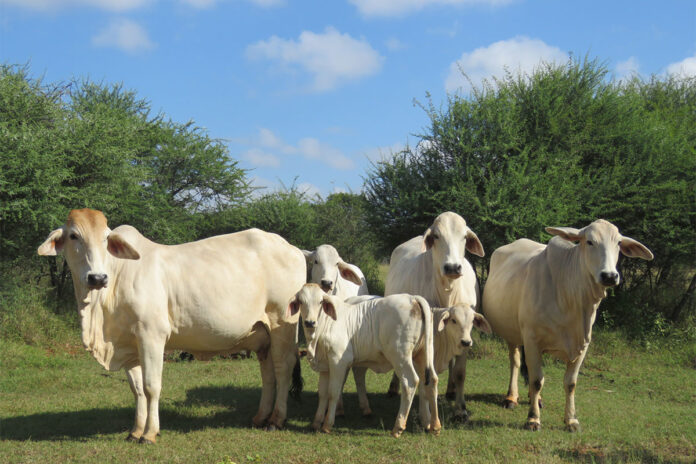
Louis Meyer from Lichtenburg in North West, owner of the Loriza Brahman stud, says the stud has been built on fertility, growth, milk production, and evenly natured animals since its inception in the 1960s. At the time, Meyer’s parents Nico and Julene imported three Stuart heifers and a Hudgins bull from Texas in the US. Three heifers from Howard Parker’s well-known V8 herd followed in 1965, and in 1969, a bull from the Sugarlands herd.
‘Loriza’ is a composite name incorporating the names of Nico and Julene’s two children, Louis and his sister Mariza. The business includes, over and above beef cattle production, a maize, soya, and sunflower production component as well as a game farming concern. The farming concern also includes avocado, macadamia, and wool production.

Cornerstone Brahman stud
Since its inception in the 1960s, the stud has developed into one of the cornerstone Brahman herds of South Africa.
“We pride ourselves in the production of Brahmans with a calm disposition. That is one of the most important trademarks of our herd. Over and above all the other economically important traits that are obviously vital to beef cattle breeding, we do not allow animals that show any form of being obstinate in the herd. Over the years our herd has been purposefully selected for character, fertility, and milk production.
“An even-tempered, gentle animal is a true joy to work with and contributes markedly to the overall production of the herd. It makes for comfortable and effective management and adds to the general well-being of the herd. It is, economically speaking, a very important factor. A Loriza Brahman truly is a well-behaved Brahman,” Meyer explains.
Hard African bush
The stud is kept near Nietverdiend, close to the Botswana border in North West. The Loriza herds, comprising around 1 000 registered and 5 000 grade Brahman cattle, are run on seven blocks of bushveld covering about 23 000ha.
“This is hard African bush, where only the toughest survive endemic tick-borne diseases such as redwater and heartwater, as well as predators such as leopards, among others. The Brahman is the ultimate breed for the extensive conditions we farm in. It is a true profit driver for cattlemen in our country because of its versatility and top performance under the exacting conditions. With the outbreak of foot-and-mouth disease, it was noted that the Brahmans were less affected than other crossbreeds’ and had less economic strain on the business,” says Meyer.
Performance testing and recording
The stud’s management was from the onset based on performance testing and animal recording. Founder Nico Meyer started performance testing on a group of 120 calves as early as 1978. This resulted in the Loriza stud having one of the most comprehensive private databases of recorded Brahman measurements and weights in the world.
Since 1978, more than 40 000 calves have been Phase A and B tested, while more than 8 000 bulls have been Phase D tested. This resulted in a herd characterised by hardiness, predictable fertility, top milk production, and outstanding adaptability, coupled with a mild and calm disposition.
“The Loriza herds are run along a practical and uncomplicated production system that was designed for optimum production and maximised profit margins. It is our objective to provide high-quality genetics that will add marked value to the entire red meat production sector. In the quest to produce top-performing and economical animals, we prioritise fertility and high weaning weights off the veld without pampering and excessive input costs.
“We follow a no-nonsense breeding philosophy that allows us to reliably supply carefully selected high-quality genetics, that perform well in any commercial beef production system in the country,” Meyer points out. “Once you have bought into Loriza genetics, you will not easily be pleased with others.”
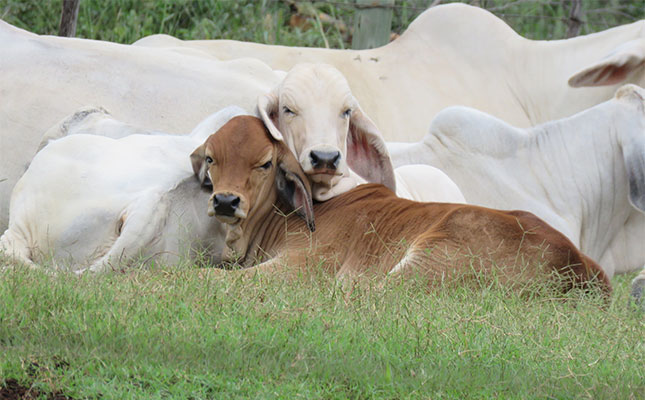
Top 5% of the national herd
Loriza’s bull testicle performance makes up to 5% of the national herd. The Loriza bulls are medium-framed, with good masculine conformation, including length and breadth in the body, as well as strong legs. Bulls are sold at 30 months, and potential herd sires are selected at 24 months by combining visual evaluation for confirmation and type supported by Estimated Breeding Values (EBVs).
“The cows are structurally sound, robust, and remarkably adaptable. Good carcass characteristics and growth in cows are absolutely essential. We maintain an average inter-calving period of 375 days, with heifers first calving at around 28 months,” says Meyer.
Outstanding fertility status
The stud maintains a fertility status of well in excess of 80%. The Loriza stud is a leader in terms of scrotal estimated breeding value (EBV), at 85%. The milk EBVs is 30% above breed average. Loriza annually supplies around 1 000 heifers to commercial operations throughout Southern Africa and about 100 bulls.
“Loriza slaughters bulls at around 18 months with an average slaughter percentage of 64% (cold). This is done without the use of any hormones. The average feed intake is 1:6:4, all done with low-cost inputs,” Meyer adds.
For more information, email Loriza Brahmans at [email protected].