
Foot-and-mouth disease (FMD) is reshaping South Africa’s cattle industry, pushing biosecurity to the forefront of every buying and breeding decision.
Against this backdrop, the Vlakte Bonsmara Study Group is reinforcing strict health protocols, traceability, and disciplined selection ahead of its 20th production auction.
Confidence in the cattle market is no longer built on genetics alone. Increasingly, it rests on the systems that support those genetics, particularly biosecurity, traceability, and compliance. For breeders, this means tighter control over herd health. For buyers, it means greater scrutiny of where animals come from and how they have been managed.
The Vlakte Bonsmara Study Group’s system has been developing for nearly two decades. Starting in 2007 as a small group of four breeders on Limpopo’s Springbokvlakte, it has grown into a structured organisation of over 20 members. The group is known for its consistency, discipline, and shared breeding philosophy.
“We felt a need to create something through combined effort and strength in numbers,” says Kobus du Toit, chairperson of the study group, in conversation with Farmer’s Weekly.
“Today, that collaboration also means taking collective responsibility for the health and integrity of every animal we sell.”
With FMD continuing to disrupt livestock movement and market access, the stakes have shifted significantly. Movement controls, quarantine requirements, and heightened veterinary oversight have become part of daily operations. In this environment, even minor lapses can have far-reaching consequences, affecting not only individual farms, but regional and national trade as well.
Systems that prioritise control, transparency, and compliance are no longer differentiators – they are prerequisites.
Structured growth, shared standards
From its early days, the study group has evolved into a formal company with shared infrastructure and clearly defined entry requirements. Two founding members, Tian Kruger and Jean Gouws, remain involved, providing continuity and institutional memory.
Membership is both an investment and a commitment. Prospective breeders must acquire shares in the company, when available, and meet strict criteria in terms of herd quality, scale, and infrastructure. This ensures that all participating members operate at a comparable level.
Consistency is reinforced through regular interaction and evaluation. On-farm visits form part of the selection process ahead of auctions, allowing members to assess animals collectively and benchmark performance across herds.
“We share a common breeding philosophy, and we do farm visits when animals are selected for auctions. That allows members to benchmark themselves,” explains Du Toit. “It has led to a very high internal standard in terms of management, breeding, and the type of animal across all herds.”
This internal benchmarking has become one of the group’s defining strengths. It creates alignment not only in breeding objectives, but also in management practices, an increasingly important factor in a high-risk disease environment.
Bred for resilience
The Springbokvlakte is widely regarded as a strong cattle-producing region, but its conditions are far from forgiving. Tick-borne diseases remain a constant threat, while periodic drought places pressure on grazing systems and stocking rates.
“We are subjected to harsh tick-borne diseases and regular droughts,” says Du Toit. “That forces you to stay within carrying capacity and breed sustainably. Only the best, hardy animals are considered.”
This environment has shaped the type of Bonsmara produced by the group – animals that must perform under pressure, rather than under ideal conditions. Fertility, adaptability and functional efficiency are prioritised alongside growth and carcass traits.
The result is a balanced animal suited to commercial production systems, which explains the group’s strong following among commercial beef producers. While stud buyers are present, the group’s core focus remains on delivering animals that add value at farm level.
A milestone under pressure
On 11 June 2026, the group will host its 20th production auction, a milestone that reflects both longevity and resilience in a sector where many group sales have struggled to maintain relevance.
“It means a lot to us, given the challenges that group auctions face nationally,” says Du Toit. “We’ve grown from humble beginnings into a strong, elite group hosting some of the stronger sales in the country.”
This year’s offering is substantial: 50 bulls, 250 females across production stages, and around 600 weaners and slaughter animals. Almost all members will contribute, with animals selected through a rigorous, multi-stage screening process.
Selection begins on-farm, where an internal panel evaluates animals for structural soundness and phenotype in line with Bonsmara SA standards. Stud animals undergo an additional inspection by senior inspectors prior to the sale.
“Only animals that pass our internal screening are nominated for the catalogue,” says Du Toit.
This layered approach to selection underpins the group’s reputation for quality. Over the past decade, Vlakte Bonsmara sales have consistently ranked among the top 20% nationally in terms of price and clearance rates, with a strong record of full sales.
Adapting the sales model
The group plans to host a conventional physical auction, supported by an expanded online component via Meerkat and SwiftVee, a clear reflection of how cattle marketing is evolving.
“The plan is still to have a standard auction, but we’ve introduced a wider online component,” explains Du Toit.
Online auctions have gained traction in recent years, particularly as a way to broaden participation beyond geographic constraints. They allow buyers to engage with sales remotely, reducing travel costs and increasing access to genetics from across the country.
While Vlakte Bonsmara has not yet fully transitioned to digital-only sales, the hybrid model offers flexibility, particularly in a volatile regulatory environment.
“At this stage, we see it as complementary,” says Du Toit.
The shift also requires a different approach to presenting animals. Without the opportunity for physical inspection, accurate visual representation and detailed performance data become critical.
“We try to showcase animals properly with photos and videos beforehand, and the full catalogue is available online,” he says.
Should FMD-related restrictions tighten ahead of the auction, the group is prepared to move entirely online, a contingency that has become increasingly relevant across the industry.

Biosecurity as a non-negotiable
Biosecurity now sits at the centre of the group’s operations, influencing everything from selection and sale structure to transport and delivery.
“It has always been our number one priority,” says Du Toit. “That’s also why we moved to our own facility, where only our annual auctions take place.”
The decision to combine the production and weaner auctions this year reflects this thinking, reducing the need for repeated animal movement and limiting potential exposure.
Pre-auction protocols
All participating herds must meet strict health requirements before animals are accepted for sale. These include annual brucellosis testing, tuberculosis testing every three years, and compulsory testing of breeding bulls for trichomoniasis and vibriosis.
“All bulls on sale are tested for fertility and sheath-washed for venereal diseases, even if they are virgin bulls,” says Du Toit.
Vaccination programmes are standardised across all member herds, covering major diseases including bovine viral diarrhoea. Pregnant animals are sold with certified pregnancy status.
In response to FMD risk, additional safeguards have been introduced. Sale animals will undergo a 14-day quarantine period, with veterinary inspections conducted two weeks before and also immediately prior to the auction.
“Without the necessary veterinary paperwork, animals won’t be allowed on the sale,” emphasises Du Toit.
Managing a multi-farm system
With animals originating from multiple farms, maintaining consistent biosecurity standards presents a unique challenge. Each herd must operate within the same framework, with strict adherence to protocols.
“Quarantine, together with veterinary confirmation, is key,” says Du Toit.
Compliance is enforced at group level.
“If a member cannot meet the requirements, participation is temporarily suspended. It’s not negotiable.”
This collective accountability is central to the group’s credibility, ensuring that buyers can trust the integrity of the entire offering, not just individual consignments.
Post-sale measures
Biosecurity considerations extend beyond the point of sale. Transport represents a critical control point in preventing the spread of disease.
“All transport will be done to ensure biosecurity compliance. Vehicles must be properly sanitised and accompanied by the necessary permits and documentation. Buyers, in turn, are encouraged to implement quarantine protocols upon arrival. Keep the animals separate for as long as possible – 21 days is the norm,” he says.
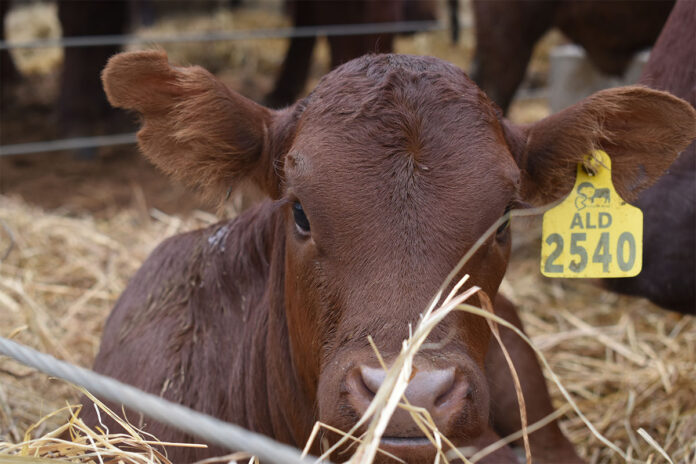
Traceability supports these efforts. All animals are RFID-tagged, and sellers are registered on the national livestock traceability system, enabling full trace-back capability.
FMD and shifting market dynamics
Despite ongoing uncertainty, demand for quality animals remains resilient.
“There seems to be strong demand for good breeding animals and weaners, even amid the FMD crisis,” says Du Toit.
At the same time, the cost of compliance has increased. Additional veterinary inspections, extended quarantine periods, and stricter movement controls have added complexity and expense to the production cycle.
“It brings additional veterinary costs, with extra checks required,” he notes.
However, these pressures may also be reshaping buyer behaviour. Increased awareness of disease risk is placing greater emphasis on trusted sources and verified systems.
“The extra mile is being implemented to ensure safe purchasing. That builds confidence,” explains Du Toit.
In this context, breeders who can demonstrate robust biosecurity practices may gain a competitive advantage.
Setting the standard
Du Toit believes study groups have a critical role to play in setting benchmarks for the industry. “We should be the example of how to tackle disease management,” he says.
The group has already taken proactive steps, including strengthening traceability systems and working with private veterinarians to support vaccination efforts and reduce pressure on state resources.
Looking ahead, stricter standards appear to be inevitable.
“Traceability is the starting point. In future, animals that cannot be traced back will most probably not be allowed at auctions,” says Du Toit.
Certainty as a value proposition
The cattle industry is entering a period where buying decisions are shaped as much by compliance and traceability as by price and phenotype.
For the Vlakte Bonsmara Study Group, that shift reinforces a long-standing approach.
“It’s about doing everything in your power to protect the herd, the buyer and the industry,” explains Du Toit.
The group’s 20th production auction marks both a milestone and a signal of where the sector is heading – towards a system where credibility is built not only on genetics, but on the processes that support them.
In that environment, the value of an animal lies not only in its performance, but in the certainty behind it. And in uncertain times, that certainty is becoming one of the industry’s most valuable assets.