
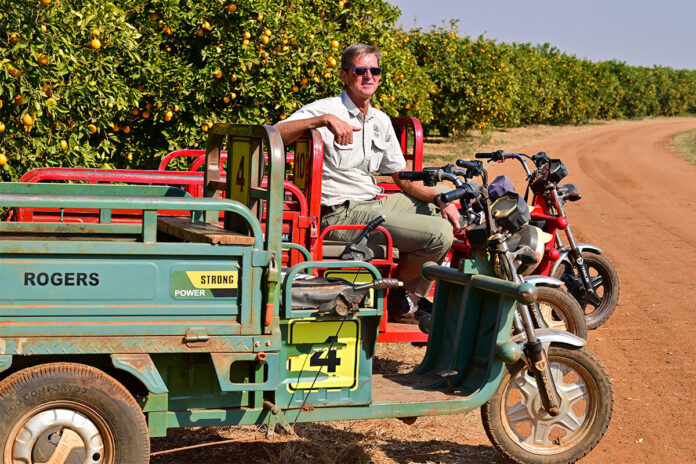
De Beer first encountered the Lekkewaan brand seven years ago when Pierneef Smit, the then general manager at Lekkewaan, supplied a TailG 1.3 for evaluation on the farm.
“I realised almost immediately that these vehicles could be used very effectively on the farm for specific applications,” De Beer told Farmer’s Weekly.
As the business is firmly committed to sustainable and environmentally responsible farming practices, the electric vehicles’ zero-emission operation aligned perfectly with its long-term vision. The farming enterprise continually seeks to improve its methods to protect and preserve the environment for future generations.
Innovation is another key driver behind the decision to adopt electric vehicles. The business actively embraces advanced agricultural technology that enables it to farm more intelligently, efficiently, and responsibly.
In 2021, Vaalbos Trust planted the first wine grapes in the Loskop Valley, supporting its vision of producing wine in Limpopo. In 2024, years of dedication paid off with the first hand-harvested wine grape crop.
Towards the end of 2024, just before the first full-scale harvest, construction of the farm’s new wine cellar was completed – a dream within a dream.
Lower operating costs
“What I like about the Lekke TailG 1.3 is that it requires very little maintenance, and has significantly reduced our fuel expenditure because we now use the TailGs as run-arounds instead of bakkies or tractors. The lead-acid batteries typically last about two years,” explains De Beer.
The vehicles are used primarily by the irrigation team to travel between the citrus orchards while maintaining irrigation systems, starting and stopping pumps, and inspecting centre pivots.
Previously, workers either travelled in bakkies, consuming costly fuel, or walked between orchards, resulting in valuable time being lost as the citrus blocks are spread across the farm.
The TailGs are also used by the security team to patrol perimeter fences at night. Their quiet operation makes them particularly well suited to this task, especially when compared with quad bikes or bakkies.
Built on a robust metal frame, the vehicles have also proven to be remarkably durable. De Beer recalls one incident where a TailG collided with a Toyota bakkie on the farm.
“The bakkie came off much worse than the TailG. It sustained serious damage to its side, while the TailG hardly had a scratch. Best of all, the TailG driver wasn’t injured,” he says.
Although Vaalbos Trust currently uses only the three-wheeled TailG models, De Beer is considering adding four-wheeled versions, such as the Lekke Noddy or Lekke Mini, to the fleet. Alternatively, he may wait for the side-by-side models from the rumoured new range expected later this year. These vehicles would be allocated to production managers and supervisors.
Alternative to quad bikes
De Beer explains that the farm previously relied on quad bikes, but found the Lekkewaan vehicles to be a far better alternative.
“The Lekkewaan is a much better option because of the savings on fuel and the lower maintenance costs compared with quad bikes. It is also more reliable and safer because it isn’t as fast. Another advantage is that it generates far less dust, which is always a concern for citrus trees growing alongside farm roads.”
He is also impressed by the vehicles’ off-road capability, even though they are not specifically built for off-road use. De Beer is equally impressed with Lekkewaan’s after-sales service.
“They make it easy to obtain parts whenever we need them,” he says.
Although the TailGs are not regularly used for transporting loads on their farm, they prove useful when carrying hay bales to the horses or transporting a few bags of citrus for inspection.
Drivers do require some time to become accustomed to handling the three-wheel configuration, particularly as it steers with the single front wheel.
“Every now and then, a driver turns too sharply and ends up in a fence or even another vehicle,” admits De Beer.
According to De Beer, the only real drawback is the standard tyres from China supplied with the vehicles, which often result in punctures, especially in rough terrain.
“For us the significant savings on fuel and bakkie maintenance costs is probably the biggest reason why we would recommend the Lekke TailG to fellow farmers,” concludes De Beer.