
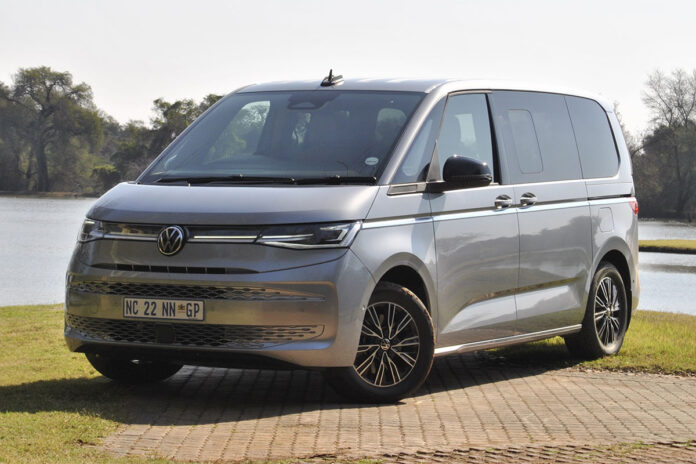
With the Caravelle notably absent from the launch of the Transporter last year, Volkswagen (VW) was frank in its decision not to introduce the derivative.
While the Transporter was touted as a replacement for the outgoing T6.1, VW pointed out that the joint-venture model with Ford doesn’t carry the T-Series denominator. Instead, it is called the Transporter and not the T7, as the latter is a Volkswagen trademark.
The same applies to the Caravelle, which the brand stated was never meant to be just another model in the Transporter line-up. It does away with the generational ‘T’ in its name and is now simply called the Caravelle locally, rather than the T7 Caravelle. However, while the Caravelle name isn’t featured anywhere on the exterior, a new addition is the eHybrid badge.
Because of South Africa’s poor- quality fuel, the van will, for the time being, be offered solely as a plug-in hybrid. Officially called the VW Caravelle eHybrid 4Motion, the new powertrain combines the 1,5 TSI Evo engine with an electric motor in the six-speed DSG transmission and a second unit mounted on the rear axle.
Powering both motors is a 19,7kWh battery pack. The result is 180kW of combined power and 350 Nm of torque, with a claimed electric-only range of 95km.
DC charging of up to 50kW takes a claimed 26 minutes from 10% to 80%, while the 7kW on-board charger requires four hours for a full charge.
For South Africa, VW has opted for a single, all-inclusive variant. This includes the Family Package, with ambient lighting and keyless entry, and the Easy-Open Package, with an electric tailgate and electric dual sliding side doors.
Also standard are tri-zone climate control; a 13-speaker, 840W Harman Kardon sound system; adaptive cruise control; blind-spot monitoring; park assist; rear traffic-cross alert; and safe exit assist.
The Caravelle has a 2-2-3 seating configuration, with the second row having captain’s-style chairs. In a change from the T6.1, the second-row seats no longer swivel in place and must be removed and manually rotated.
The previous folding table has also been dropped in favour of a sliding centre console that offers a range of cupholders and other storage areas.
On the tech front, the dashboard is dominated by a 10,25” infotainment system with wireless Apple CarPlay and Android Auto, and a 10” digital cockpit instrument cluster. As much as the touch sliders for climate control are still frustrating, cabin ergonomics are well devised.
On the road, however, is where the Caravelle surprised the most. Starting up in electric vehicle mode, speeds of up to 130km/h can be reached without the petrol engine intervening. Once the battery is depleted, the powertrain reverts to what is called E-Hybrid mode, with propulsion provided by the TSI’s 130kW and 250 Nm.
When combined, the transition between combustion engine and electric propulsion is only noticeable when fuel consumption starts to rise. The engine also becomes vocal under heavy acceleration once the battery is depleted.
WHats the verdict?
Unsurprisingly, there’s little to fault the Caravelle on regarding comfort. The ride is soft, and the vehicle feels more modern and premium, representing a resounding step up from its predecessor.
Vehicle pricing
The VW Caravelle eHybrid comes in at R1 794 000. Pricing includes a three-year/120 000km warranty, a five-year/
100 000km maintenance plan, and a two-year battery warranty with unlimited mileage, or eight years/160 000km.