De Keur’s regenerative practices in its pome fruit orchards use 25% less irrigation water than conventionally managed blocks while delivering comparable yields, with some blocks even exceeding them, according to farm manager Anton de Jager.
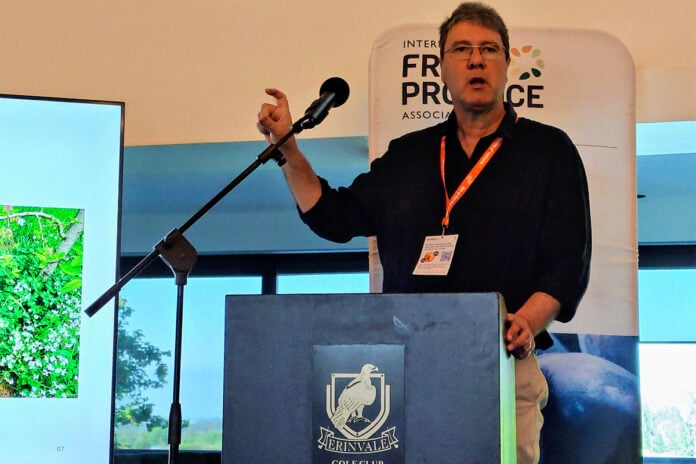
Speaking at the recent IFPA (International Fresh Produce Association) Sustainability Summit in Somerset West, De Jager outlined the gains and challenges that have come with the farm’s transition to regenerative agriculture.
A seven-year drought had prompted the management team to rethink its farming practices, resulting in De Keur introducing regenerative practices on roughly 160ha (25%) of its pome fruit orchards five years ago.
Over time, changes became visible beneath the trees. A darker layer of soil developed near the surface, water soaked in more readily, once-compacted ground became easier to penetrate, and earthworms returned, along with other signs of soil life.
De Jager said vegetation beneath the trees also provided a habitat for insects, including pests that would otherwise move into the canopy.
However, the changing soil conditions required a rethink of familiar routines. When the team discovered anaerobic micro-organisms in the soil, indicating oxygen-poor conditions, they realised the regenerative blocks were being over-irrigated. Measurements revealed the lower water requirement, prompting adjustments to the irrigation programme.
Learning to feed the system
The transition brought some tough lessons. De Keur stopped applying synthetic fertiliser to the trial blocks and introduced a feeding programme based on compost and supplementary foliar feeds, guided by plant sap analysis.
De Jager acknowledged that the switch may have been too abrupt for established orchards. If he had a chance to start again, he said he would begin with nursery trees, allowing them to adapt to the regenerative approach from an early stage.
The new programme also meant careful attention needed to be given to nutrient supply. De Jager explained that soil organisms could help make nutrients available to plants but could not create the minerals that were absent from the soil. Those shortfalls still needed to be identified and corrected.
Getting the compost right proved another hurdle. The team initially planned to buy compost, but they struggled to find one that contained the range of organisms they wanted, so they began making their own.
Making compost become a demanding job of its own. Leaving it in a stockpile for months before application was no longer an option, and rain sometimes delayed production. The team now needs to monitor the compost regularly and carefully manage moisture, storage, and handling to keep the organisms alive.
De Jager likened the daily attention the compost requires to caring for a baby whose nappies need changing.
De Keur has stopped using herbicides across both regenerative and conventional blocks, but extending the full regenerative approach to the rest of the operation is a work in progress.
“There are some practical challenges that still need to be resolved before the system can be expanded,” De Jager said.
Investing in people
Learning to manage the new system was a major part of De Keur’s transition. De Jager sought guidance through specialist training, mentorships, and visits to other farmers, but described the journey as a rather “lonely one”.
Employees needed support to understand and buy into the new approach, as well as training, particularly in managing livestock alongside the orchards.
But building this expertise came at a cost. Although the regenerative blocks operated within the same production budget as conventional orchards, training and other learning expenses were funded through a separate research and development budget.
Including those expenses would have made the transition more expensive than the production budget alone suggested.
Andrew Ardington, founder and director of the Regenerative Agriculture Association of Southern Africa, said training should be a planned investment. Farmers and managers need time to understand changing conditions, test ideas, and adapt their decisions.
He cited a US regenerative agriculture school’s recommendation that each management team member receive an annual education budget equivalent to a 13th cheque, roughly one month’s salary.
Businesses with the resources should budget for that learning, while smaller growers would need a more collective approach to accessing knowledge and support.
De Jager said De Keur still had still a long way to go, but it was willing to share its experience to help other farmers navigate the transition.
He suggested that growers with limited budgets start with changes that do not require expensive inputs. One option is to stop using herbicides and allow existing vegetation to provide ground cover, rather than buying costly cover-crop seed.
Observing the plants that grow could also offer clues about soil conditions, helping farmers decide what to address next, De Jager said.
Sharing the cost of change
Even with modest first steps, growers face costs in testing and developing new farming practices. De Jager called for others in the value chain to help fund this work, arguing that farmers should not carry the burden alone.
Ardington said financial institutions also need to become more comfortable with assessing regenerative farming businesses. A lack of the same extensive financial track records available for conventional systems could make lenders reluctant to back the transition to regenerative agriculture.
He suggested that insurers provide another incentive for change as evidence emerges about differences in production risk between farming systems. Improvements in soil health and resilience should, in his view, count when institutions assess the farms they finance and insure.