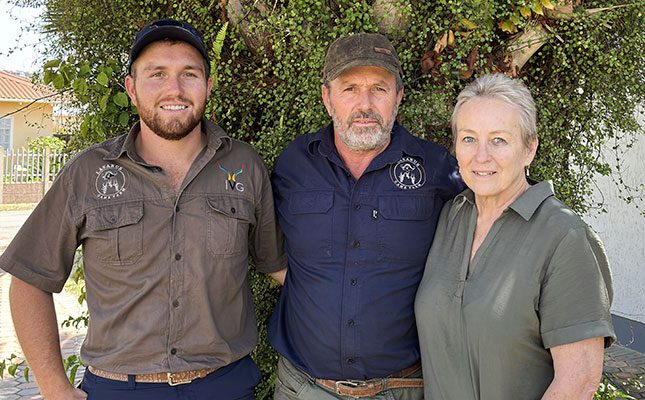
Nico Lerm, owner of Lasarus Game Farms, farms with his wife, Sonette, and son, Hertie. The operation is divided between two main properties: one in Albertinia, Western Cape, and the other near Modimolle in Limpopo. Both host a wide variety of wild gamnice for stud breeding and hunting.
Nico breeds game and other wildlife, including buffalo, kudu, sable, wildebeest, and white rhino. The farms have accommodation for hunters and tourists, providing designated guiding for both.
READ Ankole Longhorn: Cyril Ramaphosa’s passion and pride
Alongside his game, Nico runs four different livestock breeding operations: Indigenous Veld Goats, Meatmaster sheep, his own breed of free-range African chickens, and Ankole cattle.
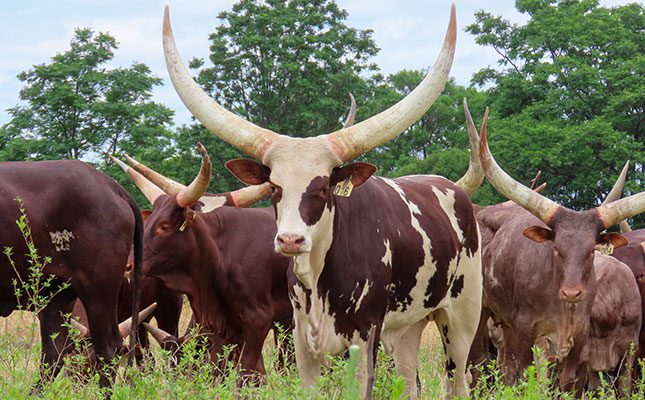
The beauty of the Ankole led him to explore them as a possible investment.
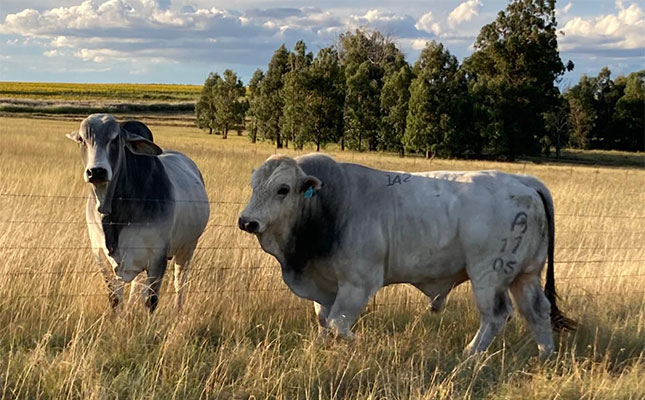
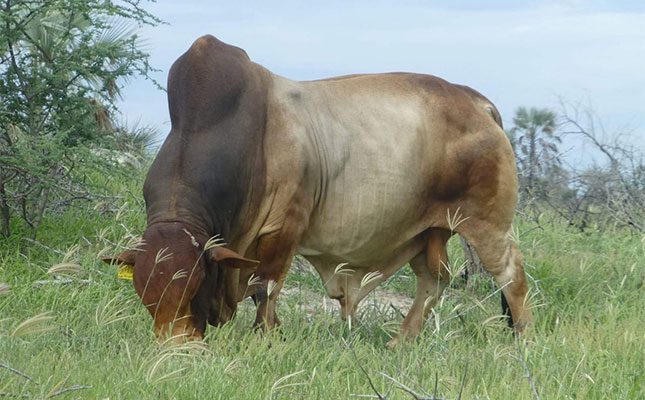
“In 2013, we bought what are now known as Watusi cattle out of zoo captivity. We believed they would complement the game farm because of their vibrant hides and large horns,” he says.
Three years later, in 2016, Nico heard that the first full-blood Ankole offspring were being auctioned, and he decided to invest in his first Ankole bull, appropriately named ‘Ramaphosa’.
He crossbred the bull with the Watusi he had and reserved the offspring for trophy hunting. He subsequently purchased full-blood Ankole cows, which he used to form his Ankole stud in 2017. He now maintains the divide between the crossbred herd () and the pure-bred stud.
Similar, but not the same
Hertie is a member of the Ankole breeder’s society of South Africa and says the history between Ankole and Watusi cattle has been controversial due to their similarities. While originally considered the same as the Ankole, Watusi cattle were not tested and classified. In contrast, the Ankole breed was tested extensively and was officially recognised in 2019.
All full-blood and purebred Ankole cattle in South Africa are descendants of the original embryos flushed by Dr Morné de la Rey of Embryo Plus at Ramaphosa’s request.
Every Ankole born of this lineage is assigned a status: calves born of two full-blood Ankole gain full status, while those from a crossbred Watusi cow with a full-blood Ankole bull can be ‘upgraded’ to purebred under the society’s rules.
The society enforces strict bylaws and a traceability system to preserve the original bloodline. All full-blood offspring must be DNA tested and go through a stud selection process between the ages of one and three years old.
If the offspring do not meet the requirements or are not tested within three years, they are removed from the stud registry and may not be used for commercial stud breeding.
Once stud farmers started to expand their enterprises, they soon realised the gene pool was too small due to the single-source nature of the genetics. To avoid inbreeding, several breeders joined forces to introduce new genetic lines into the country from Uganda.\
Nico has since been able to source sexed semen from top-performing full-blood bulls to breed his offspring. The Lerm family and the Kinnear family, who own Cattle Group Farming, entered into a partnership, combining their respective Ankole herds, and established Cattle Group, which currently consists of 130 full-blood Ankole cattle.
Herd expansion
Nico separates his stud and hunting animals between his two properties. Ankole kept for hunting and tourism are kept in separate camps on the farms, and the stud animals are kept on the Modimolle farm, called Lasarus Rietspruit.
“We invested in a farm further north to be closer to the embryo stations,” he explains.
Access to these facilities allows for a more efficient turnover in the breeding process without extensive logistical planning.
Both properties cover roughly 3 000ha to facilitate the game and livestock but are run differently. Because the Ankole on the Albertinia farm are bred for hunting and viewing, they roam free and aren’t restricted to any camps.
“When tourists visit us, they want to see animals behaving as they would in the wild, without human influence. So, we keep the Ankole with the game, just like a reserve or national park,” adds Nico.
The stud cows are kept in smaller camps of about 300ha each for easy access and to keep them docile when staff are present. The stud bulls roam with the game.
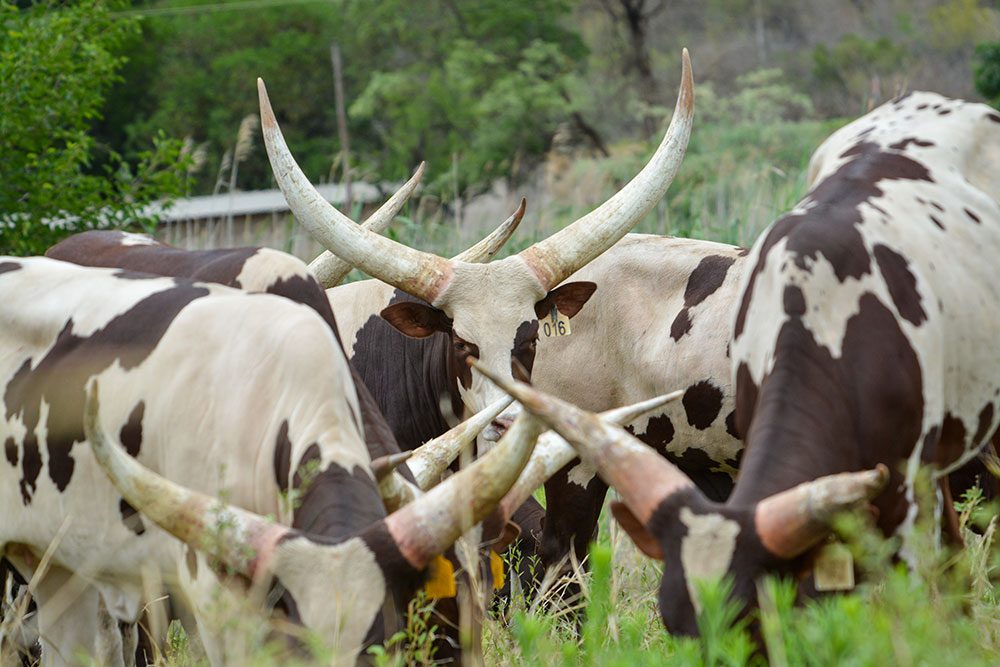
Nico says a common concern for new buyers is the wide horn span of the Ankole, especially for movement around confined pens and when they need to be clamped. However, he explains that cattle expertly manoeuvre their horns to avoid getting stuck or injured.
He doesn’t follow a mating season, focusing instead on producing calves year-round using natural mating, artificial insemination (AI), and embryo transfers.
“One of my main goals is to build the herd as quickly as I can while maintaining optimal animal health and stud standards,” he says.
Although Nico has three stud bulls, he also buys in sexed semen from Embryo Plus, which uses various ‘super bulls’ with strong stud characteristics and fertility rates. This semen is used for conventional AI of his heifers and in embryo flushing of his top performing cows.
Based on the availability of viable embryos, Nico will use a set number of recipient cows to carry the embryos, and the remaining heifers are mated in a separate programme.
Heifers that are not recipients of embryos are given two opportunities to conceive: first via AI, and then they’re placed with his bulls for two months. AI-conceived offspring are 90% female, helping him grow the herd as quickly as possible.
“We maintain an average conception rate of about 50% through AI, so we use our bulls to ensure conception for all our cows,” he explains.
Nico mates his heifers at between 15 and 18 months old, depending on their condition. He aims for them to weigh between 250kg and 300kg in order to reach maturity.
Nutrition and health
Nico’s semi-intensive feeding programme allows for low-maintenance weight gain. The Ankole graze on sweet- and sourveld and are supplemented with a commercial cow feed that supplies the necessary minerals. As they are browsers, they will also feed on seasonal leaves and brush.
He attributes his low disease rate to the Ankole’s hardy nature. He doesn’t face any significant challenges but picks up occasional heartwater and redwater in individual cattle.
Ankole cows have a long productive lifespan and can produce calves for up to 20 years, with an average intercalving period of 12 months.
Nico hasn’t had any consistent birthing complications, mainly due to the low average birth weight of Ankole calves. His cows have successfully produced multiple sets of twins, but he says that if a set of twins consists of one bull calf and one heifer, the chances of the heifer being infertile are high due to their exposure to testosterone in the womb.
Dynamic marketing
As the Ankole breeder’s society grows by the month, it becomes more feasible to host and contribute to marketing events and auctions. Nico sells all his Ankole stud cattle via catalogued online auctions that he and other reputable breeders host.
Due to the low volume of Ankole currently being sold at auction, he auctions them alongside his game.
Their young bulls are weaned at eight to ten months and then introduced to the free-roaming herds, where they continue to grow to be hunted or to be used as breeding bulls.
READ Bright future for Ankoles as bull nets R3 million at auction
Those that show promising stud characteristics are removed to be reintroduced as stud bulls. All his heifers are kept aside for further breeding and marketing.
Full-blood and crossbred Ankole variants have steadily risen in popularity over the last four years due to the dynamic nature of the breed. Not only is the stud market on the rise but the hunting and tourism markets are, too.
Due to their unique beauty, Ankole are also being bought for aesthetic purposes and placed around wedding venues or estates. Since the breed can be presented as a pedigree animal and a desirable trophy, it offers a unique opportunity to expand to serve all three of these markets, as Nico has done.
He emphasises that Ankole aren’t just treated as trophy animals; they’re also hunted for their meat.
“We breed Ankole to be as visually appealing as possible with colourful patterned hides and big horns, but we also ensure they are healthy and heavy for good meat output,” he added.
He also explains that Ankole cattle play an important cultural role in South Africa, which furthers the demand for premium cattle.
“Since we have started marketing our Ankole, there has been a demand for them as a significant cultural symbol. They serve as a sort of heritage breed, which benefits our community of breeders, as it helps to further introduce the Ankole nationwide.”
Committed investment
Nico, one of South Africa’s first Ankole investors, remains optimistic about the breed’s market potential. He notes, however, that high costs deter many buyers and expects prices to stabilise only as supply increases.
“Although there is a steady demand [for Ankole], buyers often don’t realise how high the input costs are. They are still a sought-after niche breed, and the market prices reflect that,” he explains.
Not only do the live animals come at a hefty cost, but so do the genetics and embryos. Sourcing semen and embryos across borders drives costs and retains a high risk factor.
“Embryo transfer is risky, and there is certainly no guarantee of conception. Any fluctuations in climate or health status can result in the host losing the embryo,” he explains.
Nico advises potential breeders to ensure they have a diversified operation that can partially fund the start of a breeding herd. Due to the high costs, having established livestock herds or other profitable operations allows for investment security and assurance.
As Ankole start becoming more commercially available, he continues to be a leading representative of the breed. Nico, along with Cattle Group Farming, is hosting a live and online auction of full-blood Ankole cattle in South Africa, set to take place on 7 February 2026, in Modimolle, Limpopo.
He hopes that the excitement and physical presence of established and new stud farmers at the auction will lead to larger sales showcasing the best of what the nation’s top breeders have to offer.
Nico’s opportunistic approach to investing in Ankole has led to the steady, profitable growth of his herd. His ventures further speak to the viability of this hardy yet enchanting breed for the local market.
Email Nico Lerm at [email protected].