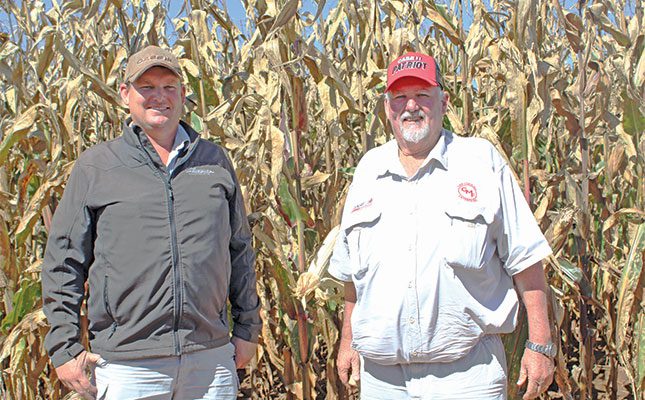
Get it done, and get it right, is perhaps the best way to summarise Michael and Gareth Allen’s farming philosophy.
This father-and-son team at the helm of G&M Farming Enterprises in Middelburg, Mpumalanga, were the Grain SA/Syngenta Grain Producers of the Year in 2024. They focus on high input to achieve high output, aiming for utmost precision in the application and timing of the inputs.
The Allens plant grain on 1 800ha, of which two-thirds are planted to maize and the rest to soya beans each year. The fields are rotated so that two consecutive years of maize are followed by one year of soya beans.
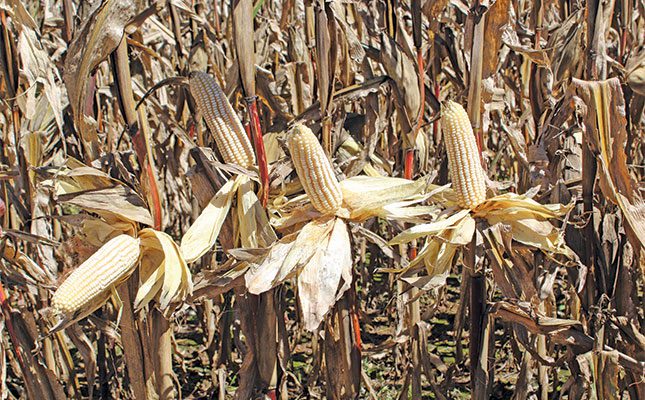
Only white maize varieties are planted, since the farm is in close proximity to processing plants for maize meal. They focus on three varieties: Pioneer’s 1517R and 253R, and Pannar’s 3R573R. These are termed ‘racehorse’ varieties due to their high yields. Good disease resistance and standability are two further reasons these varieties have been chosen.
Although these are irrigation varieties, the Allens plant them on dryland, relying on the average annual rainfall of 650mm to 700mm to see them through. A strong focus on soil heath and moisture retention, however, ensures that even at a high stand these varieties pay off.
Over the past five years, the Allens have achieved an average maize yield of 10,6t/ha, but have attained as much as 13t/ha in some years. Soya bean yields average 2,5t/ha, with 3,7t/ha being the highest they have achieved.
Get the basics right
Their strategy for success? “Get the basics right, then add technology like the right equipment and seed varieties,” says Michael.
“If you have an old planter that bounces along in the fields, sometimes planting the seed deep, sometimes shallow, missing a few holes and rows, you are not going to get an adequate crop off the land to survive the cost-price squeeze in this day and age. If you have tractors that are leaking oil, sometimes work, sometimes don’t, you’re not going to get a return on your investment.”
With the continuous rise in input costs, Michael reveals that this led him to change his outlook on farming, even before Gareth joined the farm. Instead of going bigger, he decided to focus on higher yields.
This has meant that every detail of grain production needs to be optimised to ensure a maximum return on investment. This is an ongoing process focused on building soil health, and utilising the latest technology that provides a greater return on the investment.
The Allens live by the motto ‘feed the soil, not the plant’. This means high fertiliser rates, but equally important, creating the right soil structure.
“We create a sponge effect in the soil so that water can infiltrate, and roots can grow deep to reach stored moisture during dry spells,” Michael explains.
The farm has mostly Red Hutton and Avalon soils. The fields are conventionally tilled up to depths of 400mm.
“This ensures optimal moisture penetration and gives the plants’ roots the best opportunity for growth. We find our crops are increasingly able to withstand dry spells and maintain quality, because the water is there and can be reached when the crops need it,” explains Gareth.
Soil structure
Michael adds that one of the biggest issues with soils that have not been properly worked to adequate depths is that when it rains, water runs off the field and away from the areas being planted. This renders the rain of little use to the plants. If the water is able to seep deep into the soil where the crops are planted, it remains there and can be accessed when needed.
Using the correct implements is paramount in creating the right soil structure. “We use a Case IH Ecolo-Tiger 875 ripper to break the soil under the surface, lifting it slightly with the tines to get oxygen into the soil. The soil then falls gently back into place, without disturbing its natural layers.
“There are different microbes that live in different depths of the soil, and it’s important not to disturb the layers by placing those which live in the top 100mm at a 400mm depth, and vice versa. This is what a plough would sow, and it takes years for the soil to recover and get back to the natural order again,” says Michael.
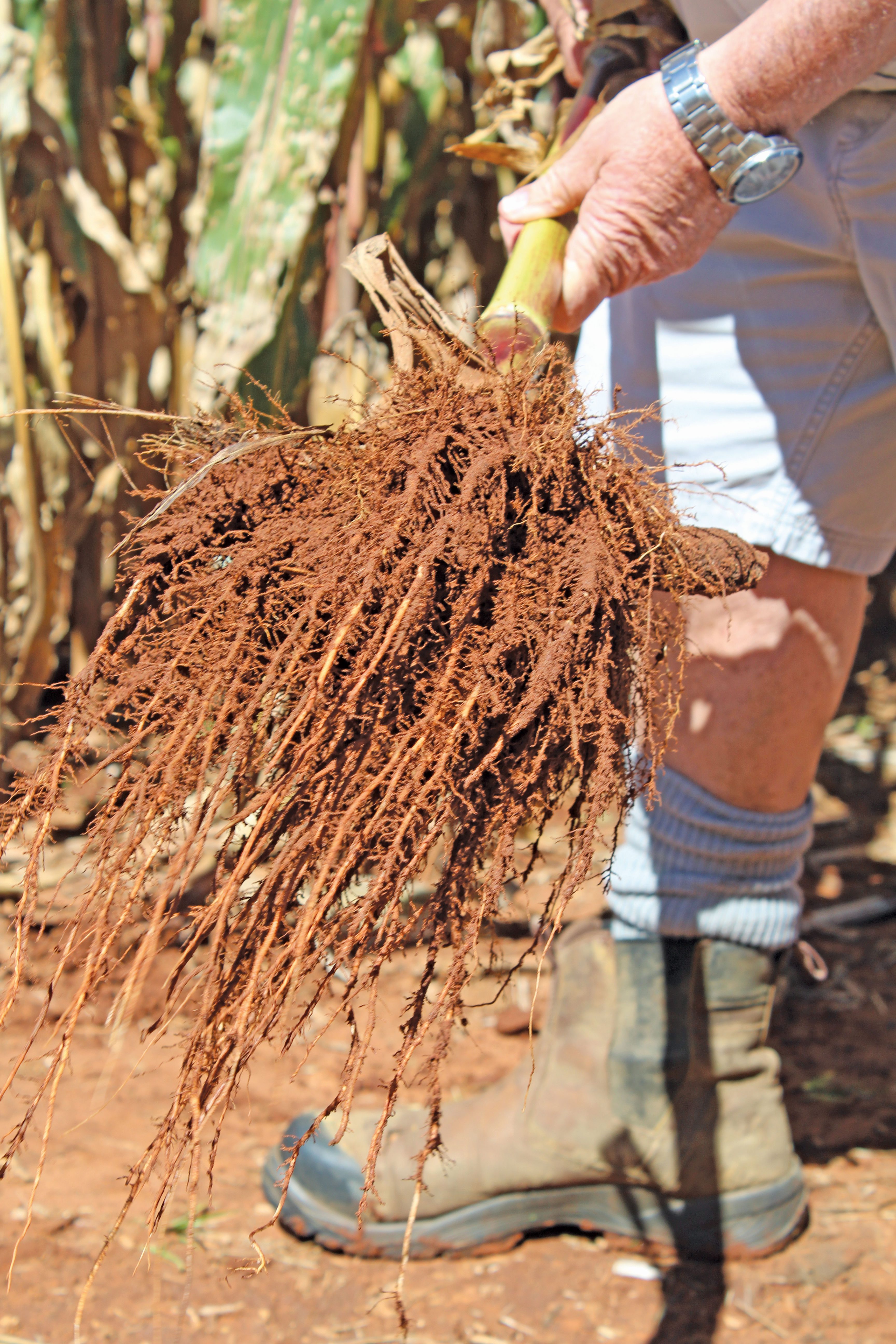
Ripping is done as soon as possible after the harvest has been completed, and will continue until clods start forming when the soil is too dry. Clods are detrimental to achieving high stand in the next season’s crop.
Ripping lines are alternated each year. In the even years, soil slightly to the right of the rows are ripped, and in the odd years, slightly to the left of the rows.
During the harvesting process, maize residues from the previous season are incorporated into the top 100mm of the soil. “Because of the high plant stand there is a lot of material that needs to be chopped up and worked into the soil, which is why we attach a disc to the harvester.
“Just before planting, once sufficient rain has been received, we follow with an 18m Case IH Tigermate field cultivator, using tines to create a seedbed,” Gareth explains.
Increasingly erratic weather has meant that the optimal planting window for grain has shrunk.
“Conditions to plant, harvest or spray could be ideal today, so getting these tasks completed is essential, because tomorrow the weather could change and mean that you can’t get into the field for days. If it’s time to work, you need to be able to,” says Gareth.
The Allens therefore focus on technology that can speed up the respective processes to ensure they can get through the whole farm, on time. For planting they start in October each year. Equipment that can handle the workload is crucial. Perfect planting time is between 10 and 20 October.
“We use a Case IH Early Riser 2160 planter, which has a 24-row, 30-inch planter. It’s got a strong frame so you never have frame-cracking issues.
“It has high-flotation carrier wheels up front, so there isn’t a bulldozer effect that would result from the soil being pushed along by tyres. Since the high-flotation tyres are ahead of the main planting beam, we get more even planting depth throughout the whole planter,” Gareth explains.
Speed wins the day
Further benefits that help timely planting are the trailing depth wheels that reduce rolling resistance, and a narrow leading edge on the disc coaters, which makes a narrower opening in the furrow where the seed is placed.
“This means you can plant at a higher speed because it has less soil to open and close. The smaller opening in the furrow also means the soil does not dry out as much as it would if a larger opening was made, so we retain more moisture,” adds Gareth.
“This all means I can plant at a speed of around 11km/hour. I’ve got a lot of hectares to plant, and being able to speed up without losing efficacy is a major benefit of this technology.”
While soil fertility and healthy soils are paramount for good yields, optimal plant population and stand are two further focus areas for the Allens. Here, even emergence is the starting point.
“Your stand has got to be perfect, because for every plant that does not develop fully, your yield drops,” says Michael.
Having the correct planting depth and spacing ensures that there is no competition for the plants and suppression of growth.
This is why even emergence is critical. “All the plants need to emerge within 24 hours of each other; anything more and the plant essentially becomes a weed that draws nutrients, but does not reach its potential.
“The technology on the planter helps to get the perfect depth, because it’s got a downforce system that ensures each seed is placed at the exact same depth, every time. Without it, the seed could be planted shallower in hard patches, and deeper in soft patches,” Gareth explains.
The single-cob varieties are planted at a stand of between 55 000 and 75 000 plants/ha. Variable stand is done based on the potential of the soil. All inputs are applied at variable rates using Case IH’s FieldOps system.
Gareth explains why the right technology is a vital factor in even emergence: “The Case IH Early Riser 2160 has a vacuum planter, which uses air pressure to suck a single seed from the tank and place it in the furrow. This provides around 99,9% accuracy, ensuring that only one seed per hole is planted, and that no holes are skipped. This translates to a saving in cost on seed, but more importantly gets every seed to where it needs to be so there is even emergence, which translates to high yields.”
The planter has a central feeding system that allows the row units to be topped up with seed fed from large bins held in the shed. This has reduced labour needed for planting since the row units don’t need to be filled by labourers tipping seed from individual bags. It also translates to time saving, so Gareth says they can plant more hectares in a day.
While liquid fertiliser was previously applied during planting, the Allens have switched to granular fertiliser that is broadcast at variable rates in September. This has sped up the planting process.
“We get a much more even spread of nutrients through granular broadcast, which prevents consolidation of roots in the furrow where the liquid applications would be placed. Because we need to make use of every bit of moisture in the field, we want our roots to spread out, even between the rows, to use the moisture that is there,” says Gareth.
Technology reduces risk
With yield being the focus, a high plant stand is coupled with above-average fertiliser rates.
“Increasing inputs increases risk, but technology helps to reduce the risk. Because fertilisers, seed, and chemicals are so expensive, having the correct implements with the correct technology is vital to ensure that every input is applied optimally, not over-applying, under-applying, or overlapping.
“This is where the cost of technology becomes worthwhile because your inputs are as efficient and effective as possible, with everything being applied as close to perfect as possible. This is what creates yield,” he adds.
Spray applications on the crop are done using AIM Command Flex technology. This provides control over the droplet size of the chemicals being sprayed, and a better chance that each droplet hits its target area. Spray drift is reduced, which minimises waste.
“The AIM Command ensures that even pressure, spray pattern and droplet size is maintained throughout the process, regardless of the speed you drive at. Other systems result in a finer droplet size the faster you go. So you need to be sure to maintain a certain speed the whole time, which also limits how fast you can get through a field. The AIM Command is therefore a big advantage when you have a lot of hectares to cover,” says Gareth.
Michael adds that the bulk of the pesticides need to be sprayed 36 days after planting.
“If you get a shower of rain on day 35 after planting, it means we must wait until day 38 to spray, and then try to catch up to make up for the delay. If we can get into the fields on day 36, we push to get it done as soon as possible so that if rain does cause delays in the days thereafter, we are not too far behind. In agriculture, timing is everything.”
AIM Command Flex provides sectional control so nozzles can be shut individually, preventing overlapping. Michael explains that overlapping not only impacts cost, but yields, and therefore the return on investment.
“All chemicals have a negative effect on the crop, even if they are tolerant, as would be the case with Roundup Ready maize. The effect might be minimal, but if you are applying a double dose of chemicals it adds up, negatively affecting yield. So there is a big benefit in having technology that gives greater control over the spray, and eliminates unwanted applications.”
The Allens have also fitted the spray boom with twin jet nozzles, which allows for the liquid to be sprayed forwards and backwards, providing more comprehensive coverage.
When so much has been invested to obtain a good yield, the harvest process cannot be neglected. The Allens harvest using the Case IH Axial-Flow 8250 combine harvester with a 12-row Geringhoff head for the maize, and a MacDon Draper Flex head with a Crary Wind System for the soya beans. The latter assists to harvest cultivars that are shorter, which has increased yields by up to 300kg/ha.
No compromise on quality
Gareth notes that care must be taken to ensure the equipment is being handled in such a way that the desired grain quality is not compromised.
“The machine must be set according to the harvesting circumstances and the quality you want. The grain sensors on the harvester then assess what is coming in, and if it differs from the setting, it will send the operator an alert.
“If there are more broken grains, or dirtier grains than what the operator set as the standard, then the operator knows he should adjust the process, possibly driving faster or slower,” says Gareth.
“With additional technology like Harvest Command, the process is adjusted automatically. Without the alerts, you could harvest a whole field without realising that how you were operating the machine was actually reducing your quality.”
While the range of technology used at G&M Farming Enterprises is broad, Michael singles out two applications that have made the biggest difference to yields: AutoPilot and yield maps.
“With AutoPilot on the equipment, it’s running exactly where it should, with an accuracy of 25mm. This reduces fuel consumption and input costs because it removes overlapping,” he says.
The Allens recently added the VSN Visual Guidance system, which senses where the plants are in a field and ensures that the tractor steers between them, and never over them.
“Often, when you drive in loose soil, the tractor can be pulled aside and trample crops, but the VSN system prevents this,” Gareth explains.
With technology developing so rapidly, the rate at which equipment becomes outdated has sped up.
“We’re trying to find the balance between staying up to date, but not losing too much on trade-ins, which have increasingly low value because they become outdated so quickly.
“Upgrading is however not negotiable. Anything that increases your yield and margins is worth it,” says Gareth.
For more information email G&M Farming Enterprises at [email protected].