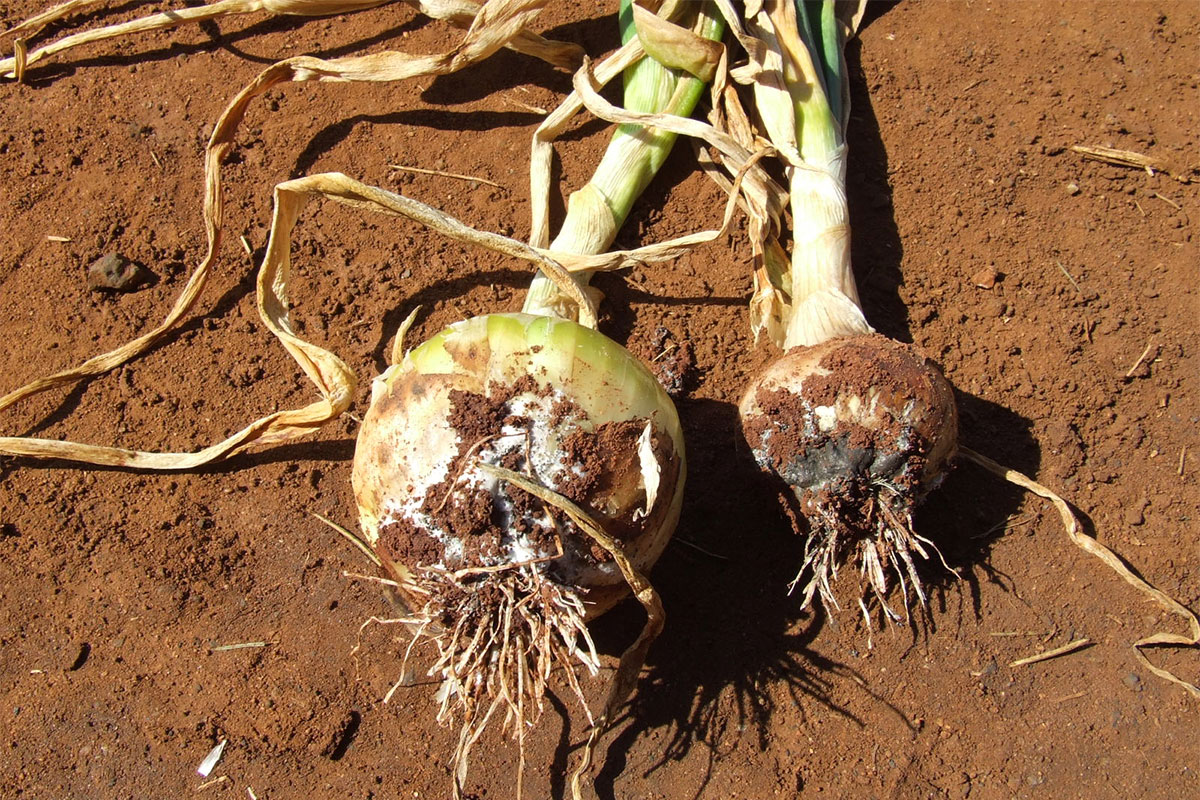
Each disease afflicting onions is caused by a different fungus or bacterium, but they can also be influenced by adverse weather, soil conditions, and nutritional imbalances.
Below are some of the common onion diseases that occur in South Africa.
Downy mildew is more of a problem in humid, subtropical areas. It is caused by fungi of the Peronospora genus, is extremely destructive, and can spread rapidly in favourable conditions, as the spores are carried by the wind and can quickly infect a huge area. The disease manifests as a fuzzy, grey mildew on the leaves.Years ago, in desperation, I sprayed contact products like Dithane M-45 with a good wetting agent at a rate of 2 000ℓ/ ha to ensure every surface was fully covered. However, it only had a slight effect on disease reduction.
Then the systemic product metalaxyl came onto the market. In a trial, I used a knapsack sprayer to spray a few rows and had complete control, even on adjoining rows where there was slight spray drift.
As with so many other products, overuse reduces its efficacy, so new products must be used in rotation with metalaxyl to extend their useful life.
Pink root has become very common in areas where onions are traditionally grown. It is caused by the fungal pathogen Phoma terrestris. Once in the soil, it remains there for many years but becomes increasingly destructive with every successive onion crop grown on the land.
The roots develop a pink colour and start to die off. Consequently, bulb size is drastically reduced. The disease is more destructive in heavy, poorly drained soils.
Although soil fumigation will reduce infection, it is very expensive, and the only practical solution is to plant varieties that are resistant to the disease, which is indicated by the letters ‘PRR’ on the seed label.
Purple blotch is caused by the fungus Alternaria porri. Warm, wet weather favours the disease, especially when the plants have been stressed by hail or thrip damage. Keeping the crop well fertilised can help prevent severe damage.
The disease is referred to as purple blotch because oval purple blotches with concentric rings form on the leaves. It starts as water-soaked spots with white centres, and is also more prevalent when downy mildew has infected the plants.
The A. porri fungus needs a wet surface for at least 12 hours for spores to germinate. Thus, you should start sprinkler irrigation only once the leaves have dried after morning dew to limit the free water on them.
Older leaves are more susceptible to infection. There are systemic fungicides that can be applied at the first sign of purple blotch.
Botrytis leaf blight is caused by the Botrytis squamosa fungus, and the symptoms are small, white spots on the leaves that look a lot like thrip damage. The disease usually starts from volunteer plants or piles of culled plant material.
Spores from the fungus are widely disseminated by the wind. At the first sign of symptoms, you should apply a suitable fungicide, as the disease can quickly become severe.
There is a programme to breed resistance into Allium cepa (the common onion species) from another onion species that does not form bulbs.
White mould is caused by the fungal pathogen Sclerotinia cepivorum. The mould develops in cool conditions and grows at the base of the onion. If white mould is detected in a land, it should not be planted to any Allium species for at least four years.
Culled bulbs should be destroyed and not placed in a compost pile. No onion varieties are resistant to this disease.
Bill Kerr is a vegetable specialist and breeder.