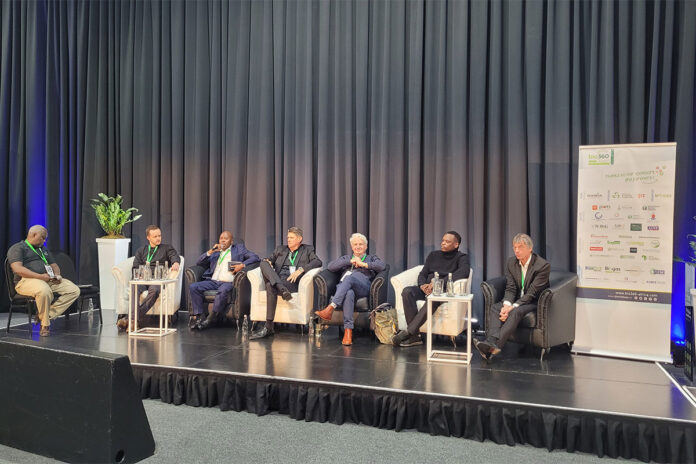
Bio360 Africa took place at the Gallagher Convention Centre in Johannesburg on 17 and 18 June.
Speakers agreed that biochar remains a nascent industry, with limited farmer familiarity slowing adoption, despite growing interest in its soil health and carbon benefits.
Panel member Tim Egan, head of new technology at Regen Organics, said farmers are confronted with a constant stream of new products and must make difficult choices about where to spend limited input budgets.
“Farmers are reluctant to invest in products without clear proof of performance. We need to work with influencers in communities, such as respected farmers, and set up local trial plots to decrease the perceived risk [of biochar use],” he explained.
Clayton Postma, managing director of Aquagel, said convincing farmers to adopt biochar remains a significant challenge, particularly in a sector where many producers are only one failed crop away from financial ruin.
“Farmers don’t want to act as guinea pigs for unproven technologies. They need multi-season data before committing.
“Current fertiliser price pressure creates a potential opening for alternative inputs, but farmers still need assurance that new products will deliver measurable results. Without that certainty, adoption will remain limited,” he said.
Musa Msimango, CEO of Phambili Energy, said the biochar industry will require financial innovation to support early adoption and help farmers through the period of yield lag after switching from synthetic fertilisers to biochar, before soil benefits become visible.
He added that farmers need financing that supports them through the first few seasons after applying biochar, before they can see the results in the soil.
“The practical model for biochar is circular: process organic waste into biochar, aggregate farmers into buying groups, and use blended finance to reduce first-mover risk. Do that, and we create resilient farms, local input industries, and measurable carbon and soil gains.”
A key theme emerging from the discussion was whether biochar should be positioned as an alternative to synthetic fertilisers or as a complementary input. Panellists firmly rejected the idea of competition between the two, calling instead for collaboration.
Egan said it is a misconception that biochar and fertiliser companies are adversaries, arguing that partnerships could strengthen rather than undermine both industries.
“[Regen Organics] has adopted a collaborative approach with fertiliser companies like Yara, for example, to develop complementary products that support existing farming systems.
“Partnerships with established brands also help accelerate trust among farmers, particularly when those brands already hold strong credibility in the market.”
According to Egan, while such collaborations require time, repeated trials, and engagement across multiple decision-makers, they ultimately strengthen confidence in new products and support more sustainable adoption pathways.
As the industry continues to evolve, speakers agreed that the path forward will depend less on product promotion and more on trust-building, shared evidence, and practical collaboration across the agricultural value chain.