
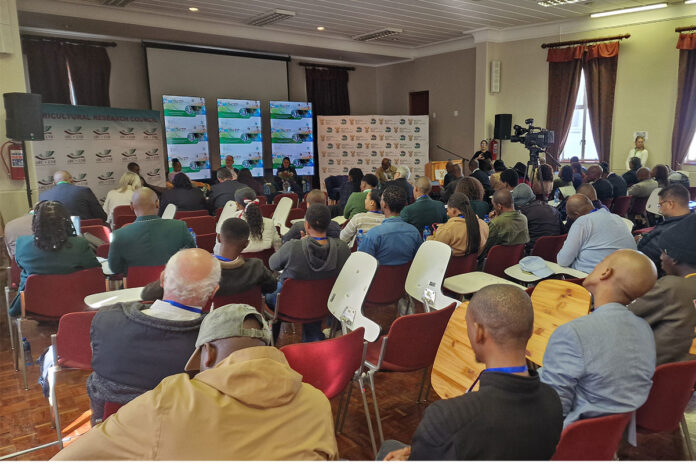
Co-hosted by Nietvoorbij campus head Prof Bongani Ndimba and Department of Agriculture (DoA) Director-General Mooketsa Ramasodi, the session brought together government leaders, industry stakeholders, and young farmers as part of the DoA’s Youth Month activities across the country.
Speaking during the discussion, Dr Khumbuzile Mosoma, senior manager of agribusiness development at the National Agricultural Marketing Council, said research shows that young farmers often produce without clear access to buyers or adequate market information.
“On the ground, they struggle to find sustainable markets. They produce, for example, 1 000 cabbages, but only then try to find a buyer. Compliance requirements, including quality standards, washing, grading, and packaging, remain major hurdles,” she noted.
Agriculture full of career opportunities
Sean Kearns, Western Cape chairperson of the African Farmers’ Association of South Africa, said agriculture must not be presented as a fallback option, adding that the sector needs to fundamentally rethink how it prepares young people.
“If we only teach young people how to grow but not how to run an enterprise, we are doing them a disservice. A young farmer must know what it costs to produce even something as simple as a single beetroot.”
He added that agriculture must be repositioned as a technology-driven, opportunity-rich sector.
“Young people today are far more tech-inclined. We need to bring in drones, hydroponics, and precision agriculture and show that there are multiple entry points into the value chain, not just farming,” Kearns said.
Piet de Jager, CEO of the Fresh Produce Exporters’ Forum, noted that barriers can be even higher in export-oriented industries such as fruit.
“The industry is very demanding and sophisticated, with strict compliance requirements and high establishment costs,” he said.
However, he pointed to broader opportunities beyond primary production. “We recruit from across disciplines – economics, data, business – because agriculture today supports a wide range of careers. My advice is to start small, find mentors, and build over time.”
Dr Litha Magingxa, president and CEO of the Agricultural Research Council (ARC), echoed the need to rethink how agriculture is perceived.
“Agriculture is a long-term career and not limited to primary production. It has many dimensions and there are many opportunities linked to it,” he said.
Magingxa also highlighted the role of research, science, and innovation in shaping the sector, pointing to the ARC’s training and development programmes aimed at building skills across the agricultural value chain.
Calls for coordinated action to support youth
From the floor, audience members called for stronger partnerships between industry and young farmers, particularly around certification, mentoring, and direct market access.
The session concluded with a clear message from Ramasodi that unlocking youth potential in agriculture will require not just dialogue but also coordinated action across finance, markets, skills, and support systems.
“It is imperative that the Department [of Agriculture], in collaboration with industry role players, creates an enabling environment in which young people can access land, skills development, technology, financing, and market opportunities to participate meaningfully in the agricultural value chain,” he said.