
At a time when South African agriculture is under increasing pressure to do more with less, innovators are turning to overlooked by-products to unlock new value chains. One such innovation is emerging from an unlikely intersection of agriculture, healthcare, and manufacturing, where pineapple leaves, long treated as waste, are being transformed into absorbent fibre for reusable sanitary and incontinence products.
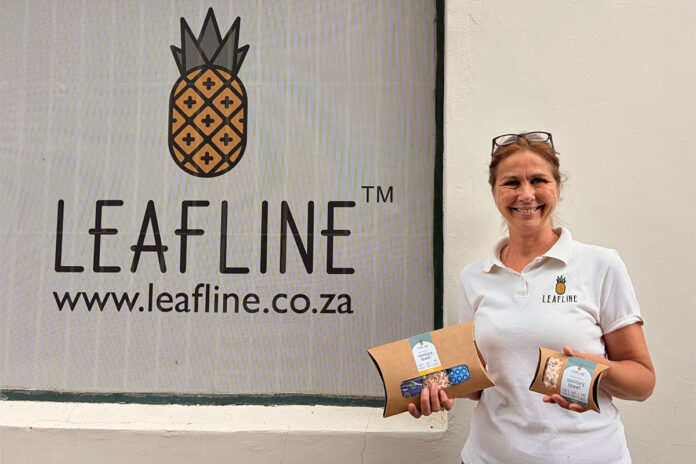
Candy Androliakos, founder and director of Leafline Washable Sanitary Wear, in Bathurst, Eastern Cape, says the business is built on a simple but powerful idea: using agricultural by-products to create practical, locally manufactured solutions that reduce waste, create jobs and support rural economies.
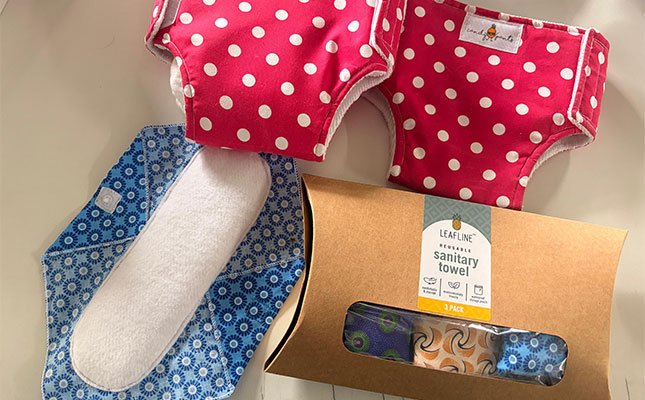
Founded in 2018, Leafline produces reusable sanitary towels, adult incontinence wear, infant nappies, and bed and seat protectors, all incorporating fibre extracted from pineapple leaves. While the products sit in the health and hygiene space, Androliakos stresses that the backbone of the business is agricultural innovation.
“This is not just a sanitary product story. It’s about farming systems, waste streams, fibre production, and how agriculture can support entirely new industries,” she says.
An overlooked yet useful by-product
South Africa’s pineapple industry is concentrated largely in the Eastern Cape, with Bathurst widely recognised as the country’s pineapple capital. The cayenne pineapple, grown predominantly for fresh consumption and processing, generates large volumes of leaf material once fruit has been harvested.
Traditionally, these leaves are either left to rot in the field or burnt to make way for replanting. According to Androliakos, this practice represents a missed opportunity.
“The leaves from the finished plant are usually burnt. But the entire leaf can be used. The fibre becomes a raw material, and the green part of the leaf is fed to cattle,” she says.

This approach aligns closely with circular economic principles increasingly promoted within agriculture: keeping materials in use for as long as possible, extracting maximum value from raw resources, and reducing environmental harm.
For pineapple producers, fibre extraction offers the potential to diversify income streams without affecting fruit yields. While Leafline currently operates at a small scale, Androliakos believes the model could grow into a formalised agri-processing subsector.
Leafline did not begin as an agricultural venture. Androliakos’s journey started while working in a retirement home, where a resident challenged her to find an alternative to disposable incontinence products.
“She asked me to make her something reusable. I had a pattern for the undergarment, but I needed an absorbent material that was natural and safe,” she says.
The breakthrough came during a visit to Bathurst, where Androliakos noticed a billboard at The Big Pineapple highlighting the various uses of pineapple fibre. One of those uses was absorption.
“That was the moment. I realised the solution might already exist within agriculture,” she says.
She approached a local pineapple farmer who had experimented with fibre extraction and asked him to prepare a batch for testing. The fibre was trialled with elderly users, refined, and eventually incorporated into a functional product.
Strength, absorption, and biodegradability
The fibre used by Leafline is extracted from the leaves of the cayenne pineapple. Once processed, it resembles natural cotton wool and is stitched into reusable products.
According to Androliakos, pineapple leaf fibre has several properties that make it particularly suitable for agricultural-based manufacturing applications.
“The fibre is stronger than cotton. Once processed, it becomes a natural cotton wool that can be sewn into products without synthetic additives,” she says.
Unlike conventional disposable sanitary products, which rely on superabsorbent polymer gels, pineapple fibre is entirely natural and biodegradable.
“The gel in disposable items does not decompose. Those products take between 500 and 800 years to break down,” she says.
From an environmental perspective, this has major implications for landfill, water systems and soil health. Disposable nappies and sanitary products are a significant contributor to municipal waste and sewage blockages, particularly in urban and peri-urban areas.
Health considerations meet farming innovation
Beyond environmental concerns, Androliakos points to health issues associated with conventional disposable products.
“The gel absorbs urine and feels dry, so the product stays on for long periods. When body heat interacts with gel soaked in urine, it can move back into the urinary tract and cause infections,” she says.
Reusable products made with natural fibre behave differently. While they require washing, they also encourage more frequent changing and airflow, reducing prolonged exposure.
For farmers and agri-processors, this shows an important point: agricultural innovation increasingly intersects with human health, consumer safety and sustainability, expanding the relevance of farming beyond food production alone.
Challenges of changing consumer behaviour
Developing a functional product was only part of the challenge. Convincing consumers to adopt washable alternatives proved more difficult.
“The biggest challenge is getting people to wash the products. Most people prefer something they can throw away, without thinking about the environmental impact,” she says.
This resistance affects scaling, despite the long-term cost benefits of reusable products.
“Washable items work out cheaper over time because they are reused, but on the shelf, they look expensive compared to single-use products,” she says.
This price perception is a familiar challenge in agri-based value-added products, where production costs reflect labour, local sourcing and sustainable inputs rather than mass-produced imports.
One of the most compelling agricultural aspects of Leafline’s model is what happens at the end of the product’s life cycle. After approximately two years of use, the fibre component of Leafline’s products can be buried in soil.
“The nitrate level in the used product acts as an excellent fertiliser,”she says. In addition, the green material left after fibre extraction is used as livestock feed, ensuring that no part of the pineapple leaf goes to waste.
This integrated approach mirrors regenerative agricultural thinking, where outputs from one process become inputs for another.
Leafline’s production model places strong emphasis on rural employment and skills development. Manufacturing is done locally, with staff recruited and trained from surrounding communities.
“Leafline trains and employs staff from the rural community. Some of our sewing is outsourced to Enkhutazweni Special Needs Centre in Port Alfred,” she says.
For agriculture-dependent regions such as the Eastern Cape, this kind of decentralised manufacturing helps retain value within rural economies, rather than exporting raw materials and importing finished goods.
Proudly South African accreditation has further supported market access. “It creates exposure and opportunities through shows and marketing,” she says.
Market access and distribution
Leafline products are available through selected local retailers, an online sales platform, and approximately 40 SPAR stores, where washable sanitary towels are stocked.
Androliakos says consumer feedback on product performance has been positive, with most concerns centred on upfront cost rather than functionality.
This feedback is informing ongoing education efforts, aimed at explaining the agricultural origins, environmental benefits and long-term savings associated with reusable products.
While Leafline currently focuses on sanitary wear, Androliakos believes the broader opportunity lies in commercialising pineapple fibre as an agricultural input.
“We are trying to sell the idea of pineapple fibre. Once that is established, we may look at other fibre options,” she says.
For pineapple growers, this could mean new partnerships with fibre processors and manufacturers, adding resilience to farming enterprises affected by volatile fruit markets, rising input costs and climate variability.
With Leafline recently reaching the milestone of manufacturing its own fibre, the business is now better positioned to control quality, consistency and supply.
Measuring impact beyond profit
To date, Leafline has sold and donated more than 7 000 washable sanitary towels. According to Androliakos, this has contributed to measurable reductions in landfill waste and water pollution.
“Sanitary towels do not end up in pipes that burst into rivers and dams,” she says.
While still modest in scale, these numbers highlight how agri-based innovations can deliver environmental benefits far beyond the farm gate.
Looking ahead
Over the next five to 10 years, Androliakos defines success in practical, agriculture-linked terms. “Export opportunities, good profits, sustainability and extra employment,” she says.
For South African agriculture, Leafline’s journey offers an important case study: how waste streams can become revenue streams, how fibre crops can complement food production, and how rural manufacturing can strengthen local economies.
As pressure mounts on farmers to adopt climate-smart, resource-efficient practices, pineapple leaf fibre may prove that some of the most valuable agricultural innovations are already growing in the field, waiting to be used.
At Leafline, the commitment remains clear: minimal waste generation, biodegradable materials, reduced carbon footprint, and the empowerment of women through sustainable livelihoods.
For more information email Candy Androliakos at [email protected].