
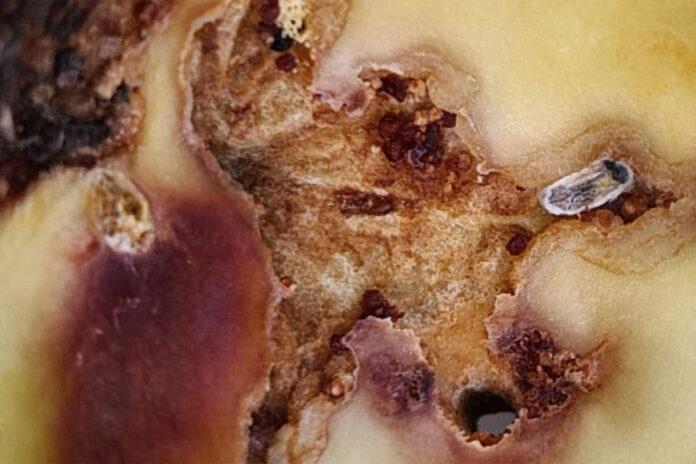
Macadamia nut borer (MNB) has become an increasingly important pest in macadamia production systems, with damage often eclipsing that of stinkbugs. Yet the true impact of infestations may be far greater than many producers realise.
According to Schalk Schoeman, owner of Sonbesie Consulting, successful management depends on understanding how the pest causes damage, measuring that damage accurately, and implementing control measures early in the season.
One of the challenges with macadamia nut borer is that much of the damage is not immediately obvious.
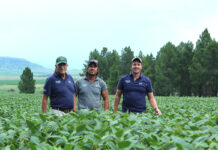
During a recent Global Macadamias farmers’ day in Alkmaar, Mpumalanga, Schoeman explained that larvae can feed directly on kernels while the shell is still soft, typically before mid-January. Feeding activity in the husk can also cause premature nut abortion during the early stages of development and lead to immature nuts later in the season.
“The problem is that these immature nuts often look identical to mature nuts from the outside, but affected kernels weigh very little. Because processors generally assess quality based on kernel mass, severe infestations can reduce total kernel recovery values. This means growers may suffer financial losses even when damage is not immediately visible,” Schoeman explains.
He warns that this can result in a significant underestimation of pest pressure and, consequently, an underinvestment in control measures.
Effective management begins with measuring the extent of damage. Farmers are advised to assess nut borer damage on trees during January and February, as this provides a valuable indication of how much should be invested in management during the following season.
Schoeman nots that since damage is seldom evenly distributed across a farm, certain orchards and cultivars may experience far greater pressure than others. This makes it unnecessary in some cases to apply blanket treatments across the entire operation.
Timing is everything
Growers have a range of management options available, including chemical and biological products, pheromone-based technologies and physical practices such as pruning and orchard sanitation.
While chemical and biological spray products can deliver relatively quick results, Schoeman cautions that excessive spraying can create secondary problems. Instead, applications should be carefully timed and integrated into a broader management strategy.
Research comparing orchards where an early December spray was applied with those where it was omitted highlights the importance of timing. In orchards that received one spray during each of the months November, December, January and February, nut damage reached 20%. Where the December application was excluded and only three sprays were applied, damage increased to 68%.

Schoeman states that the preferred spray timing is when premature nut drop has ended, typically around nine to 12 weeks after the main flowering period.
He stresses the importance of monitoring both flowering and egg-laying activity.
“Moths prefer to oviposit deep inside the tree canopy so coverage is king. Increasing your spray volume does not necessarily equate to good coverage. Proper pruning plays an important role in ensuring spray penetration and coverage throughout the canopy.”
Yellow delta traps can assist with monitoring, but Schoeman notes that male moth activity does not necessarily correspond directly with the presence of egg-laying females. Scouting data remains critical for decision-making.
In some situations, a late November spray may be sufficient when combined with other management tools, but this decision should always be guided by monitoring information.
Above all, Schoeman emphasises that growers should focus on protecting the main crop early in the season.
Building an integrated management programme
Biological control methods form an important component of an integrated management approach. Available options include viruses, Beauveria bassiana soil treatments, entomopathogenic nematodes and supplementary releases of Trichogrammatoidea cryptophlebiae parasitoids.
Unlike chemical interventions, biological tools may take longer to deliver results, making early application particularly important.
Schoeman quips that it is a numbers game, so early applications are important. “Out-of-season nuts can harbour nut borers and help maintain parasitoid populations, while a diverse orchard floor vegetation can contribute to a more stable ecosystem.”
Schoeman points to observations from small-scale farmers in Limpopo’s Vhembe region, where wide planting spacings and cultivated inter-rows are associated with relatively low pest pressure.
“Maintaining plant diversity on the orchard floor can also support soil and water conservation, although vegetation should not compete excessively with trees for resources.”
He adds that considerable research is still required to determine the most suitable species and species combinations, with projects currently being undertaken by Macadamias South Africa and Hortgro.
Pheromone-based technologies provide another valuable management option. These include attract-and-kill systems and mating disruption products.
However, Schoeman notes that pheromones are generally species-specific, while macadamia orchards may host more than one moth species during a season. In addition, gravid females (those that are carrying eggs) can move into orchards later in the season, potentially reducing the effectiveness of these technologies.
For this reason, identifying the dominant species on a farm is an important prerequisite before implementing mating disruption programmes.
Several other factors can influence the success of a pheromone programme. Mating disruption may be less effective in windy areas where pheromone concentrations are diluted, while long, narrow orchards are also not considered ideal. Schoeman suggests that orchards should generally be at least 8ha in size for mating disruption programmes.
Both mating disruption and attract-and-kill products perform best when applied early in the season.
“The battle for these moths will be decided during the early season. It is very difficult fixing a nut borer problem once nuts are showing signs of borer infestation such as frass and premature abortion,” says Schoeman.
An integrated programme may include perimeter or blanket applications of attract-and-kill products, depending on damage levels. Monthly releases of approximately 20 000 parasitoids can follow after flowering, with a final release before Christmas.
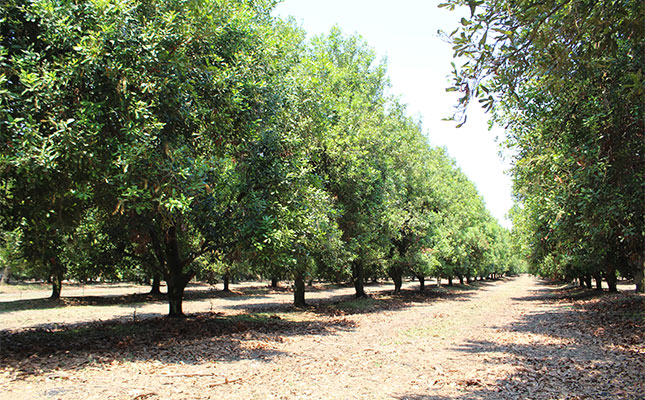
Once natural nut drop has ended, a registered pesticide can be applied, provided adequate nut coverage is achieved. In severe infestations, virus-containing products may also be considered.
Monitoring should continue throughout the season, including regular inspections of nuts on the ground from December onwards.
Schoeman says growers have a significant number of useful tools available to manage macadamia nut borer. However, the pest’s complex life cycle means there are no simple threshold values that apply across all situations.
What remains clear is that success depends on acting before populations escalate.
“Most control measures work very well if applied early in the season. It will be very difficult, if not impossible, to rectify high infestation levels from January onwards if nothing was done in the early season,” he says.
By understanding the pest’s life cycle, accurately measuring damage and integrating multiple management tools, growers can maintain good control despite increasing pressure on pesticide availability. Just as importantly, keeping records of damage levels from year to year can help guide future management decisions and protect both yield and kernel recovery.