
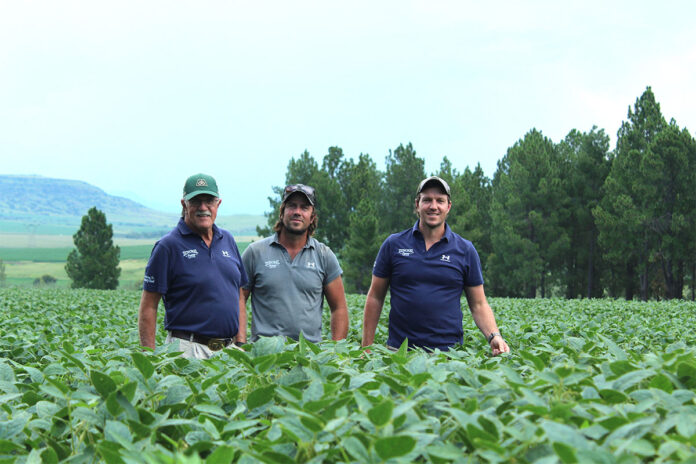
Egon Zunckel was the fourth-generation farmer when he took over Zunckel Farms in Bergville, KwaZulu-Natal from his father in 1984, and he could very well have been the last. What was once a sprawling enterprise across KwaZulu-Natal (KZN), earning the family the label ‘the rich Zunckels’, was in fact a business facing bankruptcy.
“We were on the skids. All but one of the farms had already been sold off. I had to take out a loan from the bank to buy the farm from my father, and was really thrown in the deep end as years of poor management meant it was not really a fully operational farm,” Zunckel explains.
He was soon hit with the harsh realities of farming.
“My first maize crop was a write-off. We called it hail and drought, and while that had an impact, bad management was also to blame.”
One of the biggest issues was that the farm’s soil was capped and any rain that fell ran off the fields.
“We were suffering from a drought, but not necessarily in a drought year,” says Zunckel.
In the late 1980s, a fertiliser salesman who had recently returned from a trip to Brazil told Zunckel that he should consider stubble mulching and do away with tilling the soil to improve water retention.
No-till was a foreign concept to Zunckel, but he attempted conservation tillage the next year, using a chisel plough to lightly work the soils instead of conventional tillage equipment. This worked well to improve moisture retention, and for four years Zunckel followed this method.

The shift to no-till combined with cover crops then came about by chance.
“We decided to enter a field into the 10 Ton Maize Club competition in KZN. We worked the field very neatly using the chisel plough and took care in planting the seed. On the field next door, we decided to double-crop the maize into the harvested wheat field. There was no time to do it neatly, so we just used the chisel plough once before planting.
“That year, and for another thereafter, the field that was double-cropped and where the seed was just hacked into the soil beat the neatly prepared competition field next door by 2t/ha. The water infiltration was better because there was effectively a cover crop in winter. This convinced me that cover crops and no-till was the way to go.”
A thriving enterprise
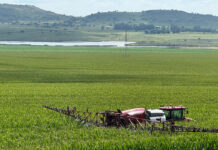
Zunckel has come a long way since he took over the 700ha farm. Today he farms on almost 5 000ha with his two sons, Tyson and Carl, who joined him in 2009. The operations stretch across farms in Bergville, and Warden in the Free State.
It includes 2 800ha dedicated to cropping, with 750ha under centre-pivot irrigation in the Bergville district. Around 1 680ha are planted to yellow maize in summer, with about 500ha of this irrigated. Some 1 120ha are planted to soya beans, of which around 250ha are irrigated.
Winter wheat is grown on 250ha of irrigated land in the Bergville district. The remaining cropland is planted to cover crops in winter to aid soil health. In summer, around 200ha of dryland is dedicated to cover crops on the Free State farms.
The operation’s crop rotation policy involves growing two years of maize, followed by one year of soya beans.
The next year, winter wheat or cover crops are planted, before returning to maize again the following year.
To get the full benefit of regenerative farming, veld-raised cattle of mixed breeds are kept to graze the cover crops and fertilise the soil. Between 500 and 1 000 oxen are kept at the Bergville operation, with Warden having a commercial beef herd of 350 breeding cows.
A high-density grazing system is used on the grasslands, with feed supplemented by cover crops. The meticulous management of the cattle within this system has meant that in the Warden area the carrying capacity is three times the normal rate, while in Bergville it is five times the normal rate.
Zunckel quips that he did not experience the typical yield lag that often occurs when farmers switch from conventional tillage to no-till, because the yields were low to begin with. His journey has instead been one of gradual, steady advancement, implementing every lesson learnt to improve from one year to the next.
Progressing to no-till
Zunckel’s first no-till crop was to be planted using his conventional Monosem planter.
“But I couldn’t get 5m down a row without all the stubble piling up, so I contracted a friend who had a planter with disk coulters that made it easier. We saw immediate results that season as water infiltration improved and the soil didn’t cap. I then bought my own planter with disc openers.”
During the first 10 years of following the no-till programme, Zunckel doubled the carbon content of the soil from 1,5% to 3%. This was done without the assistance of cover crops.
He explains that tillage reduces carbon in the soil since the increase in oxygen as a result of tilling causes an explosion of bacteria in the soil. “The stubble that has been tilled into the soil is then quickly gobbled up by the bacteria. This is unsustainable as the carbon content declines over time.
“The larger carbon content, on the other hand, increases the potential of the soil, creating a bigger ‘bucket’ in which the crops can grow, so they fare much better.”
Zunckel reached another turning point after 14 years of no-till. This time he was led to see the benefits of adding cover crops and cattle to the operation, forming a regenerative farming system.
“One year we had a maize crop go down on a recently purchased farm – literally. It looked like it had been trampled by a herd of animals. I could grab a maize stalk with two fingers and pull it out of the ground,” he says.
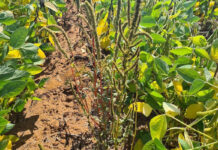
A nematode infestation in the soil had led to lesions on the roots and Fusarium root rot set in. Zunckel believes the nematodes were able to take hold of the crop because the plants were not healthy enough to withstand them.
“We planted the crop too early and tried to reduce costs, so we decreased fertiliser, fungicide and pest control. We ended up harvesting a mere 7t/ha on an irrigated field.”
To make up for the loss, Zunckel drilled oats into the field and then rented it out for a neighbour to graze his cattle. Zunckel did not have any cattle at that stage as he believed they would compact his soil.
The next season soya beans were planted to that field; this was also not overly successful either.
“In retrospect, I realised that I’d planted the soya beans when the oats were still at an allelopathic stage, which inhibited the growth of the soya beans.
“But then we planted wheat and it was the best yields we have ever reaped at 8t/ha. We then followed up with maize again, doing everything by the book in terms of disease control and fertiliser, and averaged 15,8t/ha on the irrigated field. The stalks couldn’t be pulled out of the ground they stood so strong. This made me see the value of cover crops and cattle integration.”
Cutting costs through regenerative farming
Zunckel initially planted a wide range of cover crops, sometimes up to 14 different species. He has since whittled it down to a mix of four, which changes from season to season to maintain diversity. Cover crops that are poor hosts for nematodes are prioritised. The introduction of cover crops has also helped mitigate Fusarium root rot and poor soil structure.
The introduction of cover crops meant that Zunckel needed his own cattle to graze them. The addition of cattle has not only made a regenerative farming system possible, bringing with it all the environmental benefits, but adds to the overall profitability of the business. The fact that there is sufficient food on the land for the cattle means they can be veld-raised, and the meat fetches a premium in the market.
To maximise the efficiency of the cover crops by getting them into the ground sooner, Zunckel overseeds some soya bean fields when they reach senescence. This is done using a drone.
“Seeding when leaf drop is at about 30% means that the seeds are still able to get to the soil and be covered by the rest of the leaves. We saw previously that seeding when leaf drop has progressed too far means that the seeds struggle to germinate,” he says.
The grain crop’s harvester is fitted with high tracks, which means the cover crops that have started growing are not trampled. The cover crops are not fertilised or irrigated.
For Zunckel, the proof of the benefits of regenerative farming is in the yields, as the farm has consistently achieved around 10t/ha of maize on dryland, with dryland soya beans averaging between 3t/ha and 4t/ha. Irrigated wheat yields are between 7,1t/ha and 7,3t/ha.
“We have below-average soils, but get above average yields.”
Regenerative agriculture has also reduced costs.
“We don’t need a whole fleet of machines to pulverise soil, the soil is healthier, and our water infiltration has improved. Since we’ve been farming no-till, we’ve never had second-grade maize and we are one of the top seed top growers for Pannar (now Corteva). We also hold the record for the most tons of quality seed delivered to Pannar. This proves to me that whatever we are doing to improve soil health and management is working.”
Maximising soil and plant health
Zunckel’s aim is to eliminate the use of harsh chemicals on the farm to further boost soil health, but laments that it would be difficult to achieve while maintaining high yields.
“We plant racehorse cultivars, and they need a certain amount of inputs to reach their potential. But it is important to find the balance and not be a ‘moron’ – just putting more in to get higher yields while actually doing long-term damage.
“Rather than adding more fertiliser, more pesticides, more water, the focus should be on getting the soil health as optimal as possible to reduce the need for inputs.”
Zunckel has already achieved success in this regard. For the last 26 years his soya bean crops have not received any fertiliser.
“And no, we don’t add extra to the preceding maize crop to see the soya through. On the contrary, for the last four years, we’ve halved the fertiliser planting mix on the maize, while still achieving some of the best yields in the country. The total nitrogen application is around 150kg/ha over the season, with the irrigated maize not exceeding 200kg/ha.”
For the past six years, Zunckel has spread kraal manure on his fields, applying 10t/ha to a field every four years.
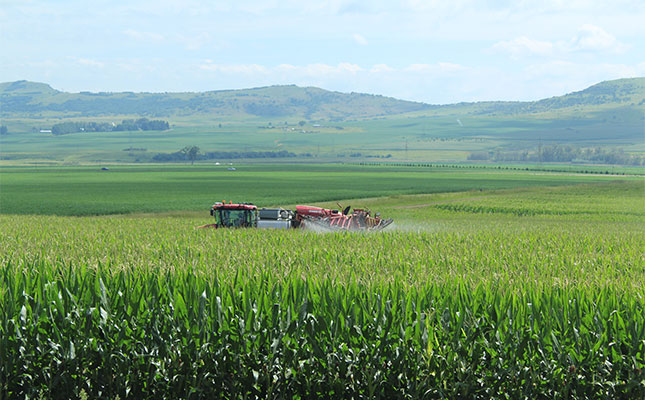
Leaf samples are taken every two weeks to assess trace element level and the necessary adjustments are then made. Fungicides are sprayed preventatively throughout the season, with the maize crop receiving up to four applications. Insecticides are sprayed when pest outbreaks occur.
Zunckel notes that the cover crops have helped to reduce herbicide applications as the cover crops suppress weeds. Planting narrow-row soya beans has also been helpful in this regard.
“Planting at a spacing of 25cm instead of 76cm saves one herbicide application as the denser canopy suppresses weeds,” he says.
The fields are cleared before planting. A glyphosate and 2,4-D mix is applied, along with a pre-emergence application. The herbicide Callisto is especially useful in a no-till operation as it kills weeds above the soil, and leaves a residue in the soil to kill seeds that would have germinated later.
Utilising every hectare with grass-fed beef
Zunckel Farms uses high-density grazing in Bergville and ultra-high-density grazing in Warden to support herd productivity and sustainable land use. The approach encourages the growth of diverse, nutritious grasses, improving soil health, organic matter and water infiltration while preventing overgrazing through the frequent movement of cattle.
Ultra-high-density grazing is particularly useful in areas where invasive grasses such as bankrotbos (Seriphium plumosum) are prevalent.
The cattle’s genetics include Bonsmara, Bovelder, Brangus, and Beefmaster breeds. Weaner steers weighing around 220kg to 250kg are bought in during autumn. They feed on grasslands until the first crop fields have been harvested and are available to be grazed.
The animals’ stocking density and duration varies according to the carrying capacity of the particular field.
This system requires careful planning, frequent livestock movement and close monitoring to ensure adequate pasture recovery. Zunckel emphasises that ongoing assessment of pasture health, soil condition and animal performance is essential, and that practices need to be adapted continually to maintain long-term productivity of both the veld and the cattle.
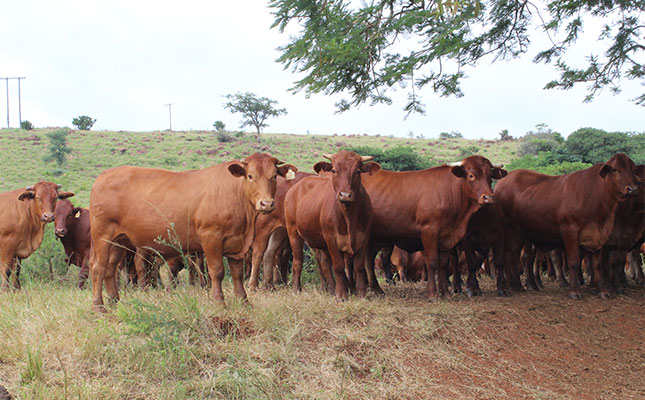
The calving in Warden takes place in autumn. This has been pushed forward in recent years to prevent cows from calving in the coldest part of the year. This also means the cows are in better condition since they have more time to utilise the cover crops after calving.
Bulls are placed with cows for around two-and-a-half months at a ratio of one bull for every 25 cows. Cows that don’t calve are culled. Over the past two years, the farm has averaged a conception rate of around 89%.
Out of the 350 calves that are born, around six are lost on average, mostly to jackals.
The calves are weaned in January and grown out for a year before they are sent for slaughter. The weaning rate is close to 100%, with weaning weights averaging 240kg. Zunckel notes that this had fallen to 190kg in the past when the mob grazing programme left the herd with too little feed.
“One must be careful not to over- or undergraze the veld. The cattle must be pushed to eat all the grasses, not only those that are palatable, while still ensuring they get sufficient nutrition.”
Looking back to the start of his farming journey, Zunckel says that although it was difficult, he would not change anything if he could go back.
“The struggles made me who I am and pushed me to where I am,” he says.
Over the years, Zunckel has built a reputation for being willing to test new ideas and adapt his farming systems, often adopting practices that were still relatively unknown in South Africa at the time. While this willingness to innovate carries risk, it also enables the business to evolve and remain resilient in a changing agricultural landscape.
Central to his decision-making is a balance between careful judgement and faith.
“I walk in faith. I have an appetite for calculated risk, but I believe one gets guidance from God when you’re walking close to Him.”
This combination of thoughtful risk-taking, adaptability and strong personal values has shaped the way Zunckel Farms has developed over the years, and continues to guide its future.
For more information, email Egon Zunckel at [email protected].