
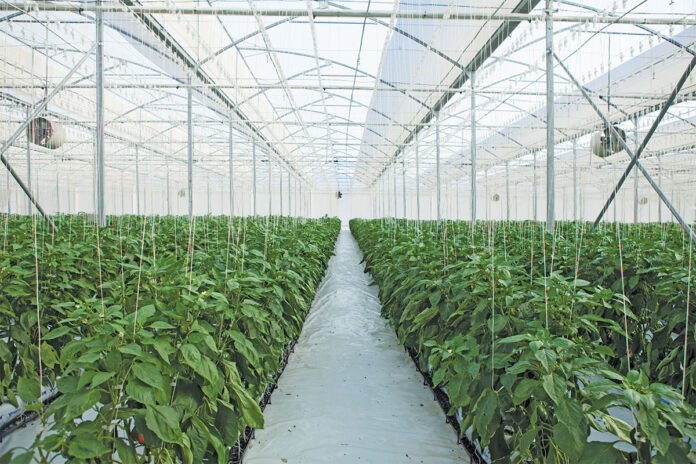
To the uninitiated, it can be difficult to understand the need for lighting in a greenhouse. The bright white plastic and netting used for the flooring, walls and roofs of contemporary plastic greenhouses make the interiors of these structures almost unbearably bright.
“Plants make use of different (light) wavelengths to grow and photosynthesise,” explains Kaylee Smit, chief cultivation officer at Cultura Fresh, a hydroponic vegetable producer supplying national retailers from farms in Klapmuts and Stellenbosch.
“Each growth phase of the plant (germination, seedling, vegetative, flowering or reproductive phase, and the maturation or harvest phase) requires a different light wavelength and a different set of climatic conditions for the plant to thrive,” she says.
While there are indoor farming industries that rely solely on artificial lighting, the establishment and running costs make them prohibitively expensive in South Africa for all but the most high-end horticultural industries, notably cannabis.
“In South Africa we have very good sunlight, so we generally use artificial lighting to supplement sunlight rather than to replace it,” says Jonathan Adams, technical manager at Vegtech Netafim, a designer and builder of greenhouses and provider of greenhouse technology.
“In developed countries, which typically receive less sunlight and have better access to capital and finance, commercial farming exclusively under artificial conditions is more feasible than in South Africa,” he explains.
Modern greenhouses are designed to optimise solar light that plants receive.
“The white polyethelene thermo plastic used on the exterior of greenhouses has good light transmission and diffuses the sunlight, so it spreads evenly to all the leaves without sharp shadows. The white ground cover reflects light to the underside of the leaves and maximises photosynthesis throughout the plant,” adds Adams.
Lengthening days, changing seasons
The two main motivations for using artificial lighting in undercover farming in the South African context is to boost growth and production by extending daylight hours, and to manipulate a plant’s growth stages to induce flowering.
“In basic terms, more light equals more growth, provided you balance the other factors such as water and nutrition. With more daylight hours you provide a longer growing day, which will lead to a higher yield,” says Adams.
For any industry that relies on flowering plants, such as the cut flower industry and growers of medical cannabis, controlled artificial lighting is used to trigger a flowering state.
“The different growth stages of the plant are dictated by the length of the day, so as the days lengthen into spring, the plants know to flower. By using artificial lighting, you can, for instance, dictate when the plants flower,” adds Adams.

Bulbs and frequencies
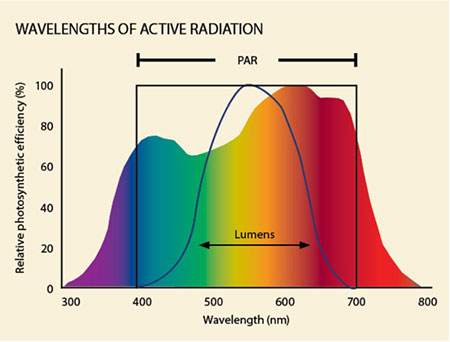
The light frequencies at which plants photosynthesise correspond broadly to the visible light.
“Few people realise that plants cannot use all the light it receives to photosynthesise,” explains Smit. The light utilised by plants to photosynthesise is referred to as photosynthetically active radiation (PAR), which ranges from 400 nanometres at the violet end of the light spectrum to 700 nanometres on the red end of the spectrum.
Traditionally, undercover farming made use of metal halide, ceramic metal halide, and high-pressure sodium incandescent lights, but light-emitting diodes (LEDs) are slowly making headway in the industry.
“LEDs are customisable and offer you a lot more control in your greenhouse,” says Adams. “You can get LED lights designed with very specific spectrum characteristics, perhaps with more red or green light, depending on what is required in your particular industry.”
Many of Adams’s clients are gradually switching from incandescent to LED lighting, as is the case with general domestic lighting. LEDs typically last longer and use less electricity, but are significantly more expensive.
“The old-school light bulbs are relatively cheap, so your cost to install them is lower, but your operating cost is higher. Which one you choose will be dictated by your finances,” he says.
Generally, high-pressure sodium lights need to be replaced every 10 000 hours or less, which is around two to three years. He says it is a little early to know whether all LEDs will last for 10 years as is claimed, but he says they are definitely much more efficient.
According to Adams, high-pressure sodium (HPS) lights are useful in South African settings because they emit a higher proportion of red light, of which plants can generally absorb more than blue or green light. In greenhouses that rely on both sunlight and artificial lighting, solar radiation usually supplies sufficient amounts of blue light radiation for the plant’s requirements.
“HPS lights are less suitable for full indoor settings because they do not emit much blue light. They also generate a lot of heat, which must be mitigated in order to maintain optimal growing conditions,” says Adams.
The industry is gradually transitioning to LED lights, with many of Vegtech’s clients replacing incandescent lights with LEDs. There is also a growing body of scientific research into how different light spectrums affect growing outcomes in a variety of crops.
The big picture
Commercial undercover farming is highly specialised precision farming in which all variables are optimised for maximum production. Lighting has to be considered within this matrix, and has to meet the needs of the crops grown in the greenhouse.
In estimating a greenhouse cultivation system’s lighting requirements, designers take into account the amount of PAR emitted by a light, which is referred to as PPF (photosynthetic photon flux), and the light reaching a specific surface is called PPRD (photosynthetic photon flux density).
The total amount of light a plant receives in a day is called the daily light integral (DLI).
“Everything in your installation must be designed to optimise lighting,” says Adams. In a South African context, where it often involves supplementing natural light, this includes the location and orientation of the greenhouse.
Due to the high levels of technology in such plants, which includes heating or cooling, irrigation and fertigation, and the monitoring of various air, water and plant parameters, greenhouses are typically designed by specialist service providers such as Vegtech, in collaboration with the various technology providers, growers, agronomists and other specialists to ensure the installation is geared towards the commodities grown.