
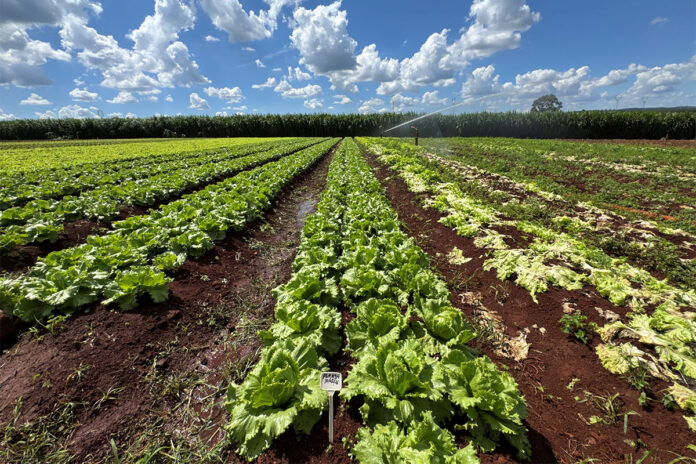
As part of the International Federation of Agricultural Journalists Mid-Term Executive Meeting in Brazil, the local guild organised a media tour for agricultural journalists. More than 50 journalists and communicators from 23 countries joined the field tours and discussions to learn more about the innovation and production systems used in the Brazilian agriculture sector.
Magda du Toit gives feedback in this feature on present-day agriculture in Brazil. Speaking to many role players, including media, government and industry officials, multi-national representatives and farmers, she found that the entire sector is dedicated to changing perspectives regarding agriculture in and outside of Brazil.
This feature covers agriculture in the province of São Paulo in Brazil. Places visited include Guarulhos, São Carlos, Araraquara, Campinas, Charqueada, Descalvado, Holambra, Mogi-Guaçu, Pirassununga and Piracicaba.
Brazil covers 8,5 million square kilometres and borders 10 of the 12 countries in South America, except Chile and Ecuador. The country represents 47% of the continent with a population of 213 million.
When talking about climate change, the Amazon forest, of which some 60% is located in Brazil, is almost always brought into the discussion. As the world’s largest and most diverse tropical rainforest, it is often described as the lungs of the planet because it absorbs and stores global carbon emissions.
Another, less popular reason is the reports of deforestation of the Amazon rainforest for the expansion of cattle and crop farming.
The story is, however, not just about agriculture growing at the expense of the environment. Brazil, frequently criticised for harming the Amazon rainforest, is making positive changes. A fact often overlooked is the effort Brazilian farmers put into safeguarding the country’s forests and supporting biodiversity. Farmers are playing a key role in finding solutions.
Brazil’s agriculture sector leads the way in no-till farming, regenerative practices, use of adapted seeds, mechanisation, and smart agriculture. As local and global challenges grow, Brazilian farmers are turning to creative approaches to cut emissions and keep productivity high.

According to Gustavo Spadotti, head of the Brazilian Agricultural Research Corporation Territorial, Brazil is committed to stopping deforestation and fulfilling its Forest Code-mandated restoration of millions of hectares of original vegetation. He says that the Atlantic Forest Connection Project serves as a model for striking a balance between meeting production demands, agricultural needs and environmental challenges.
“In addition, land degradation aspects such as soil erosion, soil compaction, salination and overgrazing are recognised as a problem, and the government is not only doing research but also working with farmers to employ plans to address this,” he pointed out.
When Brazilian farmers say they have the toughest environmental legislation in the world, they mean that every rural property in the country is required to reserve a percentage of the land for native vegetation.
The percentage of the total property that needs to be restored or preserved, if the farm already has enough forests, according to the Brazilian Forest Code, depends on the total size of the property.
The aim of the 1934 Forest Code is to protect rivers, soils and forests on private land. It requires that landowners reserve between 20 and 80% of their land for forests. If it is a large property, 20% needs to be restored; if small, a lower percentage is agreed upon. It also depends on the area. In some areas 20% is the norm, whereas in other areas close to the Amazon forest, it can be as much as 80%.
According to Spadotti, some 21 million hectares officially fall under this law, playing an important role in preserving and reinstating natural forests as well as in the sequestration of CO2 from the atmosphere.
This protection plan not only aims to preserve and restore native vegetation but also focuses on incorporating sustainable land-use methods to improve agricultural output.
He explains that the Brazilian government considers riverbeds and freshwater springs as well as other ecologically sensitive areas as property of the state and the society, even if these areas are located on someone’s private land. The law states that the landowner is allowed to use the land, though it still ‘belongs’ to society and it therefore deserves to be protected or restored.
In addition, the Brazilian government, local communities, and a broad coalition of partners have launched the ARPA Comunidades initiative, signalling a new chapter in Brazil’s ongoing commitment to protecting the Amazon. This project builds on the achievements of the original Amazon Region Protected Areas (ARPA) programme, which was the world’s largest tropical forest conservation effort and prevented more than 104 million tons of CO₂ emissions.
The ARPA Comunidades initiative seeks to bolster protection for nearly 60 million acres (about 25 million hectares) of sustainable-use protected areas and establish an additional 7,4 million acres (3 million hectares) of new reserves, directly supporting over 130 000 people.
Farmers are thus not only helping forest regeneration, but they are also still maintaining productivity while encouraging biodiversity and the use of fewer chemical fertilisers.
According to Spadotti, the future holds many opportunities.
“Our role will be even more relevant, but we must continue to evolve, adapting to new demands and using the most advanced technologies to support Brazilian rural producers.”
Wild animals in orange orchards
It’s not only trees that are important to the government and farmers of Brazil. In a survey on biodiversity carried out by Embrapa Territorial and the Citrus Defence Fund financed by the Innovation Fund for Farmers, more than 300 species of wild animals have been identified on orange farms in the states of São Paulo and Sudoeste/Triângulo Mineiro.
Spadotti notes that jaguars, ocelots, monkeys, maned wolves and coatis are some of the 28 species of mammals of Brazilian fauna found on five farms in the so-called Brazilian citrus belt. Bird species are even more abundant, with 268 species counted, of which some are under threat of extinction, such as the aracuã-guarda-faca, the curassow and the curió.
Land degradation
Degraded pasture recovery is part of the voluntary commitments of Brazil in the 2009 United Nations Climate Change Conference in Copenhagen (COP15).
According to Spadotti, 20% of the country’s 180 million hectares dedicated to pasture suffers severe degradation and another 40% moderate degradation. These findings from an Embrapa study were also published in the scientific journal Land in 2024. (visit shorturl.at/yWwUb).
The study, however, found that some 30 million hectares have the potential to be recovered through methods such as combining livestock, crops, and forestry production, adaptation to low-carbon agriculture, or other practices.
“Embrapa is committed to combining livestock, crops, and trees to turn around a sector,” Spadotti said.
“Our scientists maintain that livestock can go from being part of the problem to being part of the solution. The biggest problem is to explain the concept to farmers, as changes will affect their businesses. Embracing sustainable livestock farming requires investment, planning, and a long-term strategy,” Spadotti emphasised.
The recovery of degraded pastures for sustainable agricultural production is one of the greatest opportunities to increase national agricultural production with no need for converting more natural vegetation areas to fields for crop production.
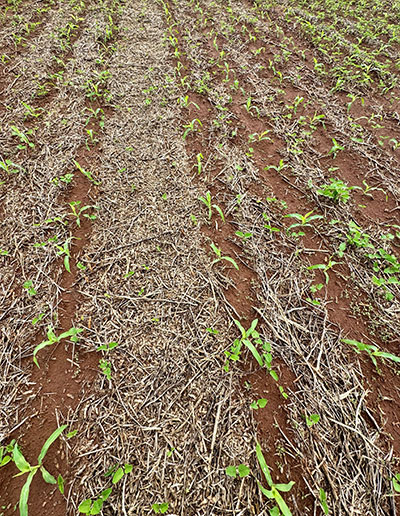
No-till practices
What people sometimes forget is that Brazil was one of the pioneers in no-till farming. With no-till, farmers avoid ploughing and instead plant seeds directly in the stubble of the previous year’s crop. No-till cropping is beginning to be extended to cover some 140 000km of Brazilian farmland.
Other projects
At Embrapa’s 32 research centres and 192 farm units working on the low-carbon initiatives, the researchers are looking at capturing methane emissions from pig manure to make biogas, as well as to reduce nitrogen fertiliser use by engineering new strains of nitrogen-fixing bacteria.
There are also many farmers who not only practice regenerative agriculture, but who also make time to share their efforts and research with the general public. One such farmer is Ribeirão Feijão.
At Escolada Floresta, he established a forest school where children and the general public can learn more about regenerative agriculture. When visiting, visitors have the opportunity to learn about the importance of environmental preservation through exhibition models, interpretive trails, a nursery, a trail of the senses, as well as talk to the owner.
For more information, viisit Escolada Floresta at escoladafloresta.com.br, or the Brazilian Agricultural Research Corporation at embrapa.br.