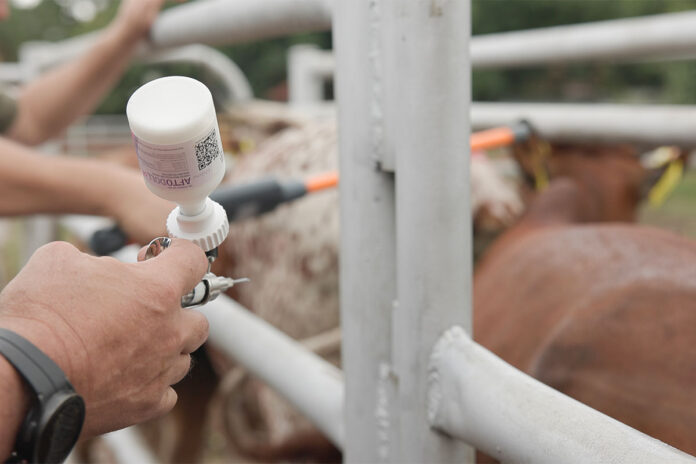
The platform was demonstrated on 17 July in Koedoespoort, Pretoria, during a training session for invited private veterinarians. Among the attendees were Dr Shaun Morris, a veterinarian and CEO of private practice Octavoscene, and Lizelle Cloete, who manages vaccine ordering and administrative support at the practice. Octavoscene was invited to test the proposed workflow and provide practical feedback ahead of the programme’s implementation.
The demonstration followed the landmark agreement reached on 9 July allowing private-sector participation in the importation and distribution of FMD vaccines under prescribed conditions, marking a significant shift in South Africa’s approach to controlling the disease.
Representatives of Dunevax and Buffalo Analytics met with Minister of Agriculture Willie Aucamp, Department of Agriculture (DoA) Director-General Mooketsa Ramasodi, and senior DoA officials on 16 July to discuss the implementation of the new vaccination framework.
The meeting established a practical process linking farmers, veterinarians, state veterinary services, Dunevax, and Buffalo Analytics through a controlled system intended to support vaccine access, veterinary oversight, and digital traceability.
During the meeting, Aucamp said government wanted to remove unnecessary bottlenecks because, “we understand the urgency of the situation”, adding that the new arrangements would make vaccine importation and distribution “better and quicker”.
How the system works
Dr David Pretorius, CEO of Motsumi Darts and developer of the Buffalo Analytics platform, and Dr David Gerber, founder and CEO of Dunevax, demonstrated how the system manages the vaccination process, from vaccine ordering to regulatory reporting.
Farmers begin by registering on the platform, where they capture their farm details, nominate their veterinarian, and accept the terms and conditions. One of the key requirements is that farmers consent to sharing vaccination data with the DoA. All vaccines administered must also be recorded by scanning the QR code on each vial.
Once a farmer submits a vaccine request, it is automatically routed to the nominated veterinary practice. The veterinarian reviews the request, confirms that the regulatory requirements have been met, and approves the order.
After payment is received, the vaccines are delivered to the veterinary practice. Before the practice releases them to the farmer, the veterinarian records the farmer’s details, the farm’s details, and the number of cattle to be vaccinated on the platform. This automatically notifies the DoA of the planned vaccination, helping to ensure compliance with the requirement that authorities are notified before animals are vaccinated.
QR codes provide traceability
The platform continues to track each vaccine dose after delivery. Each vial carries a unique QR code that is scanned during vaccination, confirming where the vaccine was administered and linking it to the registered farm.
According to Gerber, the information is uploaded immediately, allowing vaccination records to be submitted electronically while reducing paperwork.
He explained that if the required information is not submitted or QR codes are not scanned, the system flags the omission and can suspend further vaccine purchases until the outstanding information has been provided.
The platform can also generate reports for the DoA, display vaccination dashboards, monitor vaccination coverage, analyse disease trends, and automatically remind veterinarians when booster vaccinations are due.
Gerber said traceability lies at the heart of the system.
“The QR code provides proof that the vaccine was used where it was intended to be used,” he told Farmer’s Weekly.
The digital records also enable vaccination trends to be analysed geographically and compared with disease outbreaks, while helping to monitor compliance with reporting requirements.
A simple system
After completing the training, Morris described the platform as practical and user-friendly: “I’m not a computer person, but the process is simple and easy to follow.”
He added that producers who are unfamiliar with digital systems could easily be assisted by their veterinarians or practice staff.
“The complexity is not the software. The important part is complying with the rules.”
According to Morris, farmers need only adhere to three rules: register on the platform, ensure vaccinations are correctly reported, and scan every vaccine’s QR code during administration.
“If those requirements are followed, the process should work,” he added.
Administration support for farmers
Some farmers have raised concerns that the additional registration and reporting requirements could create an administrative burden.
Cloete, however, believes farmers will adapt quickly.
“Loading the initial information onto the system will take a little time, but once the farm has been registered and authorised, everything becomes much easier,” she explained.
She stressed that producers will not be expected to navigate the process alone.
“The important thing is that farmers should not be intimidated by the administration. We will assist them through the process. They won’t have to manage everything on their own.”
According to Cloete, the reporting requirements have been incorporated into the platform itself.
“The reporting to the Department of Agriculture is built into the system. As long as farmers follow the rules, the process should work smoothly.”
She believes producers will embrace the system once it has received final approval from the DoA.
“If we suddenly had 3 000 farmers wanting to register tomorrow morning, I would welcome it with a smile. This is one of the most positive developments we’ve seen for the livestock industry in a long time.
“More than anything, it gives the industry hope again.”
What this means for farmers
Morris believes government’s decision to allow greater private-sector participation in FMD vaccine importation and administration represents a significant step forward for the livestock industry.
He said that one of the key advantages is that producers will now be able to plan booster vaccinations more effectively.
“In areas with very high infection pressure, a booster vaccination three to four weeks after the initial vaccination can provide substantially stronger immunity than a single dose,” he explained.
He described vaccination as a relatively small investment compared with the financial losses caused by an FMD outbreak.
“Considering the value of today’s livestock, vaccination is good insurance.”
Morris stressed that veterinarians will continue to play a central role in advising producers on vaccine selection and timing.
“There will be different vaccines available over time, and veterinarians will continue advising their clients on which vaccine best suits their circumstances.”
He also welcomed greater competition among suppliers.
“Competition is healthy. Companies should compete on the quality of their vaccines and the science supporting them.”
Morris also praised Aucamp for the approach he has adopted, saying he believes the minister has made important progress within a relatively short period.
“This minister is trying to solve the problem. He has only been in office for a short time, but we’ve already seen major strides in the right direction. He has recognised that there are people in the private sector with the expertise and capacity to contribute to the solution.”
He added that veterinarians now have an important responsibility to encourage producers to participate in the vaccination programme.
“Every veterinarian needs to convince their farmers that this is the right way to go. Vaccination is an investment in protecting the value of the herd and reducing the impact of foot-and-mouth disease.”
According to Morris, the priority should be ensuring that South Africa has access to sufficient vaccines.
“Manufacturers overseas have many other markets. If South Africa does not make use of available vaccines, other countries will.”
He added that FMD is becoming increasingly prevalent internationally.
“Nobody is waiting for South Africa. We either make use of the available solutions, or we fall further behind.”
Digital records could strengthen disease control
Gerber said the Buffalo Analytics platform was designed to do more than facilitate vaccine sales.
By creating a digital record of every vaccination through QR-code scanning, batch-level reporting, and automated compliance checks, the system is intended to improve traceability, strengthen regulatory compliance, and provide government with real-time information on vaccination coverage and disease control.
Dunevax and Buffalo Analytics explained that these capabilities form part of the implementation pathway discussed with Aucamp during the 16 July meeting, during which the minister had said government’s priority is not which company supplies vaccines but rather ensuring that enough doses reach livestock producers as quickly as possible.
“We’re not going to get involved in any competitions. I just want to see vaccines coming into the country, going to farmers, and getting into cattle as soon as possible,” Aucamp said.
He urged importers to make full use of the new framework to accelerate vaccine availability.
Hope for a new phase of FMD control
Morris believes the combination of improved vaccine availability, digital reporting, and greater private-sector participation gives South Africa an opportunity to accelerate its national FMD vaccination campaign.
“The technology is there. Now it’s up to veterinarians and farmers to use it properly. If everyone follows the process and vaccinates their animals, we stand a much better chance of bringing the disease under control,” he concluded.