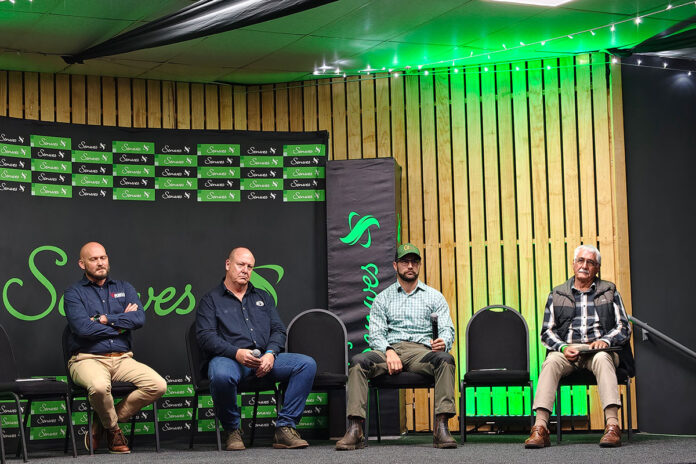
Discussions revealed broad support for stronger disease control and greater access to export markets, but little agreement on how to achieve these goals.
Participants debated how to win farmers’ support for vaccination and traceability, pay for implementation, and give producers a meaningful say in decisions.
They agreed to consolidate shared points in a written statement for review and endorsement. Representatives would then discuss the proposals with their members and regional structures before taking them forward nationally through their organisations. Requests concerning the Department of Agriculture (DoA) would ultimately be directed to the minister of agriculture.
Calls for management changes
AgriSA CEO Johann Kotzé urged industry representatives to raise their concerns about state animal health management collectively with the agriculture minister. He said confidence in the existing management had been damaged and called for changes that would bring a different approach to the challenges facing the sector.
Kotzé’s comments followed accounts of delays in accessing foot-and-mouth disease (FMD) vaccines, difficulties securing export approvals, and barriers to cooperation between departmental officials and industry specialists.
Dewald Olivier, CEO of Red Meat Industry Services (RMIS), said industry experts were expected to help secure export access without full access to the DoA’s correspondence with trading partners. They could participate in discussions but were not allowed to see certain emails, including what had been communicated and to whom. This made it difficult to identify outstanding requirements and help resolve delays.
Olivier also questioned the handling of the FMD outbreak, arguing that some decisions imposed damaging consequences on producers, feedlots, and abattoirs. He added that even where a decision can be defended on technical grounds, its economic effects across the value chain need to be considered.
He called for a public–private partnership that clearly defines what government and industry will each undertake, adding that industry specialists need to be included in the relevant discussions and given the necessary information to help prepare and implement the work.
According to Olivier, government would retain its official signing role, while industry expertise and capacity supported the processes needed to secure market access.
Giving producers a say
Accountability within the industry also came under scrutiny.
Pieter Meyer, chairperson of the Red Meat Producers’ Organisation (RPO) in the Free State, argued that existing structures are not adequately connecting industry decisions with producers’ needs. Although the RPO is represented across the country, farmers do not necessarily feel that their views influence its work.
He called for a stronger bottom-up approach, citing Meat & Livestock Australia’s producer consultation process and arguing that regional producers should help set priorities and review proposed projects.
Meyer also wants farmers to see tangible benefits from levy expenditure. Mentioning an estimate that the Free State holds between 25% and 28% of South Africa’s cattle, he argued that a corresponding proportion of spending should benefit the province, directly or indirectly.
As an elected representative, Meyer said he needed to go back to farmers and demonstrate what their representation had achieved.
Rebuilding trust
Free State Agriculture (FSA) President Francois Wilken argued that securing participation in the red meat industry requires leaders to rebuild the trust damaged during the FMD crisis.
He linked this distrust to difficulties obtaining vaccines and divisions over FSA’s efforts to secure access to them, which ultimately led to court action.
According to him, a united industry response could have helped secure access sooner. However, the FSA had encountered opposition and found itself being treated as an adversary.
The industry now faces another problem: farmers who were willing to pay for vaccines when the threat was immediate have become harder to persuade.
Wilken urged leaders to listen to farmers beyond formal meetings. Many farmers are more comfortable explaining their concerns in conversations on their farms than in front of an audience. Leaders need to understand those concerns, explain the benefits of participation, and use trusted people to spread the message.
He supported traceability but questioned attempts to resolve years of delays by imposing requirements during a disease crisis, explaining that unclear guidance and pressure to comply risk creating further resistance.
Wilken said calls for unity will achieve little if cooperation means accepting one organisation’s terms, adding that a common approach is needed to accommodate different views.
Leading towards a shared vision
Kotzé argued that listening to farmers carries a responsibility to lead them towards the industry’s shared vision.
Where farmers resist vaccination or traceability, representatives need to explain why these measures are necessary to achieve agreed upon growth and export ambitions.
Leaders weaken their role when they adopt resistance as their own position and present it as representation, he warned. Understanding producers’ difficulties must be accompanied by a willingness to challenge views that prevent progress.
Kotzé called for communication in both directions: farmers’ concerns should inform decisions, while leaders should take the agreed vision back to producers and help make their participation practical and affordable.
This includes working to secure affordable vaccination and effective systems, while building support for their use.
Giving farmers a reason to participate
Dr David Gerber, founder and CEO of Dunevax Biotech, proposed market incentives to give farmers a direct financial reason to vaccinate and practise traceability and biosecurity.
He said discussions had been held with feedlots and auctioneers about rewarding documented vaccination and traceability. Animals accompanied by veterinary certification of vaccination against specified diseases, including FMD, could attract a premium.
This would make the benefit visible at the point of sale and give buyers a role to play in encouraging better animal health management.
Other contributions proposed that buyers require health records and traceability before purchasing animals.
Some contributors argued that voluntary participation could leave the wider industry exposed to farmers who chose not to vaccinate or follow biosecurity requirements. They favoured compulsory vaccination to secure broad participation.
Gerber cautioned that legislation alone will not ensure compliance. Referring to vaccination against other livestock diseases, such as brucellosis and lumpy skin disease, he highlighted the gap between a legal obligation and what really happens on farms.
Questions about how legal obligations, buyer requirements, and incentives should work together, and who should pay, went unresolved.
Matching funding to the plan
The debate over participation was closely linked to whether the industry has sufficient resources to deliver its strategy.
Olivier defended the progress made while acknowledging that implementation is behind where RMIS would like it to be. He described the Red Meat Industry Strategy 2030 as a continuing process and urged the industry to build on existing structures and systems.
He said a traceability platform is in place, although he conceded that the plan has not been communicated adequately.
Participants questioned whether the proposed increase in the red meat statutory levy would provide enough money to deliver the work expected of RMIS. Calls were made to reconsider the increase against a costed implementation plan and to explain to producers what their contributions would achieve.
Olivier said the levy application, which was awaiting final approval at the time of the event, provided for only a 5% adjustment for the next four-year period. He added that this is lower than the previous 6% adjustment and reflects decisions taken through the industry’s representative structures.
While some role players opposed the adjustment, several people argued that it is not enough to realise the industry’s growth plans and vision.
Olivier said the adjustment could be reconsidered after 12 months but would require organisations to consult their members, secure agreement through the relevant structures, and submit the necessary application.
No revised levy amount was agreed on at the event. The proposed way forward was to take the funding concerns back through representative structures for consideration.
Industry encouraged to build on gains
Estelle van Reenen, CEO of Sparta Group, urged participants to build on the industry’s achievements while addressing its shortcomings.
Drawing on the business’s experience of successive FMD outbreaks, she said access to vaccines had been critical to its ability to withstand another outbreak. Industry-funded research had also helped ease some of the restrictions and losses associated with managing the disease.
She argued that the benefits extended to producers selling calves. Vaccine availability gave feedlots greater confidence to continue buying calves at prevailing prices despite the risks they faced.
Van Reenen acknowledged failures in the state’s response but urged participants to focus on what is needed to move forward. She added that RMIS has a limited budget, and the industry needs to decide how to fund the work it expects the organisation to deliver.
Clear guidance and accountability
Questions about tag choices, equipment costs, and the transfer of information between traceability systems exposed gaps in communication with producers. Some concerns were disputed during the discussion, highlighting the need for clear, practical guidance on what farmers are expected to do.
Participants also called for a clear division of responsibilities between farmers, government, and industry organisations so that they could all be held accountable for their parts.