
From the shebeens of Soweto to the fine dining establishments of Sandton, the wines of the Breede River Valley need no introduction. Whether it is the iconic and budget-friendly Four Cousins range or the premium offerings from Van Loveren, Springfield or Goedverwacht (to name the producers I managed to visit on a short one-day reconnaissance towards the end of June), the region has established itself as an important player across the diverse and dynamic South African wine landscape.
When in mid-May 2026 a series of intense cold fronts triggered a historic deluge across the Western Cape, the Breede River Valley experienced its most catastrophic flooding in over a century. At its peak on 13 May, flow rates exceeded
2 000m³/second, causing widespread devastation to farming valleys, towns and infrastructure.
With the river level rising by over 7m, grape growers and wine estates in the Robertson, Slanghoek Valley, Rawsonville and Bonnievale regions suffered extensive damage.
Jenna Bruwer Kruger, spokesperson for Springfield Estate, gives an interesting statistic: “Our region has experienced four devastating floods in 1 000 days from June 2023. We accept climate change as a reality and we’ll need to adapt to more unpredictable weather patterns in future.
While Robertson bore the brunt of the flood, we only received 14mm of rain during the flood, with rainfall totals in the Slanghoek Valley, less than 100km away from us, exceeding 700mm.”
According to Robert du Toit, marketing manager of family-owned Goedverwacht Wine Estate close to Bonnievale, the flood was without a doubt the biggest in living memory, and could be defined as being of ‘Biblical proportions’ in his view.
“Nothing we did or could have done would have given us any indication of the scale and magnitude of what was to transpire and how powerless we would stand against the might of this storm.
“It gives you a new perspective on life as you witness the destructive force of the flood sweeping away infrastructure, including roads, bridges, vineyards, tanks and buildings. That said, we have a lot to be thankful for, especially the fact that no harm came to any of the families living on our farm,” says Du Toit.
Nature’s overwhelming power
Phillip Retief, CEO of Van Loveren Family Vineyards, which employs more than 600 people and exports wine to over 70 countries, echoes the sentiment of nature’s overwhelming power. Reflecting on the flood, he says: “The biggest lesson we learnt was to stay calm. In the immediate aftermath, there’s pressure to solve everything at once, but the best decisions come from taking a step back, assessing the situation objectively and working through the recovery one priority at a time.”
Bruce Jack, an internationally recognised winemaker who is involved with production of his eponymously named range of wines at the Uniwines Winery in the Breedekloof, is deeply concerned about the impact of the flood on many of the grape growers and wine producers in the area.
“This flood could not have come at a worse time. There are farmers who have been knocked down too hard; I do not know whether they will be able to stand up after this.
“Some of these people have been farming for generations, and they are already under huge financial pressure due to the current low price cycle. This is not the time for large buyers to go in with hardcore negotiation strategies. These farmers need to be paid more if they are to survive this disaster.”

One of the worst affected producers is the gargantuan Van Loveren Family Vineyards with approximately 1 000ha of vineyard under management, and an annual production of over two million cases of wine.
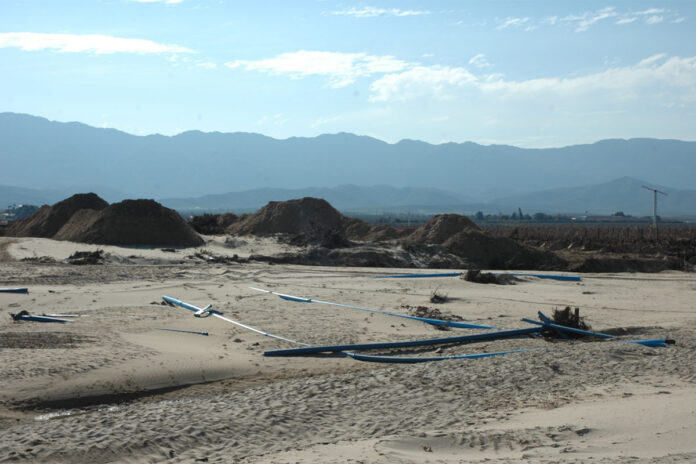
Marili McElhinney, marketing manager for the business, says: “Among the most devastating impacts of the flood was the permanent loss of approximately 50ha of vineyards. In these areas, productive vineyard land was transformed by floodwaters that stripped away fertile topsoil and left behind vast deposits of river rock and sand, making the land unsuitable for vineyard production in its current state and considered a permanent loss.
“Apart from damage to our vineyards, we also had damage to irrigation systems, access roads, and operational equipment.
“The flood also damaged key production assets and infrastructure within our cellar, including pumps, cooling systems, electrical equipment and other essential winery machinery required for daily operations.”
Bridges over troubled waters
Three major bridges were destroyed by the floods, including the Smalblaar River Bridge, which links the town of Rawsonville with the Goudini region and the surrounding N1 highway, the Rooibrug Steel Bridge, which links Robertson and Bonnievale, and the McGregor Bridge.
While Western Cape Premier Alan Winde optimistically declared that the target date for the reopening of the McGregor Bridge would be 6 June, the opening has since been postponed to August due to assessments during reconstruction revealing severe, previously hidden structural damage to the bridge’s walls.
Consequently, structural engineers ruled that these sections must be fully rebuilt before the remainder of the repair work and asphalt layers can be safely completed. For farmers and commuters, the destruction of this bridge has led to extensive round-trip detours of up to 70km.
The Western Cape Department of Infrastructure expects permanent repairs to the Smalblaar River and Rooibrug bridges to take 12 to 18 months, and for the time being, all vehicles have to take extensive detours, leading to increased logistical and agricultural transport costs.
Bottles of hope
At Van Loveren, the flooding also caused extensive damage to warehouse facilities and stock holdings, and it is estimated that more than one million bottles of wine were damaged when floodwaters swept through the main storage facilities.
With this volume of labelled wine getting damaged and the difficult conditions experienced in the production facilities, Van Loveren partnered with Food Lover’s Market to launch the ‘Bottles of Hope’ campaign.
The initiative offers a selection of wines across the Retief, Four Cousins, Rhino Run and 7Hills ranges at a special price of R100 for any three bottles, giving consumers access to exceptional wines while supporting the producer’s recovery.
Another initiative by Van Loveren is to offer flood-damaged wines online at discounted prices with a special tag attached to commemorate the flood and its impact on the Robertson Valley.
It takes a village
Asked about the response received from the greater community, McElhinney says she was astounded by how quickly people came together.
“The outpouring of support from the Robertson community and beyond was truly remarkable. Local organisations such as LC3, neighbouring farms, community members, volunteers and organisations including Gift of the Givers arrived with food parcels, blankets, warm clothing and practical supplies.
“Local businesses lent equipment to assist with the clean-up, while neighbours and local stores donated meals to keep our teams going during the recovery effort. We also saw staff helping one another, even when some were dealing with
flood damage to their own homes.
“Suppliers, customers and industry partners from across the country reached out to offer assistance, advice and encouragement. In a time when the devastation felt overwhelming, it was the kindness and generosity of people that reminded us we weren’t facing it alone.“
McElhinney is not alone in expressing this sentiment. Bruwer Kruger recounts the story of an elderly lady living in Robertson who brought a bouquet of flowers to Springfield to commiserate.
An emotional toll
While the most direct result of this kind of devastation may be financial and infrastructure loss, there is also an emotional toll that may be harder to articulate.
“Events of this nature can cause considerable emotional strain. We recognise the importance of supporting the well-being of our team and have made assistance available through professional support partners should any employee require counselling or mental health support during the recovery process,” says McElhinney.
Rudolph Scharneck, minister of the Dutch Reformed Church in Goudini, says he has encountered what could be defined as a type of post-traumatic stress disorder taking hold of business owners in the area.
“Employers are really worried about their employees and do not want to have to start laying off workers. They are doing everything in their power, even if this means selling off assets, just to keep their doors open.”
While it may sound counter-intuitive, some advise producers to leave their farms for a good amount of time after such a disastrous events so as to ‘switch off’. Others recommend that farmers should get involved by talking about their experiences with other producers and to find stress relief from outdoor activities and hobbies.
In more serious cases, trauma-focused therapy and psychological counselling can also be valuable to diminish distressing emotional responses, and to assist in confronting triggers to build sustainable, healthy coping mechanisms.
The way forward
Many of the producers of the Breede River Valley have had to close their wine-tasting venues, leading to a massive drop in cellar door wine sales. For example, at Viljoensdrift, which is popular for its wine tasting aboard a flat-bottomed river boat named Uncle Ben 2, the wine-tasting area will likely only reopen for visitors on 1 November.
Robert du Toit, chief marketing officer at Goedverwacht Estate, says it would be naive to think that similar floods could not occur again in the near future.
“We will have to learn to do more with less and ensure that we find ways to operate in partnership with nature. While we cannot physically move our winery, we could look at moving certain aspects of production and storage to higher ground.
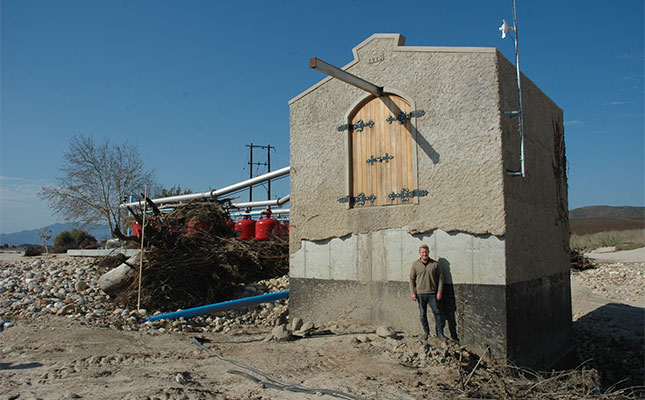
“We also need to improve the anchoring of our outdoor tanks; one of them was found washed down the river all the way to Bonnievale.”
According to McElhinney, the best way to support the affected farms is to make a point of buying their wines from retailers and in restaurants.
After replanting vineyards wiped out in the floods of 2023 and 2024, only for these vineyards to again be destroyed by the 2026 flood, Pieter ‘Boy-Boy’ Bruwer of Springfield admits that it would be pragmatic not to necessarily replant some of these vineyards at he same spot. However, he adds that “humans have short memories”.
While looking over the devastation of some of their most prized vineyards, Bruwer says: “After the previous floods, we had just managed to return to a semblance of normality. The vineyards were looking beautiful. The cover crops were green and lovely. A week later, three years of toil and labour were wiped out completely.”
While estimates have been done regarding the costs to be incurred to restore electricity, irrigation pipelines, buildings and equipment, it is the damage to vineyards that is most devastating.
Timeline of the Breede River flood events
While the scale of this flood is unprecedented in modern times and has been described as the worst flood in over a century, the past decade has seen an increase in more regular flood activity, with floods in May 2021 (peak flow of 740m³/second), June 2023 (1 350m³/second), September 2023 (1 787m³/second) and July 2024 (1 688m³/second).
While the South African Weather Service (SAWS) warned of the impending floods some time in advance, there was very little farmers could do to fully prepare for the impact.
Below follows a timeline of the event:
10 May (Sunday) to 11 May (Monday)
- The SAWS issued high-alert warnings for the Western Cape as the first cold front made landfall.
- An extreme deluge hit the region, with the Ceres Automatic Weather Station recording an astonishing 333,2mm of rain in a single 24-hour period on 11 May.
12 May (Tuesday)
- Persistent downpours caused the Breede River and its tributaries, such as the Hex River, to swell rapidly. Evacuations were initiated in low-lying areas.
- Vineyards, orchards, and croplands in the Hex River Valley, Worcester, and Robertson began taking on massive amounts of water, causing early agricultural damage.
13 May (Wednesday)
- At 6am, the Department of Water and Sanitation’s H7H006 hydrological station in Swellendam recorded a massive 7,04m rise in water levels and a flow rate of 1 990m³/second.
- Severe storms compromised the Stettynskloof water pipeline, completely cutting off the water supply to the eastern areas of Worcester.
- The swell eventually peaked, with some accounts estimating the rise reaching 11,01m before the measuring station itself was washed away. Aerial reconnaissance confirmed the river was at its highest point in over 100 years.
May 14 (Thursday)
- Following the peak, floodwaters started receding in the Overberg district and areas downstream.
- The Western Cape government reported widespread displacement. Humanitarian groups, including Gift of the Givers, deployed to provide hot meals, blankets, and temporary shelter for thousands of displaced residents.
Mid to late May
- Preliminary agricultural assessments revealed massive financial losses, with the pome and stone fruit industry alone estimating over R6 billion in potential damage.
- Disaster management teams worked to restore electricity, cellular networks, and washed-out roads in cut-off towns like McGregor and Vredendal.