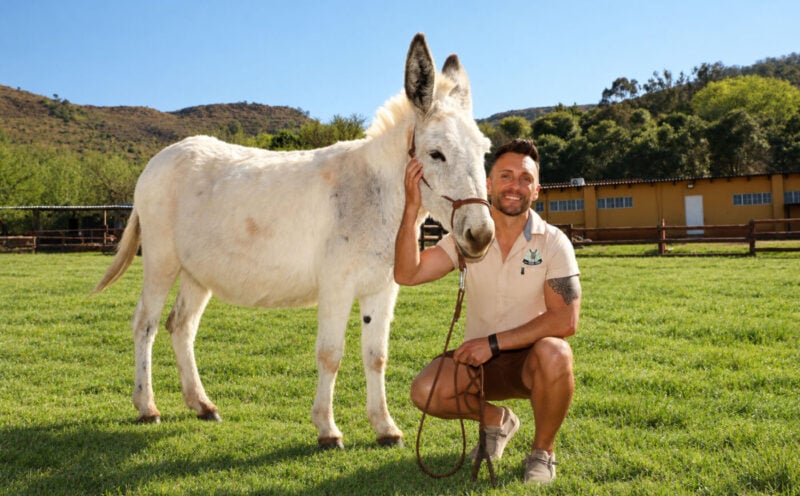
There is a thing or two that Magaliesburg farmer Jesse Christelis could tell you about necessity being the mother of invention. In what could be described as an idiom of our time, it involves turning post-pandemic adversity into opportunity. But the founder and owner of The Donkey Dairy is more humble in his assessment.
“It’s all about healing,” he says.
Swapping Joburg city life for the calm of the country back in 2011, his initial plans were to live sustainably, farming vegetables and sheep, until the jackals attacked his flock.
Learning that donkeys are natural guardians of other livestock led him to an equine abattoir, where he saved two jennies, Betsie and Saartjie, from a certain fate. Little did he know that his act of necessary kindness would pay back dividends.
Expanding the range
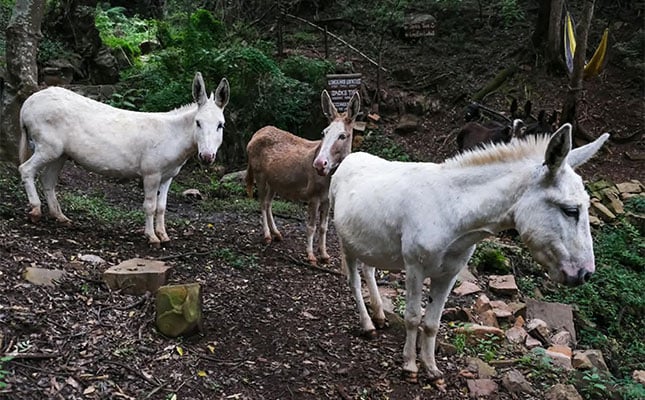
Now, another 145 donkeys later (with Betsie still there to bear witness to all that has happened) South Africa’s only agricultural concern of its kind is braying with a brilliant new product range.
It includes shampoos and conditioners that exclude sulphate cleansers and synthetic preservatives usually prevalent in skincare products.
“We’ve paired it with donkey milk and with natural oils that help to heal and soothe the scalp. It’s even been found to regenerate follicles, stemming hair loss and encouraging regrowth,” says Christelis.
Soaps and creams, the first spin-off range following the original bottle-freezing of lactose-friendly, nutrient-rich donkey milk, has now also expanded into baby lotion.
“The skin is our biggest organ and we absorb so much into our body through our skin. For babies to have a chemically based product is not the greatest start for them,” he says.
“That’s why I’m super excited about what we’re doing for infants.”
An ancient skincare legacy
Christelis’s faith in the gentleness of donkey milk, with “the perfect pH for tender skin”, is backed up by anecdotes from antiquity.
Had it not been for taking daily baths in donkey milk, Caesar might have liked Cleopatra a little less. And Emperor Nero, it’s said, favoured second wife Poppaea Sabina above Octavia and Messalina, maybe because her skincare regime involved travelling with a herd of about 500 donkeys wherever she went.
That’s a bit of a magic number for Christelis too, as he says it’s where he would like to scale his business over the next three years, growing his enterprise through volume expansion.
“Donkey milk and the various creams we have – night, day, skin and hands – was the range we had for about 10 years.”
Although it’s what kept The Donkey Dairy going initially, the logistics behind ‘the liquid gold’ coming out of North West had taken its toll.
“We were bottle-freezing milk because we didn’t want to use plastic that can leach BPA (bisphenol A) into our product,” says Christelis.
“But the cold-chain requirements of sending product to clients across the country were costing us. Once frozen, bottled milk has a shelf life of six months, but once opened, it has to be consumed in three days or less to have the benefit of its health contents (retinal and vitamin C, among others).”
Adapting through adversity
Then came COVID-19. Christelis says not being able to send supplies to stockists during lockdown was the impetus behind offering accommodation on the farm, to encourage on-site visits and ongoing exposure to the farm’s produce.
“It was tough, very tough.”
And yet, as he says in a promotional video, “something’s only worth doing if it seems impossible”.
Ongoing efforts to ratchet up research and extend output diversification led to powder milk options. One of these was a technique called spray drying. “That’s where they heat up the milk, but it denatures it, stripping the probiotic properties out of the milk and the lysozyme (an antibacterial enzyme giving donkey milk its health kick).
“We didn’t want that. We wanted to protect the integrity of our product.”
Further research took Christelis back to Europe, where his initial look-around into donkey milk farming began. The freeze-drying technique he saw on his last visit led to the acquisition of expensive technology enabling the farm to put donkey milk powder in a 480mg veggie cap, and the results are astounding, Christelis says.
“For about a year we were running trials on people suffering from eczema, psoriasis and auto-immune diseases. We were treating people with four capsules in the morning and four at night, and the turnaround in their health was amazing to see.
“When we dropped the treatment down to two capsules twice a day, people were still reporting excellent results.”
He says a woman with an extremely rare autoimmune disease, who even tried chemotherapy to treat the painful sores she was suffering from, is now in full remission since she started taking donkey milk capsules.
Christelis claims that studies in Europe involving donkey milk powder treatment for lung cancer are also delivering positive results.
“Freeze-drying our milk has just opened up so many opportunities for us, helping us to keep our product pure and pristine,” he emphasises.
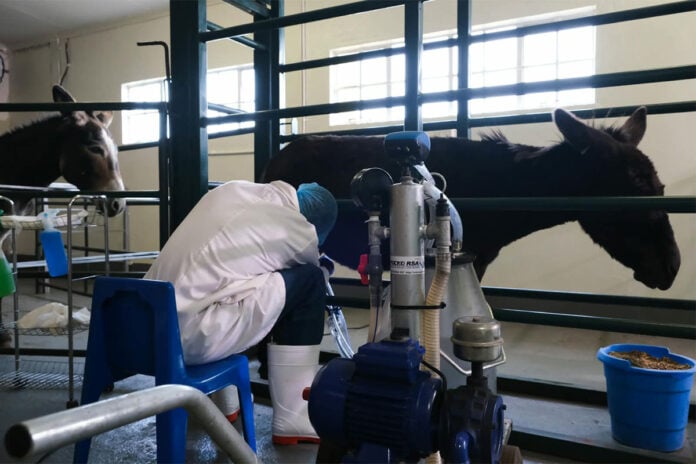
Drinking water from a mountain spring, aptly called Brayer’s Eye, and supercharged by quartz crystal as it trickles down the slope, means the donkeys are sustained by the best nature has to offer. Christelis also makes the point that donkeys have to be in a state of contentedness to let their milk down.
“If donkeys are stressed and they don’t have oxytocin, they won’t release their milk, even if their udders are full.”
He explains that jennies, unlike cows, aren’t separated from newborn foals, as this leads to stress.
“And we don’t take milk in the first two months of foaling. Only later on do we start taking milk from our jennies. Donkeys also stay in foal for up to 14 months, so you’re lucky if in a three-year period you get eight months of production.”
Christelis says one of his workers, Virginia Mudzingwa, was actually employed because of her conversational manner with the donkeys.
“She talks to them in a certain way, and it keeps them chilled and the milk flows.”
Compared with dairy cows, which can produce about 40ℓ per animal per day, a donkey’s daily offering isn’t much, amounting to about 250ml.
“That’s why it’s so expensive. But also, you only need about 30ml to 60ml of donkey milk a day to benefit from its health properties.”
The very reason Christelis wants to scale his herd to about 500 (based on successful high-yield donkey farming research conducted in countries like Cyprus) is anticipated demand growth.
He says they have received interest in their product from as far afield as South Korea, and have already exported there.
“But at the current volumes we’re running, it’s not feasible. Donkey farming in South Africa is simply not on the same level as production in Europe.”
To get to that point, Christelis has added another 50ha to the farm’s original 34ha.
He acknowledges that it’s going to take time and cost, adding that they had been approached by an investor.
“But I didn’t like what he was proposing, so I turned it down. In the meantime we have the banks helping us, who initially laughed at me when I was asking for loans.
“[But] now the banks see the value in what we’re doing, the employment we’ve created and the market potential of our products,” he says.
What initially seemed like a beast of burden he had created for himself is now the reason why Christelis can raise a toast to himself – with a donkey milk liqueur.
Disclaimer: This article is for informational and educational purposes only and is not a substitute for professional medical advice, diagnosis, or treatment. We do not recommend or suggest that readers change, alter, or start any health regimens, dietary supplements, or medical treatments without first consulting a qualified healthcare professional or doctor.
For more information, visit thedonkeydiary.com.