Historically, 1977 is viewed as one of the most disastrous vintages in the history of modern Cape winemaking.
Viticulturists had to contend with a harvest that was notoriously wet, cold, and plagued by severe Peronospora (downy mildew).
However, winemakers waiting for the grapes to ripen could find solace in the fact that the British-US rock band Fleetwood Mac released their new album, Rumours, on 4 February.
The album would spend a staggering 31 weeks at the top of the charts in the US and remains one of the best-selling albums of all time, driven by the hit single ‘Go Your Own Way’, which became a firm favourite and an anthem played in the wineries of many new-wave independent producers.
The early 20th century saw the establishment and growth of massive wine co-operatives, with the largest of them, the KWV (Koöperatieve Wijnbouwers Vereniging van Zuid-Afrika), being created in 1918 to stabilise the market and increase exports.
Until the creation of these co-operatives, winemakers worked for their family estates, often taking responsibility for general farming duties, including deciduous fruit production, cattle, wheat, and dairy.
With the rise of the co-operatives and the establishment of a dedicated department of viticulture and oenology at Stellenbosch University in 1918, with the legendary Prof Abraham Perold at the helm from 1925, the profession of winemaking as a specialised craft with promising career opportunities was created.
With the stranglehold that KWV held over the industry, including the monopoly on wine exports, the rigid structure did not allow for much individualism and creativity.
Winemakers without family farms to work on and cultivate had to find employment in the corporate world of the co-operatives.
Alternative employers were large companies such as Stellenbosch Farmers’ Winery, or independently owned estates.
The original gangster
Into this stagnant landscape stepped Neil Ellis, who would not only disrupt the industry but, in its place, lay down a new visionary architecture.
Starting at the KWV as a trainee cellarmaster in 1974, he mastered the highly technical ‘white coat’ winemaking style of the era.
After that, Ellis joined Groot Constantia as head winemaker, but the early 1980s saw him heading to the newly built cellar at Zevenwacht estate on the outskirts of Stellenbosch.
In 1984, Ellis started dabbling in making wine from bought-in grapes, and in 1986 took the huge leap of launching the first wine under his own label.
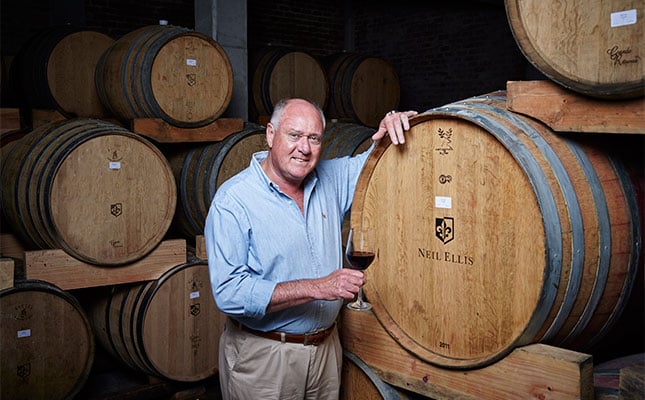
On being asked what the biggest hurdles were in the early days, Ellis recalls: “I wanted to be able to source grapes from those places I felt were best suited for a specific variety and farmed by somebody who understood my expectations. The latter was often the biggest problem, but I managed to find the grapes and growers I needed to take the project forward.
“At the time, the industry was heavily regulated, and it was extremely difficult to move grapes from one ward to another without losing certification rights, so that was an ongoing battle.
“My access to capital was very limited. I had some savings, and my dad gave me some money, but it was a case of just keeping the boat afloat and seeing where the venture would take me.
“Fortunately, the industry was transforming rapidly, and by 1990 the wine appellation regulations had been changed, and I could launch my first Elgin-certified Sauvignon Blanc.”
This was to become a major milestone in establishing a whole new wine world order, one where an independent négociant winemaker could buy grapes from whichever regions offered the best quality for a specific variety and make the wine in rented cellar space.
In the wake of this wave, a new generation of ‘vineyardless’ winemakers emerged, with industry icons such as Marc Kent, Cathy Marshall, Bruce Jack, and Eben Sadie renowned for building legendary brands without initially owning the underlying farms.
Pouring their own path
Rüdger van Wyk started his wine journey when he enrolled at Stellenbosch University in 2010 and was selected to participate in the Cape Winemakers Guild Protégé programme.
After doing internships with Kanonkop and Nitida, he was offered the position of assistant winemaker at the renowned Stark- Condé cellar in the Jonkershoek Valley outside Stellenbosch, where he managed to establish himself as a respected winemaker and gain accolades from international wine critics such as Jancis Robinson MW, who referred to him as a champion winemaker and a “rising star going from strength to strength”.
Introducing the wines of Stark-Condé to international markets took him to many countries, but with the birth of his second child in 2023, it dawned on him that while his own father had always put family first, he was away for long stretches of time and not part of some of the most important phases in the lives of his own children.
“I wanted to be more present for my family,” says Van Wyk. “I realised that this would not be possible with the path that my career was on. At the time, a friend called telling me that his US importer, Baobab Wines, was looking for a joint venture, and this collaboration and leveraging of synergies led to the creation of New Dawn Wines, focusing mainly on the US market.”
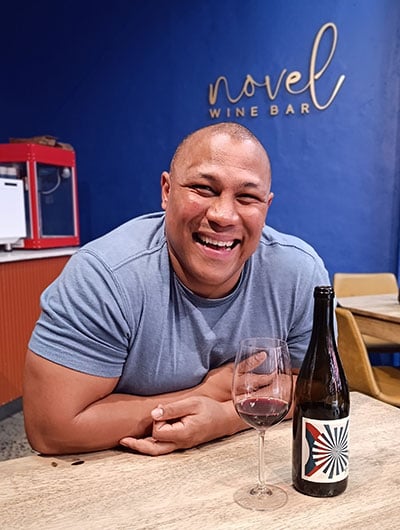
Van Wyk adds that on paper, everything looked great, and then the bombshell of increased import tariffs dropped.
“Overnight, sales fell by 40%, and I realised that we needed to pivot to withstand the storm. So we also expanded our exports to the UK market and opened a wine bar, Novel, in Salt River, focusing on introducing lesser-known and unrepresented producers to a new demographic of wine drinkers: upwardly mobile urban black consumers.
“The venue is situated in a very hip part of town, and we have the ability to adapt our product offering to the specific needs of the consumer, whether this be based on profile or price point.”
He points out that one of their top- selling wines, for example, is an off-dry Riesling with a refreshing acidity. Paired with exhibitions of upcoming artists and live music performances (Zolani Mahola was a recent performer), Novel has become a platform to create a group of previously untargeted wine consumers, something that is really necessary in an industry facing huge competition from other products such as ready-to-drink beverages.
The cost of independence
Asked whether he would recommend leaving formal employment to go independent, Van Wyk is outspoken: “A definite no, unless you have much-needed marketing and sales knowledge with guaranteed distribution channels, the necessary credibility and track record as a winemaker, a good story, and, most importantly, access to adequate financial backing to keep you going until such time as the business becomes sustainable.”
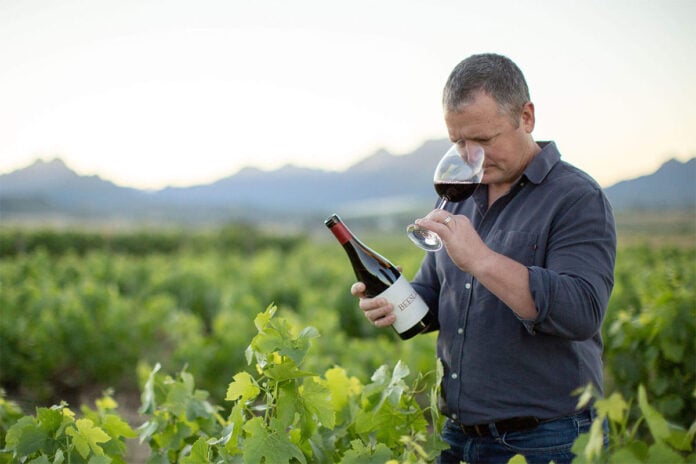
After more than two decades as winemaker at Kanonkop, widely considered one of the most prestigious wine estates in South Africa, Abrie Beeslaar decided that he “still had a lot of mountains to climb”. This from someone who became the first South African winemaker to score 100 points with the 2015 Paul Sauer in Tim Atkin MW’s annual Cape Wine Report.
Beeslaar highlights the risks of establishing your own brand: “I had the privilege to develop my brand while still at Kanonkop. If you are starting from scratch, you will need a lot of capital.”
As South Africa’s first black woman winemaker, Ntsiki Biyela started her career with Stellekaya Wines straight out of Stellenbosch University.
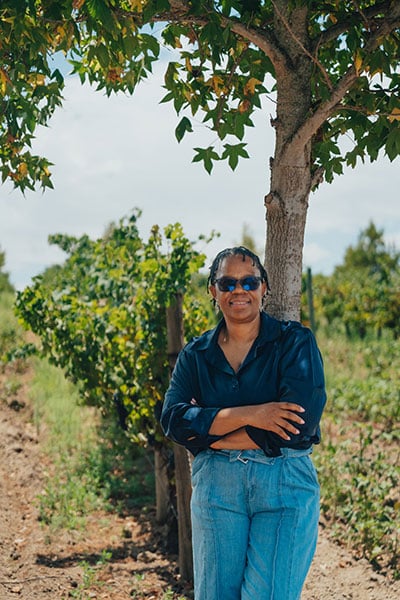
After spending 13 years there as a winemaker, she decided to launch Aslina Wines in 2016, named in honour of her grandmother.
Although she received many commendations, including being named ‘Woman Winemaker of the Year’ in 2009 and being named by Fortune magazine as one of the world’s Top 10 ‘Most Innovative Women in Food and Drink’ in 2017, she had always wanted to start her own business.
After making wine for a while and getting to know more about the business side as well, she mentions that, for her, it was a natural progression. Biyela admits that she had trepidation about starting her own brand, but with what she had learnt, as well as the help of mentors, she made the leap.
“My biggest concern was how to get access to the market with so much wine already out there,” she says.
Asked whether she would advise someone else to follow her example, her answer is somewhat ambivalent: “Telling someone to do or not to do so is difficult because currently there is so much stacked for and against small businesses. I wouldn’t stop a person, but I would advise them based on my [experience].”
Storm in a coupe
Two of the Cape’s most prominent Cap Classique makers left the employ of huge production houses to establish their own brands, but for completely different reasons.
Pieter Ferreira, fondly nicknamed ‘Bubbles’ due to his singular focus on this wine style for the 35 years he was involved with the Graham Beck cellar in Robertson as both winemaker and cellarmaster, states: “One morning, my wife, Ann, woke me and told me that in a few years I would have to retire, as it was written in my contract.
“I then approached Graham and told him about my fear of retirement at 60.
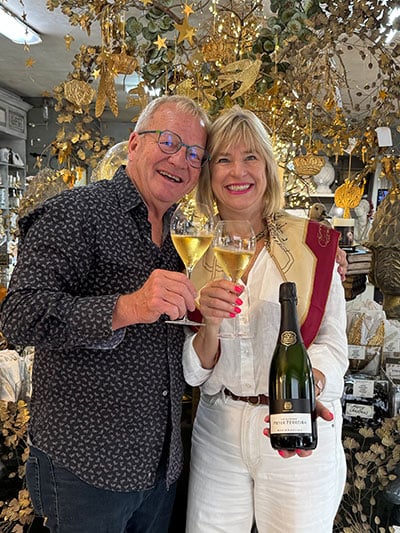
“He asked me what I had in mind, and I handed him a one-pager. “The idea was to only have the Cap Classique ready in the year of retirement and not to infringe on the Graham Beck brand. During this time, however, they shifted the retirement age to 65.”
He explains how his wife registered his name as a trademark, formed a company, and started distributing their eponymously named Cap Classique into the restaurant and retail trade.
“Today I am working for the boss [Ann] as her only employee.”
Melanie van der Merwe of Tanzanite Wines, who previously oversaw the production of one million litres of Cap Classique for the House of JC le Roux and Pongrácz, realised that she had to make the leap when her two-year-old son was miserable without his mother back home.
“I also realised that when you make wine in smaller quantities, you have so much more control over the quality of the product from beginning to the end,” says Van der Merwe.
“Another motivation was that I did not want to retire and say I made good wines for others. I wanted to say I made my wine, even if it is only in small quantities, to become who I think I could be on my own.”
To realise their dream, Van der Merwe and her husband, Wentzel, had to make a tough decision and sell their farm, as well as invest the retirement funds she received from her previous employer into their new venture.
She also continued doing consulting work for other producers while waiting for her own wines to become market-ready, all the while having to keep a keen eye on cash-flow management.
Grapes of hope
While all these producers are still bravely fighting for consumers’ share of mind, Van der Merwe summarises what was picked up from many of the independents: “Currently, it’s quite difficult as the consumption of alcohol is on a downward spiral, and the market is brutal as there is an oversupply globally.
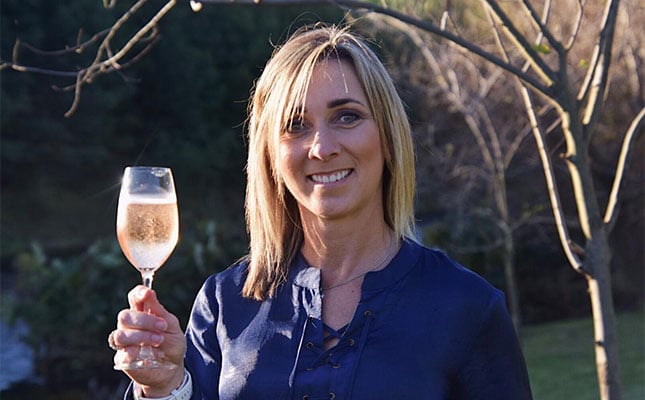
“US markets have collapsed, and the one factor that compounds the cost of Cap Classique terribly on the local market is the excise on a bottle of sparkling wine of R15, VAT on top of that and transport costs,” she adds.
She points out that the market is quite price sensitive, so it’s really not easy to start a new business: “We have to protect value and not chase volumes. So no, if I were a winemaker employed in a good position today, I would not quit my job, but rather do something on the side for a while.”
When the dream meets reality
There are also examples of winemakers who ventured out on their own from successful winemaking careers only to find market conditions incredibly difficult to navigate, throwing in the towel after a few vintages, and returning to full- time employment.
André van Rensburg launched his own brand after retiring from Vergelegen in 2022. After issues with distribution and an importer that didn’t live up to expectations, he had to discount some of his older white wine to make space for the next vintage. He has spent the last four years making wine under his own label.
“The biggest problems I encountered in starting my own brand was cost management and getting distribution and retail shelf space. I almost feel that my winemaking is now an enjoyable hobby, but a damn expensive hobby at that!” he says.
For more information, visit Aslina Wines: aslinawines.com | Beeslaar Wines: beeslaar.co.za | Neil Ellis Wines: neilellis.com | New Dawn Wines: newdawnwine.co.za | Pieter Ferreira Wines: pieterferreira.co.za | Tanzanite Wines: tanzanitewines.co.za.