
Rory Brooks, founder of mushroom farm Holy Shiitake, has an origin story not unlike many other gourmet mushroom farmers.
“I bought a mushroom growing kit to try my hand at producing my own mushrooms, had success on that small scale, and thought, ‘this is easy, let’s scale up and start selling mushrooms’,” he laughs.
At that time in 2017, Brooks had a business producing cannabis oil. Recognising the growing interest in alternative medicine, he decided to pivot towards mushroom production, since the awareness about the medicinal value of mushrooms was increasing.
But he quickly realised producing for one’s own kitchen is very different from large-scale commercial production. What followed was ample school fees, but many valuable lessons that today stand him in good stead.
“For a whole year we went through a trial and error process to see what worked and what didn’t. We eventually found the winning recipe and were able to scale up production.”

Holy Shiitake, situated near Randburg in Gauteng, produces around 400kg of gourmet mushrooms per week in the warehouse-like facility. Varieties include reishi, lion’s mane, oyster, turkey tail, chestnut and cordyceps.
One of the earlier learning curves was in realising that by just focusing on fresh mushrooms, income would be limited. Holy Shiitake today therefore offers a range of products, from fresh gourmet mushrooms to medicinal mushroom supplements, cosmetics, and dried mushrooms. They also produce an umami seasoning made from mushrooms, and supply grower kits and inputs for other mushroom producers.
Brooks clarifies that medicinal mushrooms should not be confused with psychedelic or magic mushrooms. The latter is classified as a Schedule 7 drug, equal to heroine, making it illegal.
“There is advocacy locally to have it legalised and it could possibly go the same route as cannabis. But at this stage, we steer well clear of that industry.”
Fine-tuning production
Most farmers will understand the battle that must be waged against harmful fungi in crops. What makes mushroom farming particularly challenging is that the farmer aims to grow some fungi, but not others.
Keeping the right fungi in production, and the wrong fungi out, requires a meticulous sterilisation process. Having the right equipment is therefore crucial for success, but also adds significantly to the start-up capital costs.
Brooks notes that there are farmers across Africa that grow mushrooms en masse in open fields where the environment is not sterile, yields are lower and the risk is very high for contamination and losing the whole crop. Holy Shiitake therefore produces their mushrooms in controlled environments, where much of the process takes place in a sterile laboratory.
The production journey begins with preparing the substrate. Gourmet and medicinal mushrooms are primary decomposers, meaning they grow on hardwood rather than the manure-based substrate used for button mushrooms. Brooks uses meranti sawdust sourced from furniture manufacturers because it is cleaner and contains fewer impurities than sawdust from sawmills. This reduces the time required to clean and sterilise the substrate.
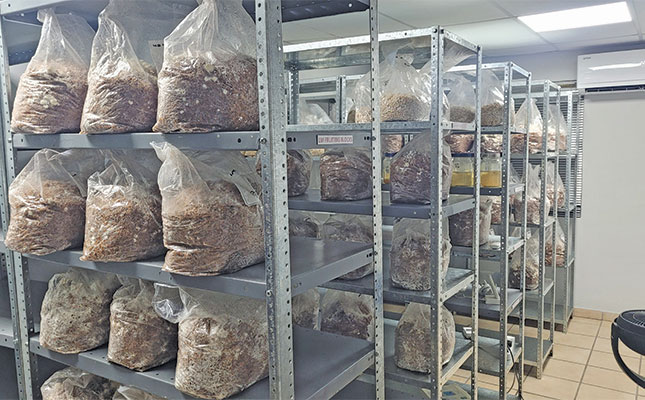
The sawdust is mixed with water and organic supplements for nutrition, then packed into bags and placed in super pasteurisers for eight hours. This high heat process sterilises and pasteurises the substrate. Once cooled, the bags are moved to the laboratory for inoculation with grain spawn.
Preparing grain spawn has also evolved. Brooks initially used sorghum, but the cleaning process slowed production. He switched to export- grade popcorn kernels which, although more expensive, save time and improve workflow. Holy Shiitake uses around 250kg of grain per week. The grain is sterilised in an autoclave at 121ᵒC and 1,06kg/cm3 of pressure. Once cooled, the spawn is inoculated with the desired mushroom strain by squirting liquid culture into each bag before they are transferred to a temperature-controlled incubation room.
Maintaining even temperature and humidity throughout the day and night is crucial. Some strains will start fruiting inside the bag if temperatures fluctuate, which must be avoided. Incubation takes one to two weeks, depending on the strain, until the grains are fully colonised by the mycelium, after which the grains are placed into the fruiting blocks.
Fruiting blocks are moved into growing rooms where temperature and humidity are set according to each strain’s preferred climate. The bags are cut open to allow oxygen in, and humidity is raised to around 90% to trigger pinning (the first growth stage). Within four to seven days small mushrooms form, at which point humidity is reduced to around 80%.
A further week later harvesting begins. Mushrooms are twisted off the fruiting blocks and multiple flushes can be taken from each block.
Once production is complete, the blocks are discarded. These are sought after by gardeners because when left in the sun they develop trichoderma fungi, which improves soil. Strawberry farmers especially favour the blocks, but Brooks says the volumes are too large to manage as a side business.
Another insight gained during the first year was to increase the quantities of grain spawn bags sourced from abroad to bring the unit cost down. Holy Shiitake uses polypropylene bags with a 0,2 micron filter patch for gas exchange. These must be imported and can be expensive for small producers. By increasing order quantities, Brooks reduced the unit cost and now sells the bags to small-scale growers at more affordable prices, making larger orders viable for his business while supporting others in the sector.
The need for temperature and humidity control means the water and electricity requirements are high. Brooks has had to invest in a generator to keep the processes going amid load-shedding or power outages. Ultrasonic atomisers are used to create humidity.
The devil in the detail
Successful mushroom production is largely dependent on selecting superior strains, and entirely dependent on eliminating unwanted strains. Brooks therefore not only invests in research and development to select and increase desired strains, but also takes extra precaution to ensure that only these are transferred into production.
Both imported and locally sourced mushroom strains are used. These are individually placed on plates that contain nutritionally rich agar, where they will grow. Brooks then inspects them under a microscope to ensure they don’t contain any pathogens. Once this has been confirmed, the strain is transferred into a liquid to make the liquid culture with which the grain is inoculated. Once the liquid has been colonised by the strain, it is again tested to ensure it has not been contaminated, before inoculating the grain.
Around 10ml of liquid is sprayed into bags containing 2kg of grain spawn during the inoculation process. The bag is then sealed before being transferred to the incubation room.
“One of the first lessons we learnt was to first place the strain on a plate and ensure it is pathogen free before making a liquid culture. There is a lot to lose when you transfer a contaminated strain into liquid, then into the grain spawn and into production,” Brooks cautions.
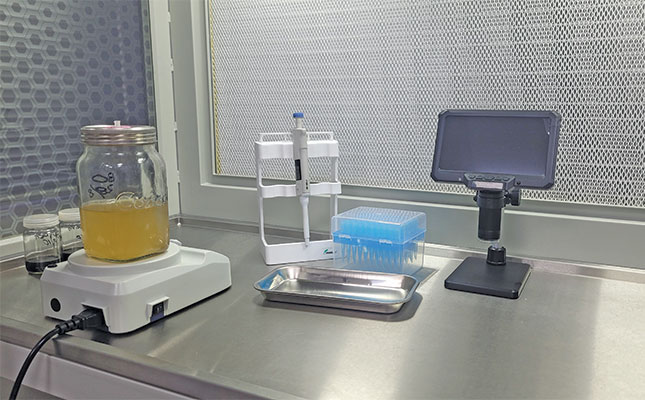
To ensure pathogens have no chance of slipping into the production cycle, all testing and inoculation is done in front of a HEPA (high- efficiency particulate air filter) laminar flow hood, which sterilises the air. All implements are also sterilised at regular intervals.
To maximise yield, Brooks develops his own strains. This is done by inspecting the mycelium of cultivars under the microscope and identifying those that have superior growth.
These are then selected and grown out on their own plate so that they can be used to develop the liquid culture. Tissue can also be taken from mushrooms that have provided good yields and expanded using the same process.
Keeping the production environment free from pathogens entails regular testing. This is done by placing open agar plates around the facility for around an hour. They are then sealed and within a few days any fungi spores that have collected on the plates would have started growing.
Brooks can then inspect the fungi to determine if any are harmful. The necessary sterilisation can then be done in the applicable zone where the contaminants were captured.
Brooks notes that a mushroom farmer’s contamination rate has a big impact on their success.
“In our grain spawn the contamination rate is virtually nil, with the fruiting blocks below 1%. We batch number our grain and fruiting bags so if there is contamination we can go back and see what went wrong,” he says.
Mushrooms’ glass ceiling
Mushroom farming, with its requirement for in-depth knowledge of fungi, can be a technical endeavour to pursue.
Brooks notes that while farmers need to be comfortable in a laboratory and understand how to work with fungi, an eager community of mushroom farmers makes the learning curve somewhat easier.
“There are many mushroom cultivation communities in South Africa on social media that are very willing to share their knowledge. There are qualified mycologists and people with a lot of experience who are happy to guide other farmers, because we all believe that the more we can grow the industry, the better for everyone.”
Brooks adds that while there are many small- scale mushroom growers in South Africa, large commercial farmers are few and far between. Holy Shiitake is considered a medium-scale farm, and is the biggest in this category.
“Scaling up production to reach the next size bracket is incredibly difficult. Mushroom farming requires very specific equipment that comes with a big cost. A laminar flow hood can set you back at least R100 000. If you want to scale up, you need more than one hood.”
Autoclaves are also expensive, and larger operations require several.
“So capital investment is a big barrier to entry, whether you are starting out, or scaling up.
“Furthermore, the processes to keep the farm clear of contaminants is time consuming and you can’t skip any steps to make it go faster,” says Brooks.
A hungry market
Holy Shiitake’s fresh mushrooms are sold to fresh produce markets and restaurants in Gauteng. Brooks says that demand is near insatiable and selling fresh mushrooms has never been difficult.
“The market will take whatever we send them. There is a huge demand, and it is increasing. People are becoming more aware of mushrooms, especially as a functional food, recognising the health value of exotic mushrooms. This is especially driving demand for varieties like lion’s mane.”
There have, however, been learning curves here too to improve margins. The first step was to find markets that could take crates of mushrooms and pack it themselves. This removed the need for Brooks to set up his own packing facility and buy the inputs.
The second step was to add value and expand their product range beyond fresh mushrooms.
“By all initial calculations, we were meant to be millionaires by now,” laughs Brooks.
“But we saw that the margins on fresh mushrooms are not big, and to make the operation feasible we needed to go one step further.”
With many of the initial steps in mushroom production requiring sophisticated, expensive equipment, Brooks realised that he could supply inputs to other, smaller mushroom farmers.
“A large part of our customer base are growers that produce mushrooms commercially. We provide the inputs at a lower cost than what they would be able to source on their own. Many don’t want, or don’t have the facilities to sterilise their grain bags to make their own fruiting blocks. So we provide the clean, inoculated fruiting blocks that have already undergone the sterilisation and spawn selection,” he says.
Holy Shiitake offers a wide range of exotic mushroom strains (over 50) – the biggest in South Africa. Brooks notes that this market can be very competitive, and establishing this division of the business has been challenging. But by shortening the wait time for grain spawn, and offering more competitive prices for inputs, they have gained market share.
The production of medicinal products and cosmetics containing mushrooms has also helped to expand their offering. While they currently sell direct to market through their online store, they are in the process of acquiring their good manufacturing practice (GMP) licence, which will allow them to supply retailers.
Holy Shiitake also has a white label service where they manufacture the products for a third party who sells the product under their own brand.
Brooks says the medicinal side of the business has been vital to diversify income streams, since these products have wider profit margins.
He adds that while the health supplements market can be volatile, since there are trends that come and go, medicinal mushrooms are still sought after.
Staying the course as a mushroom farmer is challenging.
“There are a lot of people who come and go in this industry. There is a perception that it is easy and the profits are high, but it is not so. There are a lot of steep, expensive learning curves to overcome.
“It’s also a demanding profession. Growing mushrooms requires attention 24/7. The time it takes to harvest from starting a new batch is three to six weeks, so the turnaround time is fast and requires your full attention,” says Brooks.
In an industry where precision is everything and shortcuts are costly, Brooks has learnt that resilience is as important as technical skill. He remains steadfast in his belief that mushroom farming has immense potential in South Africa.
With demand rising and new uses emerging, he sees room for many more producers, provided they are willing to put in the hard yards.
For more information email Rory Brooks at [email protected].