
Electricity costs are placing growing pressure on South Africa’s agriculture sector as tariffs continue to rise. For energy-intensive businesses such as feedlots, abattoirs, dairies and cold-chain operators, electricity is now a major production cost.
A hybrid solution
For an operation such as Vencor, electricity is essential to day-to-day operations. Processing facilities, refrigeration systems and cold storage infrastructure all require a reliable power supply. According to Connor Northing, chief technical officer at SunRanch Solar, many agricultural businesses are facing similar challenges as electricity tariffs continue to rise.
“The challenge is not unique to Vencor. Feedlots, piggeries, dairies and other intensive agricultural businesses all have high energy demands and limited scope to absorb rising electricity costs,” he says.
He adds that energy resilience has become just as important as reducing electricity costs.
“With Vencor, the approach was always energy stability and energy reliance, and also cost saving, because Eskom’s kilowatt/hour costs are running away,” he says.
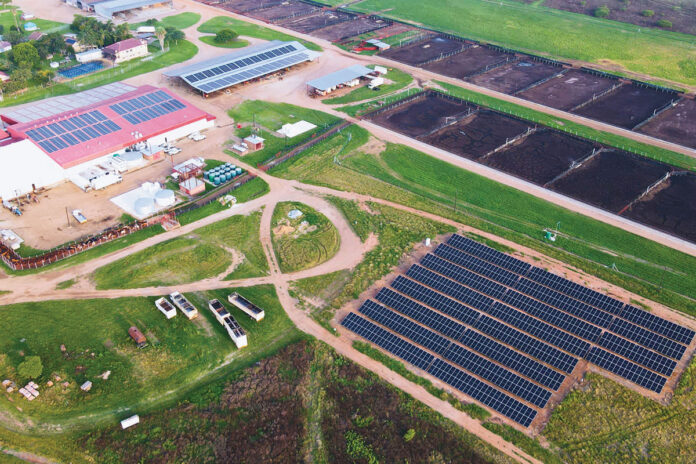
The solution adopted at Vencor combines solar generation, battery storage, and grid electricity. During the day, rooftop and ground-mounted solar arrays supply much of the facility’s electricity demand. Batteries are used during expensive peak tariff periods, while grid electricity is drawn during off-peak periods when tariffs are lower.
Battery storage also allows the operation to reduce peak demand charges by supplying stored energy during periods of high consumption. These charges, which are based on a customer’s highest level of electricity demand during a billing cycle, can account for a significant share of monthly electricity costs.
Northing explains that hybrid systems can also protect sensitive equipment against voltage fluctuations, which remain a concern in some rural areas.
Phased investment
Ruan Erasmus, CEO at Vencor Holdings, explains that Vencor did not move directly to a large battery installation. Instead, the project was implemented in phases. The first phase consisted of a 302,4kWp rooftop photovoltaic system with 300kVA inverter capacity.
A second phase added a further 349,98kWp of rooftop solar generation. The latest phase included a 542,08kWp ground-mounted array together with 2 150kWh of lithium iron phosphate battery storage and hybrid inverter infrastructure.
Erasmus further points out that the grid power, solar, battery and diesel generators are all integrated to seamlessly provide the cheapest and most reliable energy into his facility. SunRanch Solar installed a Third Party Energy Management system that is able to determine and select the cheapest power source available, ensuring optimal financial return and energy resilience on a daily basis for Vencor.

Erasmus notes that a phased approach allowed them to verify savings before committing additional capital to battery storage and additional generating capacity.
“It’s very seldom that we recommend PV and battery in the first phase of the project. We first start off with a PV system, and prove to you that we are saving you capital. Once the client is happy and we know that the technology works, we start advising on phase two, phase three, and phase four,” says Northing.
Affordability and scalability
For operations with high electricity consumption, solar remains financially attractive. Northing says solar-only systems typically pay for themselves within one to two years, depending on the operation’s load profile and electricity tariff structure.
“In terms of your return on investment, your payback period is still one to two years – two years at worst. If you look at the financials behind it, the solar system is cash flow positive from the day you switch it on,” he says.
A common misconception, according to Northing, is that battery storage is only viable for large industrial users. He points out that modern battery systems are modular and can be expanded as an operation’s energy requirements grow.
“Battery systems are fully scalable. You can buy battery blocks. One battery unit provides 215kWh. We can build those blocks and put 20 of them in parallel. We can start with one and then just procure a new block, put it down, connect it up, and switch it on,” he explains.
Northing adds that alternative financing models are increasingly being used to reduce the upfront capital burden associated with solar installations. Under these arrangements, service providers finance, maintain, and insure the system, while clients pay only for the electricity consumed.
Implementation and maintenance
Before investing in solar or battery storage, Northing recommends that producers first assess their existing electrical infrastructure.
He says installations should comply with South African electrical regulations and that customers should understand their electricity consumption patterns before deciding on system size. In some cases, relatively simple interventions, such as improved load management or the installation of variable frequency drives on large motors, can deliver substantial savings before any solar panels are installed.
Once a system has been installed, ongoing maintenance becomes critical. Although modern systems are designed to operate for two decades or longer, their lifespan depends heavily on regular servicing and monitoring.
“These systems are built to last 20 to 25 years. But if they’re not maintained, they won’t last. It is very important that we make sure operations and maintenance contracts are put in place,” he says.
Northing says quarterly inspections and proactive monitoring are essential, not only to maintain performance, but also to preserve product warranties.
He adds that solar installations should be viewed as long-term partnerships rather than once-off capital projects, with ongoing technical support playing an important role in ensuring that systems continue to perform as intended.
For more information, email SunRanch Solar at [email protected].