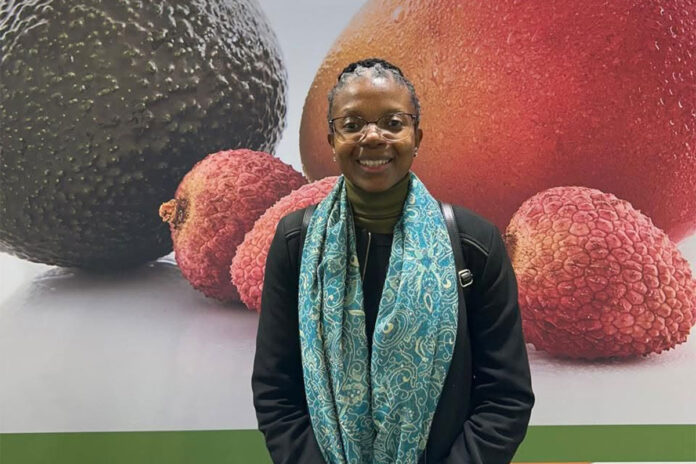
When Fhumulani Ratshitanga, CEO of Fruit South Africa (Fruit SA), reflects on her career, she doesn’t speak about titles or milestones. Instead, she speaks about people: the conversations that broadened her thinking, the colleagues who inspired her, and the farmers, industry leaders, and government officials who taught her to see agriculture from different perspectives.
For Ratshitanga, these relationships have become the foundation of her leadership style, where her role is to bring together an industry that is both diverse and deeply interconnected.
Her ambition is surprisingly modest for someone leading one of South Africa’s most valuable agricultural sectors. She isn’t driven by leaving behind a personal legacy, but by ensuring the industry remains united long after she is gone.
“I want to ensure that the umbrella of Fruit SA remains intact. There are conflicts where people don’t always see eye to eye, but I want to create unity so we can speak with a credible, unified voice. If people say I helped strengthen that unity and kept the structure together, I’ll be happy,” she says.
It is a philosophy that runs through almost everything Ratshitanga does. Whether engaging government departments or industry bodies, she believes lasting progress begins by making people feel heard.
“Trust is the glue that holds everything together. It is important to listen to the other side, allow people to express their views, and seriously consider their opinions before reaching a position.”
That approach has become increasingly important as the fruit industry faces a future shaped by geopolitical uncertainty, climate change, and shifting global markets. Rather than viewing these challenges as reasons for fragmentation, Ratshitanga believes they reinforce why organisations such as Fruit SA exist.
“The fact that Fruit SA exists means we have collaboration and a willingness to adapt. That puts us in a better position to deal with uncertainty and turn issues into opportunities. Unity is a big plus.”
Market access remains one of the organisation’s most important responsibilities. Fruit SA works to consolidate industry positions, engage government, and ensure the sector speaks with a coordinated voice on issues affecting exporters.
Ratshitanga notes that the fruit industry is highly export-oriented, which means market access conditions and global trade rules have real consequences for exporters and the entire value chain.
But she is careful not to overstate her own role. She sees herself as a custodian of structures built by those before her rather than someone starting from scratch.
Learning from those before her
“I’ve been in this position for just over five years, but the foundation was laid by my predecessors. Leadership is not built in isolation; it is built on the structures that came before.”
Her respect for those who came before her is evident. Looking back on the history of South Africa’s fruit industry, Ratshitanga says she is continually struck by the scale of its growth, and feels fortunate to have worked alongside many of the leaders who helped make it possible.
“It has been a privilege to work alongside legends in the industry and witness their drive and perseverance in supporting the growth of their respective industries. What they have managed to build and achieve is inspiring.”
Ratshitanga’s appreciation for different perspectives began long before she joined Fruit SA. Although she initially wanted to study microbiology, she pursued agriculture instead, a decision that opened her eyes to the breadth of opportunities within the sector.
Starting as a Perishable Products Export Control Board inspector, she later worked for the Department of Agriculture before joining the Southern African Confederation of Agricultural Unions. These roles gave her a practical understanding of how the many parts of the sector fit together.
“I gained a practical understanding of how the different areas within agriculture operate and how they connect with each other. Without that experience, it would’ve been far more difficult to fulfil my current role.”
The variety of those experiences also taught her the value of looking beyond one’s immediate environment.
“I’ve realised the importance of speaking to people who are not in your immediate circle, because it broadens your view. I always learn something when I talk to people from different walks of life or other industries.”
Ironically, this openness to people developed despite her naturally reserved personality.
She admits to being an introvert, and initially sought a career where contact with people would be limited.
“But if you want to grow, you can’t run away from interacting with people.”
Leading with trust and respect
Today, these interactions are one of the aspects of her work Ratshitanga enjoys most. Managing people, however, has required its own adjustment.
“Dealing with human dynamics and sensitivities has been one of the steepest learning curves. What has been tremendously helpful is seeing the person first, not their role. If people feel heard and respected, it builds trust, and then it becomes easier to manage difficult conversations.”
That same principle guides Ratshitanga when difficult decisions arise. She strives to remain objective, fair, and transparent, believing consistency is impossible if decisions are driven by emotion rather than principle.
She also believes leadership carries responsibilities that extend beyond the office. “I don’t take for granted that being in this position is a privilege. I need to conduct myself professionally and appropriately to bring credibility to the role.”
Facing the future together
As the operating environment grows more complex, Ratshitanga knows there will be no shortage of challenges. Climate change is already affecting production, water availability, pests, and diseases, while the predictability that farmers once relied on continues to diminish. At the same time, geopolitical shifts are reshaping the global trading environment on which South Africa’s fruit industry depends.
Yet her confidence in the industry’s future rests not on predicting what comes next, but on preserving its ability to respond together.
For Ratshitanga, effective leadership is not about having all the answers. It’s about creating the trust, respect, and unity that allow an industry to find them together.