
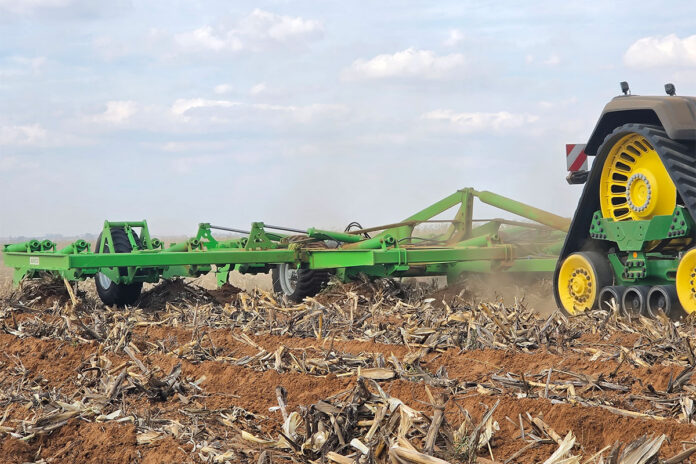
In the deep sandy soils of the northern Free State, the recipe for success remains simple: open up the soil, encourage deeper root growth, and make the most of every drop of water.
For JP Meintjes of Kruispan Boerdery, near Viljoenskroon in the Free State, the Agrico T-Series ripper and the right approach help unlock the soil’s potential one hectare at a time.
When compaction is a challenge
According to Paul Burger of Agrico, compaction is one of the biggest challenges on this type of soil.
“The sandier and deeper the soil, the more prone it is to compaction. This restricts root growth, making it harder for crops to develop optimally and ultimately reduces yields.”
Although compaction is a natural process, it is accelerated by agricultural machinery traffic, water movement and other factors. As a result, deep tillage has been part of cultivation practices in the northern Free State for decades.
“Our water table is usually between 900mm and 1m below the surface,” says JP. “That’s why we always try to loosen the soil as deep as possible, and to do that, we need a ripper.”
Paul expands: “I’ve often heard farmers say that for every additional 100mm you rip into these sandy soils, you can increase your maize yield by between 400kg/ ha and 600kg/ha. Of course, this varies from season to season, but over a number of years, you definitely see the benefits.”
A ripper designed for maximum efficiency
Kruispan Boerdery uses an Agrico T-Series ripper that was specifically designed to meet their requirements. The implement operates in a tandem configuration.
The front T1000 tine breaks open the upper soil layer, while the rear T1250 tine works deeper to further loosen the soil profile.
The design is intentionally focused on reducing draft requirements.
“The tines are only 25mm thick. This presents a smaller profile for the sand to move against, significantly reducing draft,” explains Paul.
The implement also features an optimum 30° point angle, helping to fracture the soil efficiently without unnecessary energy consumption.
Like many modern Agrico implements, the T-Series features a modular design.
“Working widths, tillage depths and kilowatt requirements differ from farm to farm. That’s why we use modular tine technology and frames that can be customised to suit each farmer’s specific needs,” says Paul.
Lower fuel consumption, higher productivity
At a time when input costs continue to rise, fuel consumption is a critical consideration for every farmer.
JP was pleasantly surprised by the performance of the new ripper.
“Our previous rippers were about half the size of this one. Back then, we worked with a 410hp tractor. Now we’re using a John Deere 9RX 830 with a 12,2m-wide ripper fitted with 16 tines,” says JP.
The difference in fuel consumption has been remarkable.
“With our previous rippers, we averaged between 14ℓ/ha and 15ℓ/ ha of diesel. With this implement and tractor combination, we’ve reduced that to around 12ℓ/ha, and in some areas even as low as 11ℓ/ha. That’s the lowest diesel consumption I’ve ever seen from a ripper doing this type of deep tillage.”
An investment that proves its value
The value of the Agrico T-Series lies not only in its technology, but also in the economic benefits it delivers to farmers.
“In Kruispan’s case, their cultivation practices were already sound. What Agrico added was lower fuel consumption and better utilisation of capital,” says Paul.
For JP, the results are already evident. “With current maize prices under pressure, good yields make a huge difference. The first fields we’ve harvested are producing above-average yields, which is very encouraging for us.”
For more information, email [email protected], call +27 82 374 6938 or visit Agrico at agrico.co.za.