Joylene van Wyk, spokesperson and media liaison for the Ministry of Agriculture, confirmed that the additional R150 million for the bank’s Blended Finance Scheme (BFS) had been transferred to the bank.
In written correspondence with Farmer’s Weekly, the Department of Agriculture (DoA) said it had made R439 million in grant funding available to Land Bank for the 2026/27 financial year. However, it did not explain how this figure related to the R325 million already transferred and the additional R150 million announced in Aucamp’s media statement on 2 October.
The additional R150 million follows Land Bank’s announcement to Parliament’s Portfolio Committee on Agriculture on 29 September that new BFS applications had been temporarily paused because the R325 million grant allocation had already been committed to applications received.
Farmers preparing for summer planting face uncertainty over whether finance will become available within their production windows. Some farmers, who previously spoke to Farmer’s Weeklyon condition of anonymity, said they had already incurred costs or taken additional credit in anticipation of receiving blended finance.
Funding figures need clarification
In his statement, Aucamp said the DoA had committed an additional R150 million, over and above the R325 million grant allocation already transferred for 2026/27. Those amounts total R475 million.
In its written response to a question about the R150 million transfer, the DoA said: “For the financial year 2026/27, the Department of Agriculture made available to the Land Bank R439 million in grant funding for support of farmers through the blended finance scheme.”
Van Wyk confirmed that the additional R150 million had been transferred. However, the difference between the R439 million cited in the DoA’s written reply and the combined R475 million announced by the minister remains unexplained.
Aucamp said the DoA, the Department of Land Reform and Rural Development (DLRRD), National Treasury, and Land Bank had been directed to resolve the temporary pause and restore full funding operations as quickly as possible.
He added that the urgency had been highlighted during a meeting with President Cyril Ramaphosa on 29 September, when he briefed the president on engagements already undertaken to address the shortfall.
Eligible uses outlined
Asked how the R150 million would be allocated and when it would become available to farmers, the DoA outlined the scheme’s scope rather than providing an allocation schedule or release date.
It said BFS support could cover the acquisition of primary agricultural land or commercially viable agricultural businesses; the expansion of existing operations on privately owned or land reform farms; and start-up operations, including brownfield and greenfield projects, especially on communal land.
Eligible uses also included capital equipment and infrastructure, working capital, and production loans. The scheme further provided for subsidised insurance cover, capped at 6% of each total grant approved.
The DoA’s response did not indicate how much of the additional funding would be reserved for production finance, how pending applications would be prioritised, or when farmers could expect payment.
Grant ceiling and farmer communication
The DoA said Land Bank was expected to manage its grant allocation and ensure every branch knew the total funding available, which should not be exceeded in a financial year.
“The application pipeline must be properly managed, and farmers must be informed timeously when the grant ceiling has been committed in a financial year.
“The funds are not infinite, and the demand for blended finance exceed the resources we have,” it said.
These requirements address commitment limits and communication, but the reply did not specify reporting intervals, monitoring arrangements, or corrective action where commitments exceed available funding.
The DoA also said it had explored a partnership with the DLRRD, whose support would enable Land Bank to finance new applications until the end of 2026/27 and beyond. It did not state the amount involved, whether that support had been formally approved, or when it would become available.
Planting deadlines remain central
Aucamp clarified that the BFS had not been discontinued, adding that funding gaps should not occur.
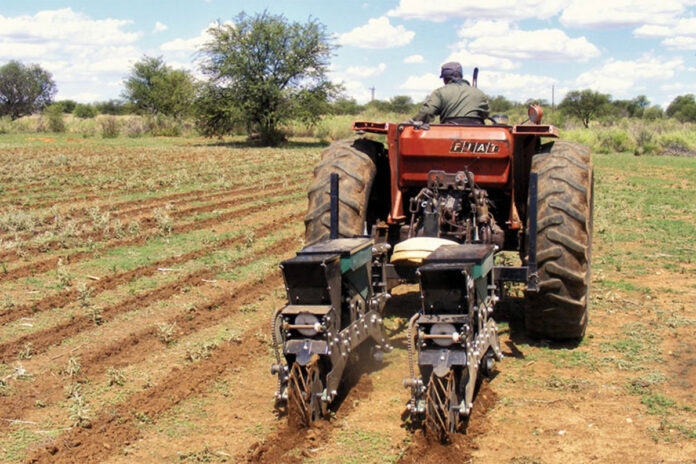
“Our focus is currently to ensure that farmers receive funding that will enable them to start planting. Land Bank has stated that in the interim, [it] is open for 100% loan funding for the agriculture sector,” he said.
Neither the minister’s statement nor the DoA’s replies provided a date for reopening new BFS applications. The statement did not detail the interim loan terms or explain whether farmers awaiting blended finance could later incorporate such loans into BFS agreements.
Athol Trollip, ActionSA MP and a member of the agriculture portfolio committee, previously told Farmer’s Weekly that delayed finance could undermine farming operations even where applications were ultimately approved.
“Farming is a seasonal activity, and certain crops can only be successfully planted in specific window periods,” he said.
Trollip cited grain farms visited by the committee in North West where, according to him, finance for maize planting arrived too late.
He said requests to switch to sunflower, which still had a viable planting window, were refused, and late-planted maize subsequently failed to cover production costs.
Trollip also alleged that delays in harvesting finance had left fruit unharvested on some Eastern Cape citrus farms.
Project support and oversight
Trollip’s concerns extend beyond funding availability to beneficiary selection, due diligence, and technical support. He said beneficiaries were “not always selected appropriately” or based on merit and potential.
Citing the example of a North West pecan operation, he said irrigation pivots were obsolete and non-functional, while the planted area and tree density had not been properly assessed.
“Land Bank sits with the bad debt, or good money spent on bad decisions and lack of proper evaluation, technical and extension services,” he said.
Land Bank said it had taken steps to improve support for beneficiaries before and after funding was approved.
Since the BFS’s launch in November 2022, the bank has approved approximately 610 applications and provided funding to 539 farmers. It puts its average time to reach a credit decision at 59 working days.
The confirmation of the R150 million transfer establishes that the additional funding has reached Land Bank. The DoA’s replies also set out eligible funding uses and expectations for managing grant ceilings. Questions remain about the reconciliation of funding figures and the timetable for making finance available to farmers approaching planting deadlines.