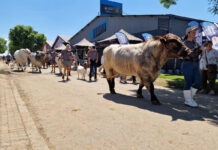
The 2026 Royal Agricultural Show, held at its new home in Tweedie, KwaZulu-Natal, from 7 to 11 October, introduced a Technology & Education Hub aimed at bringing agricultural research, technology and practical knowledge closer to farmers.
The initiative formed part of the Royal Agricultural Society’s 175th anniversary celebrations and offered a five-day programme of approximately 30-minute presentations covering agricultural innovation, skills development and practical farming challenges.
Unlike conventional agricultural exhibitions, where machinery and commercial products generally take centre stage, the hub focused on sharing knowledge and demonstrating how technology and research could be applied to improve agricultural production.
The programme brought together researchers from the Agricultural Research Council, universities, agricultural colleges, technology providers and industry organisations.
Presentations covered precision livestock farming, animal breeding and reproduction, farm security, renewable energy, electricity costs, water management, soil health and agricultural mechanisation.
Livestock production featured prominently, with discussions examining the growing role of data, animal identification, milk recording and reproductive technologies in improving productivity.
Other presentations explored technological approaches to livestock security, including systems designed to provide early warnings of possible stock theft, while energy specialists discussed solar technology and opportunities to manage electricity costs.
Agricultural education was another important component, with representatives from Weston Agricultural College, Cedara Agricultural College, Mangosuthu University of Technology (MUT), Jirah Academy and Grootfontein Agricultural College discussing training opportunities and the changing skills requirements of the agriculture sector.
The hub also provided opportunities for learners and young people to explore careers in agricultural engineering, electrical and electronic technologies, greenhouse production and livestock management.
A central theme throughout the programme was the importance of making agricultural knowledge and technology accessible to both commercial and smallholder farmers.
Reproductive technology offers opportunities for communal farmers
One presentation illustrating the practical application of agricultural research was delivered on Wednesday, 7 October, by Dr Helen Mapeka, a lecturer and livestock reproduction specialist at MUT.
Her presentation, ‘Breeding for the Future: Livestock Reproduction for Sustainable Farming’, focused on how assisted reproductive technologies (ART) could improve livestock productivity, particularly among communal and smallholder farmers.
Mapeka, a registered livestock reproductive operator with the Department of Agriculture, explained that ART encompasses reproductive interventions that assist or control breeding rather than relying entirely on natural mating.
These include artificial insemination, oestrus synchronisation, embryo transfer, superovulation, controlled mating and semen sexing.
She said commercial livestock producers and stud breeders had successfully used many of these technologies for years, but access remained limited among communal farmers.
Her work at MUT focuses on extending these technologies and the associated management skills to farmers who have traditionally operated outside formal livestock breeding programmes.
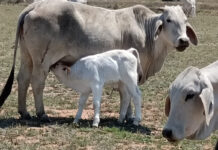
Mapeka said communal farmers owned substantial numbers of livestock, particularly in KwaZulu-Natal, but many animals were not reaching their production potential.
She identified poor reproductive performance, declining livestock numbers, inadequate record-keeping and inconsistent animal quality as challenges limiting farmers’ ability to participate in formal livestock markets.
The objective, she explained, was not simply to introduce advanced breeding technology but to return to the fundamentals of livestock management. This includes teaching farmers how to identify animals, maintain breeding records, monitor reproduction and select animals capable of meeting market requirements.
Why livestock records matter
Mapeka placed particular emphasis on livestock identification and record-keeping, arguing that farmers could lose considerable value when selling animals without documented breeding histories. She illustrated the problem by comparing two hypothetical Boran animals of similar weight, breed and physical quality offered for sale at an auction.
In her example, an animal supported by comprehensive breeding and reproductive records fetched R100 000, while a comparable animal without records fetched only R10 000.
The figures were illustrative rather than actual auction results, but Mapeka used them to demonstrate the commercial importance of reliable livestock information. She explained that buyers needed more than an animal’s physical appearance when evaluating its breeding potential.
Records provide information about parentage, reproductive performance and other characteristics that can influence an animal’s value. Without this information, prospective buyers may be reluctant to pay a premium, even when an animal appears comparable to registered breeding stock. Mapeka said record-keeping was therefore one of the first subjects covered when training communal farmers.
The principle extends beyond stud breeding. Accurate identification and reproductive records can help farmers monitor calving intervals, identify animals with fertility problems and make informed decisions about herd replacement.
Improving genetics without owning expensive breeding bulls
Artificial insemination is one of the technologies MUT is introducing to communal farming communities. The procedure involves collecting semen from selected bulls, preserving it and using it to inseminate cows without natural mating. This can give farmers access to breeding genetics that might otherwise be beyond their financial reach.
Mapeka explained that oestrus synchronisation was another important component of the programme. By using hormonal treatments to bring cows into heat within a planned period, farmers can manage breeding more systematically.
Synchronised breeding also allows insemination to take place within a relatively short period, helping farmers manage reproductive activities and potentially achieve more concentrated calving periods.
Mapeka showed photographs of calves produced through assisted reproductive technologies during her presentation. She also discussed the application of reproductive technologies in goats, including synchronisation and controlled mating.
According to Mapeka, one of the goat breeding interventions produced a high proportion of multiple births, including twins and triplets.
University project supports 33 communal farmers
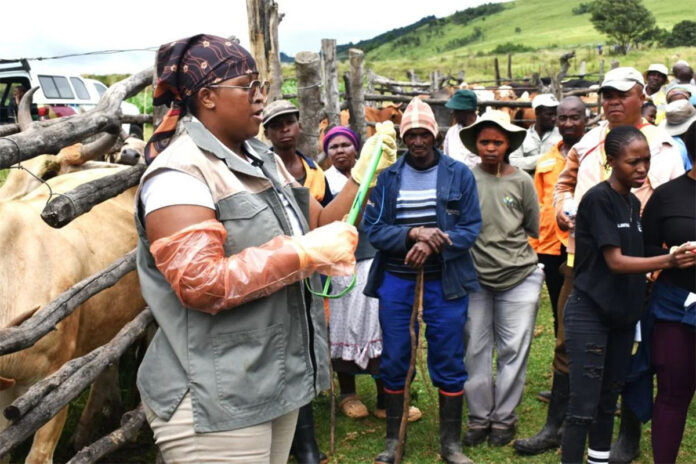
Mapeka’s presentation drew on practical work undertaken through an MUT project involving 33 farmers in Rietsdale, near Umzimkhulu in southern KwaZulu-Natal.
The project, launched in August 2024 and funded through the university’s Community Engagement and Development directorate, aims to improve reproductive performance and introduce superior genetics into communal cattle and small-stock farming systems.
It began with a two-week training programme involving local farmers, unemployed youth, women involved in agriculture and MUT animal production students.
On 22 January 2025, the project reached an important implementation stage when Mapeka and her team examined 90 cows belonging to participating farmers.
The animals were ear-tagged for identification and underwent pregnancy diagnosis. Of these, 49 cows were synchronised using hormonal treatments in preparation for artificial insemination.
The intervention was conducted with the participation of 18 third-year animal production students, providing them with practical experience while introducing farmers to reproductive management procedures.
During her Royal Show presentation, Mapeka also displayed photographs of calves born through artificial insemination and discussed the training undertaken with farmers and agricultural officials.
She said the university had provided training in reproductive technologies to officials from the KwaZulu-Natal Department of Agriculture, including animal health personnel and veterinarians.
The programme therefore extends beyond individual farming communities by helping develop technical skills among agricultural professionals.
Training young people to provide reproductive services
An important aspect of MUT’s work is its focus on developing reproductive technology skills among students and young people.
Mapeka explained that the university offers short skills programmes covering assisted reproductive technologies, including artificial insemination. Students receive practical training and, once assessed as competent, can obtain certificates.
She said the university also assists qualifying trainees with the process of registering with the Department of Agriculture as reproductive operators. Such registration is important because reproductive procedures involving other people’s livestock are regulated and cannot simply be performed commercially without the appropriate authorisation.
Mapeka emphasised that training farmers to work with their own animals was different from qualifying to provide reproductive services to other livestock owners. She said developing these skills could also create self-employment opportunities for young people who struggle to find conventional jobs.
Qualified reproductive operators could potentially establish businesses providing artificial insemination and related services to livestock farmers.
MUT also collaborates with agricultural institutions and training organisations to broaden access to agricultural skills and technical knowledge.
Bridging the gap between communal and commercial production
Mapeka’s presentation highlighted the connection between reproductive efficiency, animal quality and market participation. She argued that communal farmers needed more than access to improved breeding material if they were to become competitive livestock producers.
Animal identification, record-keeping, reproductive management and an understanding of formal market requirements were equally important.
Her work at Rietsdale demonstrates how university-led extension and practical training can help introduce these principles into communal farming systems.
The project also provides a platform for students to gain experience under field conditions and learn from farmers’ existing knowledge.
While further production data would be needed to establish the long-term impact on conception rates, calving percentages and profitability, the initiative clearly illustrates how reproductive technologies can be made more accessible to smaller livestock producers.
Mapeka’s presentation reflected the broader purpose of the Royal Show’s Technology & Education Hub: connecting agricultural research and innovation with practical challenges on farms.
The programme demonstrated that agricultural technology is not limited to sophisticated machinery or digital systems. Improvements in livestock identification, breeding management and access to technical skills can also play a significant role in helping farmers improve production and enjoy significant market participation.