Following sister Chery-owned brand Omoda, Jaecoo has rolled out two NEVs in the form of the self-charging hybrid SHS (super hybrid system) and BEV (battery electric vehicle). We sampled both on a scenic journey from Johannesburg to Durban via Golden Gate Highlands National Park and the KwaZulu-Natal Midlands.
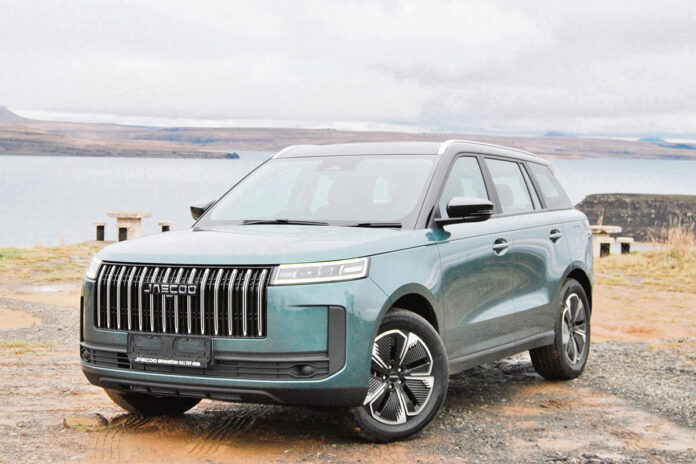
Positioned between the combustion-powered J5 Glacier and Inferno on price, at first glance, there’s very little difference visually between the SHS and its siblings. Aside from the special aero 18” alloy wheels and block letter HYBRID badge on its tailgate, the SHS is otherwise identical to the petrol-engine J5, with the same applying to the interior.
The same applies to the interior, which means the 13,2” infotainment system, the 8” instrument binnacle neatly recessed into the dashboard, the steering column-mounted selector lever, and ventilated wireless smartphone charging pad on the centre console have all been retained.
Plenty of OOMPH
Pressing the starter button reveals the biggest change as the 1,5T-GDI engine has now been supplemented by a 1,83kWh battery pack powering a single electric motor. Similar to the Omoda C5 SHS, the set-up produces 295Nm of torque and sends 165kW of power to the front wheels through a dedicated hybrid transmission.
Aesthetic changes to the BEV include the omission of the grille, with the upper air intake sealed with a black intake panel below the bonnet, which is embossed with the Jaecoo badge. In addition, the lower air intake has been squared off as part of the redesigned bumper, the charging port has been moved to the front wing, and a BEV logo has been placed on the bumper.
Bespoke interior
Mounted on the same 18” wheels as the SHS, opening the BEV’s door reveals a model-specific black-and-white interior with blue piping and stitchwork on the seats. The sole option for the BEV, both the instrument cluster and infotainment systems are carried over from the SHS, but with EV-specific graphics and readouts.
Powering the BEV is a 58,9kWh battery pack hooked up to single electric motor on the front axle. The result is 155kW of power and 288Nm of torque, which Jaecoo says translates to a range of 402km, which will require a waiting time of 28 minutes from 30% to 80% using a DC charger.
Aside from the obvious fuel consumption gains, the SHS felt smooth, as the transition from the engine to the electric system is near seamless.
Refined ride
Given that the example driven only had 25km on its odometer, the engine responded eagerly, though only in Sport mode. In its default Eco setting (surprisingly, the only other driving mode), it feels more sluggish, and the accelerator must be pressed a little more to get moving.
Refinement and comfort still impressed, however, and the efficiency-optimised wheels and possibly tyre pressure resulted in a firmer-than-normal ride on less well-maintained routes.
The BEV was quicker off the mark, but it lacked the rapid pull ordinarily expected from an EV. Switched to Comfort mode throughout much of the journey, the J5’s power delivery was more linear than spritely, but it became a stronger surge in Sport mode, although not the typically brutal force associated with EVs.
What’s the verdict?
The BEV’s ride quality felt better than the SHS. However, both models’ excessively sharp brakes proved annoying.
The Jaecoo J5 SHS and BEV offer incredible value against not only the combustion model, but from an overall package standpoint, too.
While Jaecoo has admitted that the BEV will be a niche seller, the SHS arguably strikes the best balance considering its inherent practical gains over the Omoda C5 SHS at R20 000 less.
Vehicle pricing
Jaecoo J5 SHS – R459 900
Jaecoo J5 BEV – R549 900
Pricing includes a five-year/150 000km warranty, a five-year/75 000km service plan, and, in the case of the SHS, a first-owner-only 10-year/1 000 000km engine warranty. Included in the BEV pricing is an eight-year/160 000km battery warranty.