South Africa’s agriculture sector cannot sustain its growth by relying on farmers to compensate for government failures, while public funding and agricultural policies should be delivering measurable results.
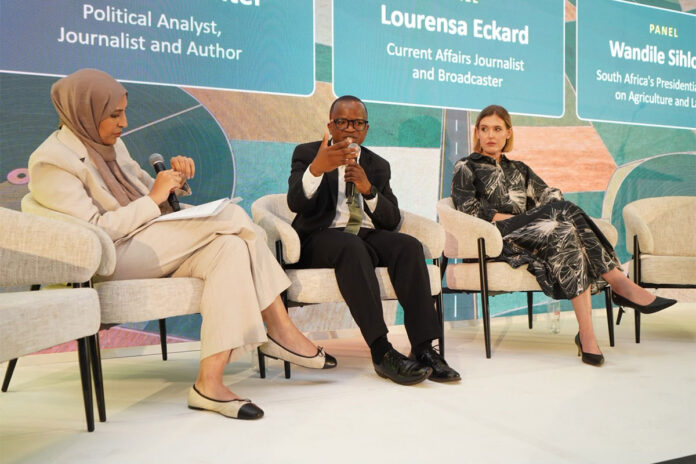
This emerged during a panel discussion moderated by journalist Qaanitah Hunter at AgriSA’s annual congress, held at the Irene Country Hotel in Gauteng on 14 October and attended by Farmer’s Weekly.
Sihlobo and Eckard examined whether South African agriculture was flourishing despite government shortcomings, and how responsibilities should be shared between the state, organised agriculture and private businesses.
Hunter opened the discussion by asking whether the sector’s resilience had become a substitute for effective government support.
Sihlobo challenged the suggestion that agriculture could prosper independently of government.
“There is no country that can actually have its agriculture sector, or any exporting industry, succeeding without the government being involved,” he said.
He pointed out that South Africa’s agricultural production had more than doubled since 1994, supported by productivity improvements, technological advances and expanding exports.
Agricultural exports had increased from approximately US$2 billion (about R33 billion) in 2000 to US$15,1 billion (R248 billion) in 2025, but this growth had also depended on government facilitating trade agreements, registering agricultural technologies and maintaining market access.
Sihlobo argued that the question was therefore not whether government should be involved, but whether it was fulfilling its responsibilities effectively.
Farmers cannot carry the burden indefinitely
Eckard attributed much of South African farmers’ resilience to the necessity of overcoming challenges in spite of limited government assistance. She contrasted their circumstances with those of European farmers, who generally benefitted from more extensive agricultural support.
However, she warned that resilience should not be confused with an unlimited ability to absorb additional costs and responsibilities.
Farmers in remote areas often felt isolated and inadequately represented, she said, creating a risk that they would increasingly seek individual solutions rather than participate in collective initiatives.
Hunter raised the problem of South Africa’s two-tier agricultural economy, questioning how smaller producers could survive challenges that better-capitalised commercial farmers were sometimes able to overcome through private investment.
Eckard argued that agricultural transformation could not succeed through land transfers and financial assistance alone. She questioned the value of supporting emerging farmers if deteriorating roads, dysfunctional ports and other infrastructure failures prevented them from getting their products to market.
She also pointed to the broader South African tendency for those who could afford private alternatives to provide their own security, education and other services.
“It’s unsustainable. It’s completely unsustainable,” she warned.
These structural problems disproportionately affected farmers without the financial means to establish alternative arrangements.
Who is responsible for fixing government failures?
Hunter asked whether organised agriculture and private businesses were increasingly taking over government’s responsibilities after years of demanding improvements to infrastructure and service delivery.
Sihlobo acknowledged the importance of public-private partnerships but cautioned that clear boundaries were needed.
He warned that allowing private organisations to assume government functions without appropriate safeguards could create concerns about accountability and undue influence over policy decisions.
He advocated using institutions such as the National Agricultural Marketing Council to facilitate structured engagement between government and industry.
Sihlobo also cautioned against portraying South Africa’s agricultural institutions as being in complete collapse. While acknowledging serious infrastructure and administrative shortcomings, he argued that such descriptions overlooked areas where cooperation was producing results and could discourage investment.
He said government and industry needed to identify which functions could be performed more efficiently by private businesses, while retaining appropriate public oversight.
Public funding must reward results
Hunter asked what would drive the implementation of agricultural policies beyond further discussions and commitments.
Eckard argued that government should place greater emphasis on evaluating the outcomes of agricultural development programmes rather than simply allocating additional funding.
She questioned whether sufficient attention was being paid to the effectiveness of grants, land reform initiatives and other support measures.
According to Eckard, public resources should be directed towards activities that increased agricultural production and employment. She suggested exploring additional tax incentives to reward productive farming and reduce reliance on administrative processes that could delay support.
She also argued that accountability should extend throughout the implementation process, from the initial policy decision and allocation of funds to whether farmers ultimately benefited.
Sihlobo identified affordable finance, access to land, technical skills and modern technology as essential requirements for expanding agricultural production. He supported expanding blended finance mechanisms, including those involving the Land Bank, but stressed that finance alone would not produce commercially viable farmers.
He argued that South Africa already had an important framework in the Agriculture and Agro-processing Master Plan and that greater emphasis should be placed on implementing existing agreements.
Municipalities hold the key to rural growth
Turning to the approaching local government elections, Hunter asked how municipal performance affected agricultural investment and the sector’s prospects for growth.
Eckard described local service delivery as critical to the viability of rural economies. She said deteriorating roads, unreliable services and weak municipal administration had consequences extending beyond individual farming businesses.
When farms became less viable, the effects were felt through reduced employment, declining economic activity and fewer opportunities for surrounding communities.
Sihlobo highlighted municipal fresh produce markets as an example of infrastructure requiring urgent attention. He argued that improving these facilities was essential for agricultural market access and food security, and that responsibility extended beyond the Department of Agriculture to other government departments and municipalities.
He also emphasised the importance of trade-related institutions, noting that agricultural expansion depended on continued access to export markets.
Organised agriculture must remain accountable to farmers
Hunter also asked whether increasingly large and fragmented agricultural organisations could adequately represent the different interests of farmers across South Africa.
Eckard acknowledged that representative organisations faced difficulties accommodating the needs of producers operating under widely different circumstances.
“They don’t have a democratic mandate,” she said, referring to organised agriculture. “They cannot be held responsible for building roads, fixing infrastructure, or improving port logistics.”
However, she argued that these organisations remained accountable to their members and needed to ensure that farmers felt heard. She encouraged agricultural organisations to strengthen communication with communities and rebuild relationships where trust had weakened.
Sihlobo agreed that fragmentation could complicate engagement with government, particularly when numerous agricultural organisations approached policymakers with competing priorities. He argued that umbrella organisations such as AgriSA could help consolidate industry positions and facilitate more effective discussions with government.
Implementation remains the challenge
In closing, Hunter asked whether government, organised agriculture and farmers could achieve greater coherence in their objectives and actions.
Sihlobo maintained that much of the groundwork had already been completed through existing agricultural development plans. The challenge, he argued, was to revitalise those agreements, involve stakeholders who had previously been excluded and deliberately implement the agreed interventions.
Eckard emphasised the importance of continuing difficult discussions, including with people holding opposing views. “Don’t stop talking to people that you disagree with,” she said.
She argued that stronger cooperation should not prevent stakeholders from questioning government decisions or demanding evidence that public spending was producing results.
The discussion highlighted the distinction between South African agriculture’s demonstrated ability to overcome challenges and the institutional support required for sustained expansion.
While farmers have continued producing and exporting despite infrastructure and service delivery constraints, the panel’s message was that future growth would depend on clearly defined responsibilities, effective partnerships and accountability for results.