Women contribute to farm businesses in many ways, from managing finances and working with livestock to organising production and helping to make business decisions. Yet these responsibilities do not always earn them recognition as farmers or a say in how the enterprises are run.
They may still be seen primarily as farmers’ wives, daughters, or helpers, even when their work is essential to the business. This can influence whose expertise is recognised, who is considered for leadership roles, and who is expected to take over the farm.
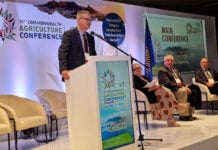
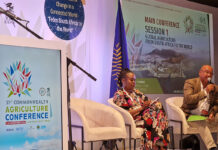
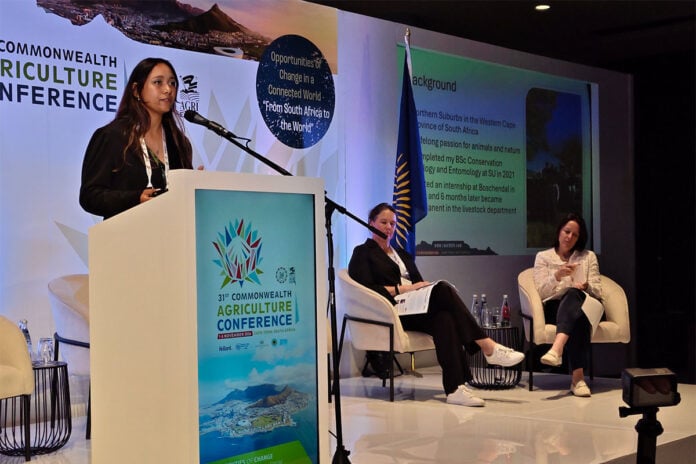
These challenges were discussed on day two of the 31st Commonwealth Agriculture Conference, held in Cape Town from 1 to 5 November, by Shannon Robertson, Boschendal’s assistant livestock manager and overall winner of the 2025 Western Cape Prestige Agri Awards (WCPAA), and Emily Norton, chairperson of the UK’s Agriculture and Horticulture Development Board. The session was chaired by Lynda McDonald, deputy chairperson of the International Dairy Federation’s (IDF) Standing Committee on Farm Management.
Their accounts showed how entry into the agriculture sector can be shaped long before a woman applies for a job or seeks a leadership position. Family expectations, exposure to farming, and assumptions about ownership all influence the opportunities women can pursue.
Land and support remain out of reach
Opening the session, McDonald said progress towards gender equality varied between countries, with women facing different barriers along the way.
She recalled the inaugural IDF Women in Dairy Roundtable, held in Chicago, US, in 2023, where CEOs and other leaders from the private sector, government, and NGOs discussed what was needed to further empower women in the dairy industry.
For women in some emerging economies, the priorities included access to a bank account, the right to own or lease land, and the ability to obtain support services without having to go through a man.
“We simply can’t talk about women in governance and leadership before those basic human rights are in place,” McDonald said.
In countries where these basic rights are established, the priorities are education and opportunities for women to enter roles in science, policymaking, and senior management, alongside better reporting on progress.
Robertson said that in South Africa, access to land remained a significant barrier, particularly for women in rural smallholder and subsistence farming communities. Land was often held by husbands or grandfathers, while women were seen primarily as household caregivers.
She added that women also need better access to finance, training, technology, and markets. Introducing them to agricultural opportunities therefore needs to go hand in hand with practical support to pursue them.
A farmer whose work goes unseen
Robertson’s own understanding of her family’s farming history illustrates how easily women’s work can be overlooked.
Her grandparents farmed strawberries and vegetables in Jamestown near Stellenbosch in the Western Cape. Growing up, she had assumed that her grandfather was the principal farmer and that the enterprise was his operation.
It was only later that she understood the division of responsibilities. Her grandfather worked in a factory, while her grandmother kept farm production going. She organised planting and harvesting, ensured produce was picked and packaged, and managed the opening of sluice gates to irrigate the crops. She also worked with other women in the community and prepared meals for them during the working day.
When Robertson asked her grandmother why she had chosen this demanding work, she spoke about the satisfaction of providing for her family and community, and the resilience farming had taught her.
“It teaches you a type of strength that you wouldn’t have known otherwise. It builds character,” Robertson recalled.
Norton described a similar lack of recognition for women in UK farm businesses. At a Women That Farm meeting, participants introduced themselves as farmers’ partners or said they “just” did the books, even though they, too, were working hard to keep the farms running.
She challenged them to claim the title of farmer and recognise the value of their contribution.
For Robertson, the assumptions are visible even among children visiting Boschendal. When groups are asked to identify the farmer, most point to the men standing with her.
Such encounters demonstrate why girls need to see women doing agricultural work and holding positions of responsibility.
Family expectations shape career choices
Norton urged women to be careful whose advice they follow, saying it could reflect other people’s experiences and expectations rather than their own interests and potential.
Despite her enthusiasm for farming, an uncle told her as a child that it was a shame she had not been born a boy. Although women in her family helped run the business, her younger brother was being prepared to take over the farm. However, he ultimately had no interest in running it.
When Norton considered her career, farming did not appear to offer a clear route forward. Her mother suggested law because she was good at arguing and the qualification could open doors.
Norton recognised that her mother wanted the best for her, but said the advice had not been right for her. She disliked legal practice and later completed a master’s degree in sustainable agriculture before creating a role for herself in the family business through dairy diversification.
However, limited investment and few opportunities to take on greater responsibility constrained her progress. She eventually pursued opportunities beyond the farm.
Norton’s experience also shaped her approach to mentoring: advice should help people recognise and develop their strengths, rather than steer them towards someone else’s ambitions.
In her subsequent work advising rural businesses, Norton continued to encounter assumptions that land would pass to men. She urged families to recognise potential regardless of gender and include daughters in discussions about the farm’s future.
“Ask your daughters, not just your sons,” she added.
Building trust and support
As the only woman in Boschendal’s livestock division, Robertson spoke about how she initially had to earn the trust of older male colleagues and challenge assumptions about the work women could do.
Over time, she built strong working relationships and credited her team, particularly her supervisor, with giving her the confidence to step away from daily farm duties to pursue opportunities created by her award, including overseas visits and speaking engagements.
“I can leave the farm with confidence, and I know when I get back, everything will be in one piece,” she said.
Robertson’s experience illustrates how a supportive workplace can help women develop their careers and share their knowledge more widely.
Safer farm design benefits everyone
The discussion also explored how working conditions could affect women’s participation.
Responding to a delegate who said he tended to protect female students from dangerous situations, Norton questioned whether those tasks could be made safer for everyone.
She described carrying calf buckets to a tap for washing when a hose could bring water to the buckets instead, as well as being asked to move a supposedly small gate that was still too heavy to carry safely.
Such difficulties could be interpreted as evidence that women lack the strength for farm work, when the task itself has been poorly designed.
Norton pointed to older men carrying injuries accumulated over years of physically demanding work as evidence that these practices also come at a cost to men.
Improving the way jobs are organised could reduce unnecessary lifting and strain, making farm work safer and more accessible to a wider range of people.
Norton added that machinery, overalls, and personal protective equipment also need to fit women properly, rather than expecting them to work with equipment designed primarily for men.
Education alone does not secure a career
According to Robertson, limited exposure to agriculture could prevent urban girls from recognising the range of careers available to them. She herself had only begun to understand the sector’s breadth after school.
She called for closer collaboration between agricultural businesses and educational institutions, particularly primary and secondary schools, to introduce girls to opportunities earlier.
However, attracting women into agricultural study and early employment addresses only part of the challenge. McDonald cited New Zealand research conducted about a decade earlier that showed women’s participation in agriculture exceeded men’s until around the age of 30, when childbirth and family responsibilities began to affect their continued involvement.
She said that retaining women after the birth of their first child and supporting their return to agriculture were therefore important challenges.
Understanding who participates in agriculture, and where support is needed, also depends on how data are collected. Norton questioned UK surveys that recorded only the principal farmer, overlooking others involved in production and management. She argued that the resulting average age of 62 did not fully reflect the younger people also farming within those businesses.
Robertson highlighted the shortage of current national data on women’s roles in agriculture in South Africa. Research she cited from 2012 showed that more than 90% of women covered by the study were general workers, while fewer than 7% held supervisory, managerial, or administrative positions.
McDonald urged agricultural organisations to track and report women’s participation in the sector. Knowing their starting point will help them set meaningful targets and assess whether efforts to improve opportunities are producing results.
Change starts with everyday decisions
The speakers emphasised that greater participation depends on practical opportunities and support, from household decisions to professional development.
For Robertson, the WCPAA had opened doors to international farming practices, technology, and professional connections. She valued being assessed via the same questions posed to male entrants within her category.
McDonald illustrated how change can begin at home. In a five-year East African project, women’s participation in co-operatives rose from 19% to 39%, supported by efforts to involve them more actively in household decisions.
She said creating these opportunities is a shared responsibility. Men in leadership positions have an important role in supporting women’s advancement and challenging assumptions about who can lead.
“We need good men to have conversations championing pathways for women when they’re not in the room,” she said.
For Norton, widening these pathways also offers opportunities for agriculture’s future. She cited French research suggesting women were drawn to sustainable and regenerative farming, attracted by its communities and more holistic approach to production.
As the sector moves towards more sustainable practices, she believes women have an increasingly important role to play.
“The future of farming is female,” Norton said.