
South African agriculture cannot allow criticism, unquestioned assumptions, or vested interests to distract it from building a profitable, inclusive, and competitive sector, according to Grain SA CEO Dr Tobias Doyer.
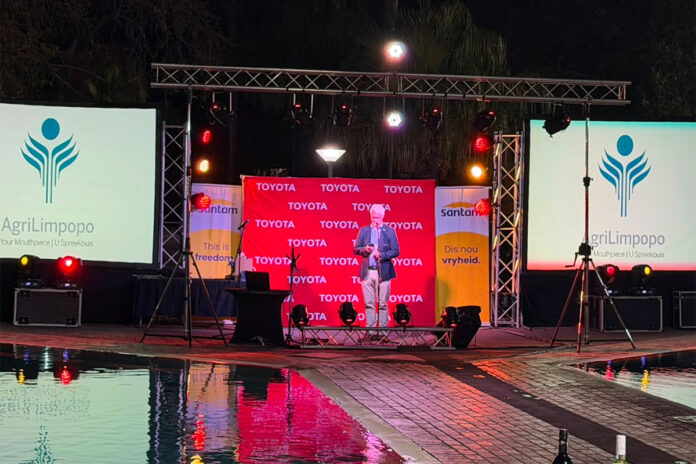
Delivering the keynote address at the Agri Limpopo Congress gala dinner at Weesgerus Resort in Modimolle on 18 August, Doyer said farmers remained under severe pressure from rising costs, failing infrastructure, policy uncertainty, concentrated markets, politics, and increasingly difficult weather conditions.
Yet the sector was still producing food, employing people, supporting communities, and carrying investment risk. Drawing on Theodore Roosevelt’s image of the person in the arena, Doyer urged the congress to ensure that efforts remain focused on the producers and not be distracted by the noise from the sidelines.
“We survived another season and are still in the arena. So before we analyse another problem, let us congratulate one another for still being in the game. Not because survival is the objective, but because staying in the arena preserves our ability to shape what comes next,” he said.
Leadership belongs at the wall
Doyer said agriculture was not only a productive sector but also a political arena in which interest groups often pursued objectives that differed from those of farmers carrying the production risk. Debates about technology, genetics, land, animal welfare, environmental rules, and consumer protection could all be influenced by agendas that have little to do with farming realities.
Organised agriculture should listen, engage respectfully, and rely on evidence, he said, but it also had to protect its ability to influence decisions. He compared the task to Nehemiah rebuilding Jerusalem’s wall while critics mocked the work, spread fear, and attacked those doing it.
“His answer was not a louder insult. He protected his people, kept them at the wall, and continued the work. Take part, stand your ground, do not retreat from the table, because empty chairs do not influence decisions,” Doyer said.
Unity does not require uniformity
The first assumption Doyer challenged was that unity in agriculture required every organisation to speak and act in the same way. He argued that the sector agrees on the important issues, even where organisations differ over strategy, tone, and tactics.
Those common goals included profitable and sustainable farms, competitive value chains, employment, foreign-exchange earnings, a reliable supply to processors and manufacturers, stronger rural towns, and national food security.
“Organised agriculture does not need unity of style, strategy, or tactics. It needs unity of purpose,” he said.
Our diversity in unity is a great asset of organised agriculture enabling healthy collaboration and tension, testing assumptions, and preventing weak ideas from becoming policy, provided that organisations continue to work towards profitable farmers and competitive value chains.
Food security needs two strong legs
Doyer also questioned the narrow view that agriculture’s primary policy role was to supply cheap food. Affordability was essential, but food security depended on both the availability of food and the ability of households to buy it.
Household purchasing power came from economic activity, including jobs, businesses, investment, tax revenue, and functioning infrastructure. Agriculture contributed to both sides of the equation by producing food while supporting input suppliers, processors, manufacturers, logistics businesses, and rural economies.
“We must therefore stop treating agriculture merely as a cost to consumers and start managing it as a strategic economic asset,” he said. A policy that repeatedly transferred the cost of affordability to the farm gate would eventually reduce production, investment, and the number of farmers willing or able to remain in the sector.
Regulation should both protect and enable competitive production
Regulation is necessary to manage risk and ensure that products, technologies, and practices are used safely, Doyer said. The goal, however, could not be the elimination of every possible risk at the expense of access to innovation.
Slow approvals for agricultural chemicals, fertilisers, animal-health products, precision breeding, and other technologies carry a significant cost. Delayed approvals result in lost competitiveness, weaker sustainability, and reduced food production while farmers in competing countries gain access to newer tools.
Balanced regulation required science-based assessment, safe use, proper enforcement, responsible stewardship, and predictable time frames. Each regulation should be tested against whether it enabled a safe, competitive and productive farming system, or merely added compliance costs and transferred responsibility to producers.
Sustainability does not mean less technology
The belief that sustainability meant using less technology was another ‘holy cow’ that needed to be challenged. Better genetics, precision farming, improved crop protection, advanced fertilisers, data analysis, and efficient machinery allowed huge sustainability improvements by helping farmers to produce more from each hectare while using fewer resources per ton.
Targeted applications could reduce chemical use, while greater fuel efficiency and productivity could lower emissions and the environmental footprint per unit of food produced. Doyer said farmers adopted technology because it reduced costs, managed risk, and raised output–the same gains that often improved environmental performance.
“Competitiveness and environmental sustainability are not trade-offs,” he said. “Access to technology is therefore not only a competitiveness requirement; it is a sustainability requirement.”
Transformation and commercial competitiveness are not separate agendas
Doyer rejected the idea that supporting developing farmers and established commercial farmers belonged to separate agendas. Machinery could be scale-specific in some cases, but genetics, agronomy, crop protection, data, market information, financial discipline, and reliable logistics were relevant to farms of every size.
Developing producers competed in the same markets and against the same international suppliers as established farmers. Giving them outdated or lower-performing tools in the name of appropriateness did not empower them; it increased their exposure to failure.
Public and private investment in farmer development, therefore, had to be protected through fit-for-purpose finance, quality support, access to technology, fair competition, and workable routes to market. Doyer said commercialisation was not achieved when a project was launched or a ribbon was cut. It was proven when a farmer could survive business cycles, reach markets, and reinvest.
Free markets still need fair rules
Markets allocate resources better than committees, Doyer said, but free markets did not automatically produce fair outcomes where power was concentrated, information was uneven, or rules distributed costs unfairly.
He pointed to the wheat tariff debate and the grain transport differential. A concentrated milling and baking sector might prefer local wheat at a discount to import parity while opposing protection for local production in the name of consumer affordability. The benefit, however, did not necessarily reach consumers.
The transport differential should also be continually refined to reduce unnecessary logistics costs and improve price discovery, he said. Existing arrangements could be defended as free-market principles by participants who benefitted from them.
“This is not proof that markets have failed. It is proof that markets need clear rules and a level playing field,” Doyer said. Every market instrument or policy should be tested by asking who benefitted, who paid, and whether the result strengthened the competitiveness of the whole value chain.
Progress matters more than consensus
Consensus could help the sector move forward, but it was not the final objective. Old assumptions and vested interests should not be allowed to veto necessary change simply because full agreement could not be reached.
Doyer said organised agriculture should support government when its actions strengthened a prosperous and inclusive sector, challenge policy that undermined that objective, and bring practical solutions that converted discussion into implementation.
He proposed six questions before the sector supported any policy, regulation, market instrument, or development programme:
- Does it improve producer profitability or resilience?
- Does it enable fair competition?
- Does it improve access to technology, markets, or infrastructure?
- Does it protect food security without quietly undermining production capacity?
- Does it deliver measurable implementation rather than only compliance and alignment?
- Does it avoid shifting public-policy costs onto farmers without a fair distribution among value-chain participants and the state?
“If the answer is no, we should not be impressed by the language around the proposal,” he said. “We should improve it, oppose it, or replace it.”
Do more and talk less
Doyer ended with a call for what he described as the right kind of leadership: not reckless leadership, but leadership that refused to accept that broken systems had to remain broken.
Agriculture had to drive unproductive ‘holy cows’ out of the kraal and harness productive priorities instead–technology, fair competition, functioning infrastructure, farmer development, food security, and measurable delivery.
“The wall is not rebuilt by commentary. The city is not restored by mockery. Hope is not created by those who carry no responsibility,” he said. “Agriculture needs the right kind of leadership. Leadership that brings energy, evidence, and persistence.”