
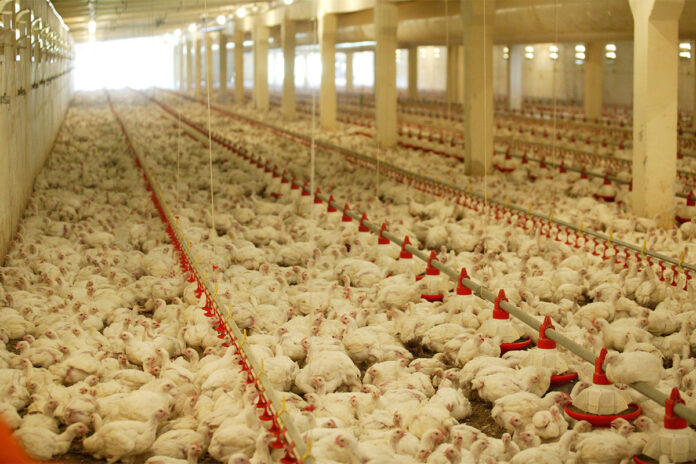
The high-density, intensive nature of chicken farming makes biosecurity a paramount concern for poultry producers, as disease or infection can spread rapidly throughout poultry houses and farms if left unchecked.
On-site biosecurity starts at the perimeter of the production facility. At a biosecurity house situated at the farm gate, every person must remove their own clothing and shower, regardless of whether they have already showered at home.
Dr Thapelo W Kekana of the Western Cape Department of Agriculture outlined the strict ‘shower-in’ biosecurity protocols required for all individuals entering a poultry facility.
The farm then supplies fresh, sanitised clothing, including boots, socks, overalls, aprons where necessary, face masks, and hair nets. This is followed by hand sanitisation and other required hygiene procedures.
Kekana emphasises that this process cannot be compromised. If a worker leaves through the final door of the gate building for as little as 10 minutes and then returns, the entire showering and changing process must be repeated from the beginning.
Controlling access to the production area
Employee and visitor parking should be located entirely outside the production zones, while administrative offices should be separated from bird housing. A single, restricted-access road should connect the gatehouse directly to the production zone, forcing every person entering the production area to pass through the central biosecurity house.
Protective clothing and personal protective equipment (PPE) must not leave the farm. For employees working a normal eight-hour shift, worn PPE should go directly into a cleaning and disinfection cycle at the end of the shift.
Employees are typically assigned two or three sets of uniforms so that one can be laundered while another is being worn. Visitors’ PPE should be handled separately. Immediately after use, it should be placed in a designated basket or bin to prevent it from being mixed with unused equipment.
Wild birds, rodents and other vectors
Flying vectors cannot be controlled through perimeter fencing alone. The main strategy is therefore to create as much environmental isolation as possible. The connection points between feed silos and chicken houses should be inspected daily to ensure that feed is not spilled during offloading and feeding. Any spilled feed must be cleaned up immediately to prevent wild birds or rodents from being attracted to the site.
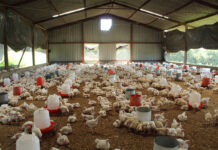
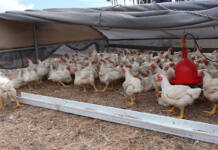
Chicken houses should be fully enclosed and structurally sealed. Mechanical ventilation systems, internal heaters during cold weather, and fans or coolers during hot weather can be used to maintain the required internal environment while excluding insects, rodents, and wild birds.
Externally, rodent traps and disinfectants should be used around the structures, while vegetation and grass should be completely cleared for 3m to 5m around them to create a vegetation-free apron. This makes the area less attractive to potential vectors.
Under this protocol, workers are also required to live nearby to reduce travel-related risks. If an employee plans to travel home or visit a location where they may come into contact with other poultry, this must be reported a week in advance.
On returning, the employee must undergo a two-to-three-day downtime period before being allowed to re-enter the clean chicken houses, in accordance with the farm’s biosecurity protocol. In addition, workers living on or near the farm should not keep backyard poultry where this forms part of the farm’s biosecurity requirements.
Contractors, vehicles and deliveries
External maintenance personnel, such as technicians and contractors, can act as biological vectors and carry disease-causing organisms. Farm owners should therefore require contractors to follow the same washing, showering, and clothing-change procedures as farm employees.
Visitor and contractor records should also be maintained, with personnel required to declare recent contact with poultry, live-bird markets, hunting activities, rendering facilities, laboratories, or other poultry farms.
Clear collaboration and, where appropriate, memoranda of understanding with contracted maintenance companies should be established to ensure compliance with the farm’s biosecurity requirements. This is particularly important because technicians may move directly from Farm A to Farm B to attend to mechanical problems, creating a significant cross-contamination risk, particularly where farms have flocks of different ages.
Vehicles and deliveries also require strict biosecurity controls, as vehicles can introduce and spread pathogens within production sites. Ideally, feed silos should be positioned along the perimeter fence, allowing delivery trucks to offload feed from outside the production area without entering the farm premises. At the gate, before any vehicle enters, the site supervisor should determine whether entry is permitted, considering the prevailing disease situation, the purpose of the visit, and the required cleaning and disinfection procedures.
Where vehicles are permitted to enter, cleaning must first remove all organic material, followed by the application of an approved disinfectant at the correct label concentration, coverage, temperature, and contact time. These measures help minimise the risk of introducing pathogens onto the farm and spreading them between production units.
Isolation between poultry houses
Strict isolation protocols should also be maintained between different chicken houses on the same farm. A single farm may contain multiple houses separated by 10m to 15m. For example, a manager may oversee numerous houses divided into Sites A, B, and C, with five houses on each site.
To prevent cross-contamination, specific employees should be allocated to specific sites. Staff should not be shared between unrelated flocks. Where this is unavoidable, a veterinarian-approved movement order and complete clothing-change and hygiene procedure should be followed.
An ‘all-in, all-out’ batch system, where all five houses on a site contain birds of the same age, may allow employees to move between houses. However, Dr Kekana advises against this practice because an undetected infection in House 1 could easily be carried into House 2 by the same worker.
If a manager needs to move between separate sites, they must shower and change clothing at each individual site boundary. Farmers should also source chicks or point-of-lay pullets from suppliers with documented, reputable health programmes.
Equipment sharing should also be avoided. Every poultry house should have its own dedicated storage room containing its own tools, forks, and spades so that equipment is not exchanged between houses. When equipment must be moved, its origin and destination, cleaning and disinfection, disinfectant contact time, and release should be recorded.
Feed silos, water, air and traceability
Feed silos should also be isolated for each poultry house to support both traceability and biosecurity. Approved feed suppliers, closed bins, spill-control measures, first-in-first-out inventory practices, and pest exclusion should be used. Every chicken house should therefore have its own independent silo.
Although modern farms typically use a single feed company to reduce the risk of cross-contamination during feed manufacturing, maintaining dedicated silos for individual houses remains important. Water and litter are also important potential routes for disease introduction.
Water should be potable, disinfected, routinely tested, and suitable for poultry production. Ventilation should be managed so that air inlets do not draw directly from mortality, litter, dust, or exhaust sources. Clean bedding should be stored under cover.
Manure, used litter and dead birds
Manure, used litter, and dead birds should be handled and stored in a way that prevents them from becoming a disease risk. Used litter should be removed appropriately following flock depletion, while mortalities should be disposed of in a manner that prevents access by vermin and limits the potential spread of pathogens.
Manure and used litter should be moved via a designated dirty route, and equipment should not return to clean zones without appropriate cleaning and disinfection. Applicable nutrient-management and disease-control requirements should be followed.
During a suspected outbreak, litter or manure should not be moved without authorisation from the relevant authority. Staff moving between manure areas and egg rooms must change the required protective clothing and follow prescribed hygiene procedures.
The South African Poultry Association (SAPA) highlights record-keeping, cleaning, and disinfection as supporting elements that cut across the entire biosecurity programme.
Good records and a written biosecurity protocol make it possible to trace movements, training, health events, and corrective actions, while an effective cleaning and disinfection programme helps prevent pathogens from persisting on the farm or spreading within it.
For more information, please refer to the full biosecurity checklist on South African Poultry Association (SAPA).