The protected industrial action has brought production to a standstill at 12 sugar mills operated by the country’s major milling companies, namely Tongaat Hulett, Illovo Sugar South Africa, RCL Foods, Gledhow Sugar Company, UCL Company, and Umfolozi Sugar Milling.
Workers represented by the Food and Allied Workers Union (FAWU), the largest of the unions, representing about 2 800 workers, the Association of Mineworkers and Construction Union (AMCU), and the United Association of South Africa (UASA) are demanding a 13% across-the-board wage increase, as well as improved allowances and benefits.
However, the unions say they are prepared to return to negotiations if employers table an improved offer of at least 7% unconditionally, compared with the 5,4% currently on offer.
The strike follows a breakdown in wage negotiations that began in February and were then referred to the Commission for Conciliation, Mediation and Arbitration (CCMA) after the parties failed to reach an agreement.
The CCMA subsequently issued a certificate of non-resolution, allowing the unions to embark on protected strike action.
A wide gap
FAWU national sugar sector organiser Sibonelo Mbuyazi told Farmer’s Weekly that the Sugar Manufacturing and Refining Employers’ Association (SMREA) had offered a 5,4% wage increase, effective 1 April 2026.
He added that, at the same time, the SMREA had offered an additional 0,6%, but this was conditional on government granting the industry the requested increase on import tariffs, which would make imported sugar more expensive, helping local sugar producers compete with cheaper imports.
However, FAWU rejected both increases.
The union has tabled demands for a 13% wage increase, a R1 000 monthly transport allowance, a R1 500 monthly housing allowance, a 40% increase in the employer’s medical aid contribution, a standby allowance equivalent to 20 hours, and that implementation of the agreement be backdated to 1 April 2026.
“Workers’ wages cannot be made conditional on government processes, while their bills, transport costs, rent, food, and medical expenses are payable every month without condition,” FAWU deputy general secretary Edwin Mabowa told Farmer’s Weekly.
He explained that the strike was not simply about percentages: “It is about the worsening conditions of the working class, the declining purchasing power of workers, and an economic system that continues to protect profits while shifting the burden of the cost-of-living crisis onto workers.”
Mabowa added that workers could no longer be expected to support the survival and profitability of the sugar industry through what he described as “suppressed wages and inadequate benefits”.
“The demand for decent wages and improved conditions is therefore not unreasonable or excessive. It is a demand for workers to live with dignity from the wealth they themselves produce.”
Milling brought to a standstill
At Tongaat Hulett, 1 828 of the striking workers are represented by AMCU, according to Christopher Ndebele, the union’s regional secretary.
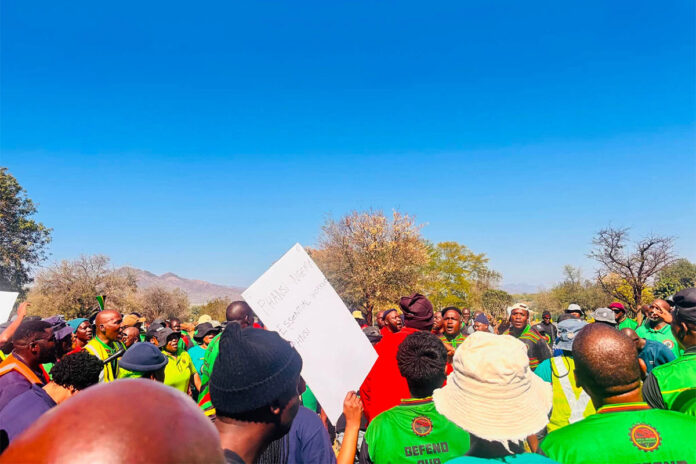
Workers protested outside Tongaat Hulett’s Maidstone and Felixton mills on the KwaZulu-Natal North Coast this week, with production largely halted since the strike began on Monday.
The company only recently narrowly escaped liquidation thanks to an eleventh-hour deal that allowed its mills to open for the sugar cane milling season.
The strike comes as producers are already facing competition from imported sugar, rising operating costs, and concerns about the long-term sustainability of local production, adding another layer of uncertainty to the industry that supports thousands of farming and processing jobs, particularly in KwaZulu-Natal and Mpumalanga.
Speaking to Farmer’s Weekly, a Tongaat Hulett Maidstone Mill worker, who wished to remain anonymous, said the workers could not continue bearing the failings of big business and government.
He said that while government needed to address the structural challenges facing the sugar industry and protect local production from destructive imports, protecting the sugar industry does not mean protecting employers at the expense of workers.
“Any tariff protection, industrial support, or government intervention provided to the industry must translate into job security, decent wages, improved working conditions, and meaningful investment in us, the workers, and our local communities,” he said.
Mabowa added that workers should not be expected to carry the cost of an industry crisis they did not create.
“Workers did not create the structural problems confronting the sugar industry and must not be continually forced to pay for it.”
He said workers were repeatedly told to exercise restraint when industries faced difficulties, while being expected to accept smaller increases and protect jobs, creating a broader imbalance in which “profits remain private, while economic hardship is socialised onto workers and their families”.
In a media statement, UASA spokesperson Abigail Moyo said workers were seeking wages and benefits that reflected the rising cost of food, fuel, electricity, transport, and housing.
“The strike signals that the collective bargaining process has reached an impasse and that conventional negotiations have failed to produce an acceptable outcome,” she said.
Moyo called on employers to return to the negotiating table, saying UASA remained committed to finding “a fair and sustainable agreement”.
The South African Federation of Trade Unions (SAFTU) has also backed FAWU and the striking workers.
In a statement, it said the dispute was about more than wages and benefits.
“The strike is about whether the workers who produce the wealth of the sugar industry will continue to shoulder the burden of an economic crisis they did not create while employers seek to protect profits at their expense.”
SAFTU also called for any tariff protection or state assistance to the industry to be linked to “decent wages, job security, improved working conditions, investment in productive capacity, and the protection of employment”.
Next steps
FAWU has called on SMREA and its member companies to return to the negotiating table with an improved mandate.
“However, negotiations cannot become a process through which workers are repeatedly instructed to abandon legitimate demands while employers refuse to substantially improve their position,” Mabowa said.
He noted that workers would continue exercising their constitutional and labour rights through strike action until meaningful movement was achieved.
UASA has also called for renewed negotiations, urging its members to continue the protected strike peacefully and within the law.