
The future of South African agriculture will not be shaped by one policy, commodity, or market. It will depend on how effectively the sector responds to constrained domestic demand, global trade uncertainty, climate variability, infrastructure weaknesses, animal disease, and the need to bring more farmers into productive value chains.
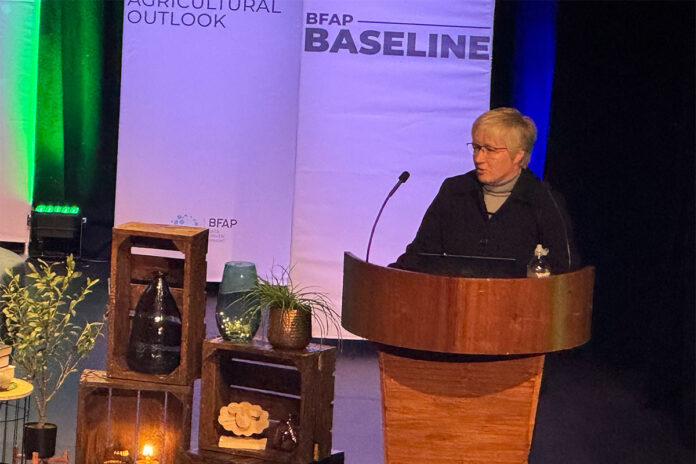
That was the overarching message at the launch of the Bureau for Food and Agricultural Policy’s (BFAP) Baseline 2026 Agricultural Outlook in Pretoria on 12 August.
Dr Tracy Davids, a director at BFAP, stressed that the baseline should not be regarded as a prediction of exactly what will happen. Rather, it represents one possible future outcome based on a set of assumptions about structural factors, with its value lying in providing a benchmark against which alternative scenarios can be tested.
Taking stock before looking towards 2050
The 2026 baseline comes at an important point in South Africa’s agricultural policy journey. The country is fast approaching the National Development Plan 2030 (NDP) deadline, while the Agriculture and Agro-processing Master Plan provides the current framework for growth and transformation.
The 2050 horizon is significant because many of the relatively accessible opportunities identified under the NDP have already been exploited. BFAP is therefore looking beyond 2030 to the longer-term structural forces that will shape agriculture, including export-led growth, technology, climate variability, natural resources, rural safety, and transformation.
Prof Ferdi Meyer, managing director of BFAP and an extraordinary professor in Stellenbosch University’s Department of Agricultural Economics, said irrigation expansion, for example, had exceeded the NDP’s original target, while import replacement and agro-processing had also contributed to growth. The sector now has to look beyond these gains towards more complex challenges.
Meyer identified nine megatrends grouped into three broad themes: export-led growth and changing markets; technology and the closing of productivity gaps; and structural issues such as climate variability, natural resources, rural safety, and sustainable transformation.
He added that one of the most important conclusions was that export growth and food security should not be treated as opposing strategies.
South Africa’s rapidly urbanising population will increasingly depend on competitive commercial value chains to supply affordable food, while agriculture in rural areas will remain central to food security. According to Meyer, the challenge is therefore to build export-oriented value chains while ensuring that domestic consumers benefit from the greater volumes, efficiency, and value generated by those markets.
A strong sector operating in a weak economy
The baseline also highlights agriculture’s remarkable performance relative to the broader economy. South Africa’s economic growth has averaged less than 1,5% per year, while agriculture has grown roughly three times faster than the economy over the past 15 years.
That performance has been achieved despite commodity cycles, the Russia/Ukraine war, weather shocks, animal disease, and serious weaknesses in support infrastructure.
Domestic demand remains constrained by weak economic growth and limited disposable income. Davids pointed to substantial differences between consumer groups, with lower-income households increasingly forced to choose more affordable staple foods, while premium products continue to perform strongly among higher-income consumers.
Against this backdrop, BFAP sees exports becoming increasingly important as a growth engine for agriculture.
Export growth comes with a price
The export opportunity is considerable, particularly in horticulture and higher-value livestock products. However, BFAP’s analysis shows that market access alone will not be enough: South African producers will have to remain competitive in increasingly demanding international markets.
Field crops illustrate the challenge. Most major field crop industries have moved into net-export positions. Export-parity pricing keeps staple foods relatively affordable for consumers and provides competitively priced feed for livestock, but it also means producers face persistent pressure to improve productivity.
The good news is that productivity gains have been substantial.
South African maize yields have increased by about 3,5% per year over the past decade, soya bean yields by more than 3%, and canola by almost 5%. Improved production practices, conservation agriculture, soil moisture management, irrigation, precision technology, machinery, and improved seed genetics have all contributed.
Future growth, however, will increasingly need to come from yield rather than area expansion.
BFAP expects yield growth to continue, albeit at a slower pace because many productivity gains have already been adopted and the production base is now much larger.
Infrastructure will also determine whether production can be converted into export growth. South Africa needs rail and port systems capable of handling large surplus volumes during good production years, rather than only planning infrastructure around average conditions.
Livestock export potential hinges on animal health
The livestock outlook is more positive than that for field crops, with strong international meat markets supporting prices. However, foot-and-mouth disease (FMD) remains one of the greatest constraints to unlocking this potential.
Minister of Agriculture Willie Aucamp used his keynote address at the launch to underline the scale of the problem, noting that meat imports had increased by 44,6% during the FMD crisis.
He said government was re-energising its disease response, with 17 million FMD vaccine doses already imported from Argentina and Türkiye, and another four million expected shortly.
Aucamp also highlighted the new arrangements under which farmers can register as authorised persons to purchase FMD vaccines through local veterinarians and vaccinate their cattle themselves.
The minister’s message was closely aligned with BFAP’s analysis: animal health is not simply a veterinary issue; it is an economic and trade issue.
Transformation needs better evidence
The baseline’s long-term vision also places transformation firmly within the discussion on economic growth.
In her presentation on inclusive agricultural transformation, BFAP analyst Khanimamba Baloyi highlighted a fundamental problem: South Africa does not have a complete picture of the agriculture sector.
A significant portion of agriculture remains unmeasured and largely unreported, while about two million households practise subsistence farming, particularly in KwaZulu-Natal, the Eastern Cape, and Limpopo. Baloyi explained that this matters because substantial resources are being invested in agricultural transformation, yet the sector often cannot accurately quantify the impact.
She added that, without time-series data, it is difficult to determine whether farmers are becoming more productive, whether jobs are being created, or whether farmers are progressing towards commercialisation.
Baloyi argued that South Africa needs to move from fragmented data to insight and foresight, measuring what works and what does not. That evidence will be critical to ensuring that transformation spending produces measurable economic and social returns.
Macroeconomic backdrop cannot be ignored
BFAP’s macroeconomic outlook added another layer of caution.
Shannon Bold, a senior economist at the Bureau for Economic Research, highlighted pressure on households, weak private investment, and the importance of policy and institutional stability.
She said that consumers entered 2026 with some momentum, supported by lower inflation and expectations of falling interest rates, but that momentum had weakened as pressures on disposable income increased.
Private investment is of even greater concern. It accounts for about 70% of total fixed investment, yet BFAP expects another negative year after a decline of about 2,2% last year. A recovery of around 2% from 2027 would still be too weak to significantly expand the economy’s productive capacity.
Agriculture cannot escape these macroeconomic realities. Investment in irrigation, machinery, technology, processing, logistics, and new enterprises depends on an economy capable of supporting long-term capital formation.
A partnership, not a prescription
Aucamp’s speech perhaps captured the central message of the 2026 baseline most clearly.
He described the report as a “trusted investment compass” that has helped the sector navigate long-term policy and structural developments.
He also acknowledged that government cannot solve agriculture’s challenges alone, adding that he is committed to building partnerships in which government facilitates and enables, while farmers and the private sector are empowered to produce food and drive economic growth.
The minister pointed to record agricultural exports of R67 billion in the first quarter of 2026 as evidence of the sector’s resilience, but warned that volatile global trade, possible US reciprocal tariffs, biosecurity threats, logistics constraints, and El Niño-related weather challenges remain significant risks.
He also committed to greater inclusivity, citing government’s R3,2 billion allocation to food security and farmer-support programmes, as well as plans to strengthen frontline advisory services.