On our way to the Welgeluk Feather Palace, an arresting sight made us pull the bakkie over, turn off the engine and gape in awe.
With dance moves like those of the Big Chiefs of Mardi Gras in New Orleans, US, a male ostrich with blood-red shins was busy courting his lady in a roadside paddock, with a large flock watching over the fence.
He dropped to the ground, spread his gorgeous wings before the bedazzled ostrich hen, gyrated in moves straight out of a raunchy cabaret and, with his head flung back, began to thrum and dance, making a loud booming noise.
Then, lifting himself on the tips of his toes like a ballet dancer, he puffed up all his feathers and ran daintily around the eyelash-batting object of his affections.
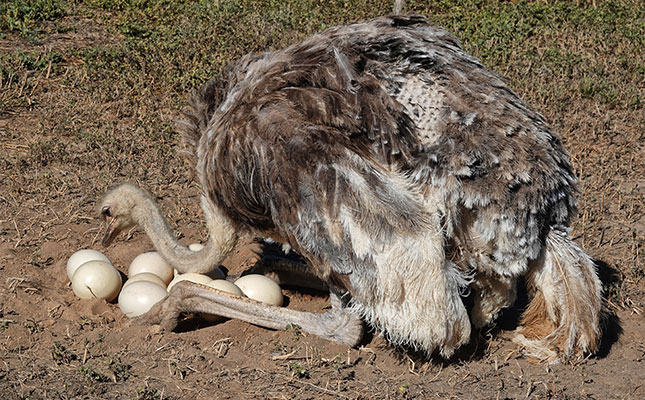
She obviously fancied him, because she lowered her head as she walked on, shivering her grey wing feathers in approval. She found a suitable spot in the dust, sat down, and the games began.

Welcome to ostrich country
“Now we’re truly in ostrich country,” said Julienne as we drove past more paddocks on the outskirts of town, into the heart of Oudtshoorn with all its iconic Big Bird signs, and out the other side onto the Calitzdorp road.
The Storied Bird
In the first half of the 19th century, Oudtshoorn was a hardscrabble village described by its detractors, rather haughtily, as Veldskoendorp – a place of poor man’s shoes. It was officially named Oudtshoorn in honour of a newly appointed Cape governor who never made it to these shores; he perished on the sea voyage out.
The 1860s began with a killer drought and ended in the Golden Age of the Ostrich. The ostrich farming frenzy really took hold when Arthur Douglass invented the incubator in 1869, and production was vastly increased.
This saga of the South African ostrich industry comes with its own exotic adventure story, worthy of an Indiana Jones film or an Allan Quatermain classic.
The Barbary bird expedition
The average ostrich farmed in the Little Karoo was just so-so, back then. It simply did not possess the ultimate plume quality to match that of the Barbary Bird, found somewhere in North Africa.
There was a need to enrich the South African breeding stock with the Barbary, to give the locals an edge over their rivals, the US. The magical feather everyone was after went by the name of Evans-Lovemore. It was blunt, strong and double-fluff dense.
So, a small and discreet party, led by Russell Thornton of Grootfontein Agricultural College in Middelburg, set out in September 1911 on a steamship up the Niger River in the general direction of Timbuktu.
A couple of train journeys later, they were based in Kano, northern Nigeria. They offered a reward for a sample of the Evans-Lovemore, located a likely source from Fort Zinder in French Sudan territory, recruited more than 100 porters, kept an eagle eye out for Tuareg raiders, and hit the desert with gusto.
Thornton begged the French fort commander at Zinder to allow them to export some of the indigenous ostriches. The answer was a firm no, and so they returned to Nigeria and put out a general appeal for Barbary birds once more.
Ostriches from all over the region were presented to the South Africans, and gradually, bird by bird, they gathered a flock of Barbary birds to take home. Nearly 150 specimens were carefully transported to the coast and shipped down to South Africa.
Thornton was hailed as a local hero, the South African breeding herds were enriched, and the Americans were full of envy.
In fact, so entrenched was the South African grip on the ostrich trade that, when the Titanic sank in 1912, part of its most valuable on-board cargo was a shipment of our feathers bound for New York markets, insured for millions of dollars.
Palaces built on feathers
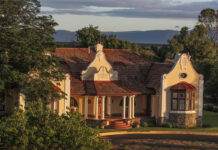
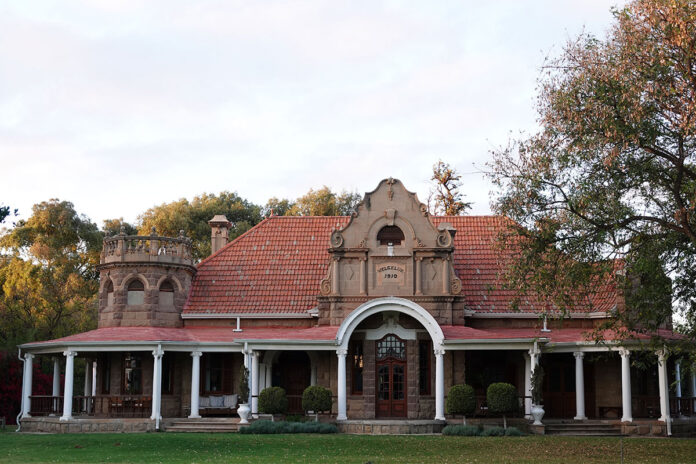
They’re all over the district, these glamorous mansions with their wraparound stoeps, pillars, long balconies, turrets and follies.
Back in 1910, when Oudtshoorn was flush from the booming ostrich feather trade, many landowners built such lavish dwellings.
Most were decorated with stained-glass windows. Doors and stained-glass windows were imported from Holland, roof tiles from Belgium, pillars and columns from Greece, woodwork from India, marble from Italy, and fireplaces from Britain. The sandstone, however, was pure Klein Karoo.
The two architects who made serious names for themselves in the district back then were British-born Charles Bullock and Dutch-born Johannes Egbertus Vixseboxse, who had based themselves in the Oudshoorn area.
You see their handiwork all over Oudtshoorn in the form of mansions that have been repurposed into old-age homes, museums, small businesses and, more recently, guest houses.
Welgeluk’s remarkable story
The Oliviers of Welgeluk Farm, just outside Oudtshoorn, built a lovely sandstone home during the boom. After the feather price crashed and stayed down during World War I and the Great Depression that followed, the Olivier family sold it for a song to Nathan Lipschitz, a local watchmaker, in 1933.
Nathan, grandfather of the present owner, Stan Lipschitz, was originally from Lithuania. He came out to South Africa and opened a jeweller’s shop, where he also sold ostrich feathers.
“His friend Bramwell Butler was very keen to buy a ticket to the Calcutta Sweepstakes,” said Stan when we sat down in one of the lounges of Welgeluk for a background interview. “So, my grandfather lent him the money for the ticket.
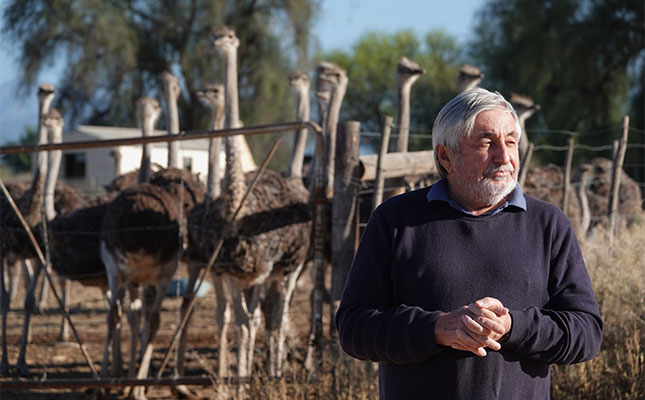
“And you know what? Butler won the Calcutta Sweepstakes and pocketed no less than £125 000 (roughly R26 million today).
“And when Welgeluk came on the market and my grandfather was interested, Butler lent him the £8 000 to buy it.”
Nathan Lipschitz never lived in the feather palace, preferring his Oudtshoorn residence. But, with the help of a foreman and several bywoners (tenant farmers), he set up a large mixed farming enterprise at Welgeluk.
Eventually, Nathan’s son Harry and his wife Ida came to live and farm there. Their son Stan and his wife Bernadette are the current custodians.
The Ostrich King
In 1890, an extraordinary Lithuanian Jewish teenager called Max Rose arrived in Oudtshoorn. Working as a feather buyer, the 17-year-old Rose quickly developed a good eye for a fine plume. He also studied ostrich breeding and feeding and soon entered the lucerne farming business.
As the new century dawned, Rose was already a substantial landowner and recognised ostrich expert. But more than that, he was said to be a mensch – a Jewish saying for an all-round good guy.
Author Sue van Waart quotes feather merchant Marcel Habib on Rose: “Max was a gambler who would bet his trousers on a horse, but his heart was pure gold.”
At the time of the Feather Fall, while many about him were losing their heads, Rose remained true to the ostriches. Even though he took a major financial hit at this time, Rose played the long game with his birds. And he also diversified his farming.
He was later appointed to the Ostrich Feather Commission and regained his status as the Ostrich King of Oudtshoorn.
“Max Rose was our neighbour,” said Stan. “He lived on the farm Seekoegat next door. He rose above the feather crash.”
Stan the Feather Man
In the ostrich farming world, you get your leather men and your feather men. Stan is in the latter camp. He has a feel for a feather, an eye for the supple sheen, the drape and the curl of a plume.
He also has an eye for a useful ostrich bloodline. Although he diversifies his farming, like his late and legendary neighbour Rose, to listen to him talk of ostriches is to hear a man express his passion, although he has never developed a taste for the meat of the big bird.
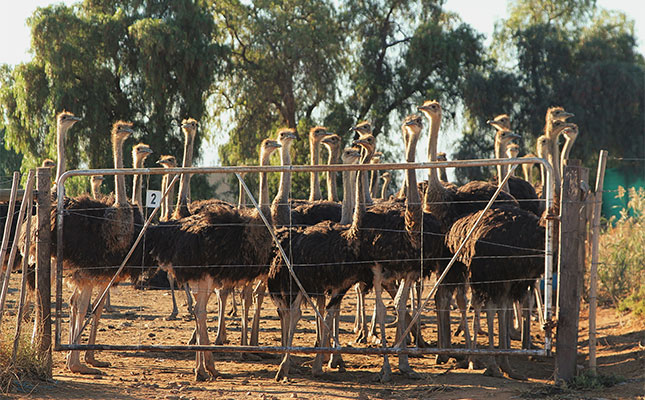
“At 14 months old, a bird’s first feathers are at their best,” he said. “They become ‘ripe’ and are easy to pluck. And that’s when you put a bank bag over its head and you pluck away.
“I also believe in allowing the ostrich parents to raise their chicks. I don’t raise them in age batches, like some others do,” he said.
“These birds eat the weirdest things. One even ate the clothes off a labourer’s washing line, and another swallowed a few knives. You can guess what happened to that one.”
They are also notoriously skittish.
“Some time ago, there was a Karen Zoid concert nearby. My ostriches freaked out, and some ran into the thorn trees and messed up their skins.”
Modern-day Welgeluk
When we first met Stan back in 2019, he was not an entirely happy chap.
The likeable Stan, who grew up in this baronial pile, was in the throes of renovating the place and both the job, and the costs involved were eye-watering.
We followed him around among the tarpaulins, ladders and paint tins where he swiftly showed us the many rooms, the rosewood Adams fireplace, the paper mache ceilings, the brass beds, the 1 500-litre bath, the nanny’s nook, the kitchens, and the pantries. It was like being in a slightly dishevelled but very grand Victorian-era English mansion.
Stan was about to turn Welgeluk into an upmarket bed and breakfast establishment. Little did he know that, in addition to renovation costs, the bleak COVID-19 year of 2020 lay waiting.
When we stayed with Stan last October, it was a different story.Welgeluk was humming with bookings, the Safari Ostrich Show Farm next door was doing very well, and Stan reckoned he had cooked more ostrich egg omelettes for his guests than any other human being on the planet.
Stan, whose business was thriving, had clearly taken to heart the Max Rose Guide to Surviving the Klein Karoo.
For more information, phone Bernadette on 082 491 1393, or visit welgelukfeatherpalace.co.za.