
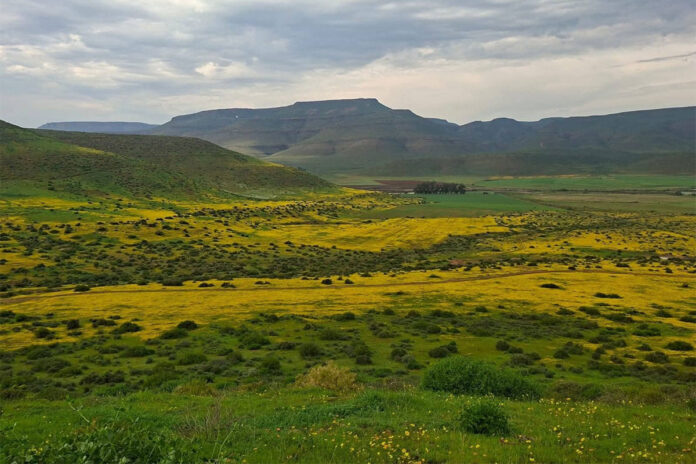
The 2026 Clanwilliam Wild Flower Show, originally scheduled to take place from 28 August to 6 September, has been cancelled for the first time since the Day Zero drought in 2017, according to the show’s chairperson, Tanja Coetzee.
Speaking to Farmer’s Weekly, she said the region, like many others in the province, experienced flooding following heavy rainfall in May, but has received virtually no rain since then.
“A fire last year would ordinarily have stimulated an unusual array of wild flowers, creating considerable anticipation about what would emerge this season. However, this year, the flowers appeared earlier than usual and were sparse and weak. A heatwave during the past week also caused most of the veld to flower out [finish flowering],” she said.
The organisers consequently decided that proceeding with the show would be environmentally irresponsible and could place additional pressure on already scarce resources.
“The cancellation is a huge disappointment for Clanwilliam. The show means a great deal to the local economy and forms an important part of the identity of the town and its people,” Coetzee said.
Stations record incredibly dry July
According to a South African Weather Service (SAWS) press release issued on 31 July, several weather stations across the south-western Cape recorded below-average rainfall in June, followed by their lowest July rainfall totals in decades.
The Cape Town International Airport station received only 14,4mm, about 16% of its long-term July average and its lowest total since recording began there in 1958.
Meanwhile, the station at the South African Astronomical Observatory recorded 15,6mm, its lowest rainfall for July in 91 years, while the Malmesbury station received just 3,2mm, its lowest for the month in 33 years.
The station in Kirstenbosch recorded 65mm, its lowest level for July in 29 years; Hermanus received 12mm, its lowest for the month in 21 years; and Paarl recorded 27,6mm, its lowest for July in 17 years.
The SAWS attributed the dry conditions to a strong blocking high-pressure system over the Atlantic Ocean, which pushed cold fronts farther south. Only three weak cold fronts crossed the south-western Cape during July.
Agricultural production
Nevertheless, major Western Cape dam levels rose from 79,2% to 79,7% in the week ending 27 July and remained more than two percentage points higher than at the same time last year.
However, Jannie Strydom, CEO of Agri Western Cape, said these levels offered little reassurance to dryland grain producers.
Winter grains and oilseeds such as wheat, barley, and canola are grown almost entirely without irrigation in the province and depend directly on seasonal rainfall. Grain producers are therefore more exposed to the dry winter than fruit and wine producers, who could draw on stored water for irrigation.
“Our concern when it comes to grain is not really about the dams; it’s about the sky,” Strydom said.
He added that livestock producers in several areas were also suffering from grazing shortages. In response, the Western Cape Department of Agriculture has approved R22 million in fodder support for affected farmers in the Central Karoo, Garden Route, Tankwa, and Barrydale regions.
Strydom said Agri Western Cape welcomed the assistance, having also provided drought relief earlier in the year.
Wheat production
Andries Theron, a wheat producer in the Swartland, said the region had experienced its lowest rainfall in more than 20 years. His farm has received only 3mm since the heavy rain in May, when between 120mm and 130mm fell.
He added that while grain crops generally still looked reasonable across the Swartland and northwards towards Namaqualand, moisture stress was becoming visible on warmer, sun-facing slopes. The same could be seen in parts of the Overberg.
“You can see that the crops on the sunny slopes are taking a knock,” Theron said.
Misty mornings had helped sustain crops in the Swartland so far, but rain was urgently needed as temperatures began to rise. Theron said he hoped the region would receive good rainfall by the end of the week.
He added that conservation agriculture practices had helped buffer crops against the worst effects of the dry conditions.
“Without conservation agriculture, the losses would have been much greater. But, at the end of the day, the crops still need moisture,” he said.
Potato production
Potato producers were also feeling the impact, according to Pierre Smit, a farmer from the Sandveld.
He explained that producers of irrigated potatoes in the Sandveld had suffered losses due to the unusually hot weather, while dryland farmers around Darling and Hopefield had incurred major losses because of the lack of rain.
Smit said irrigation farmers were also concerned about the coming production season, as sufficient rainfall is required to replenish the groundwater resources on which they depend.
Use water sparingly
Strydom urged farmers and other water users to continue using water sparingly while storage levels remained relatively healthy, and called for planned water-augmentation and resilience projects to be advanced.
“Healthy dam levels should not create a false sense of security, particularly given the uncertainty surrounding the 2027 winter rainfall season and warnings that the developing El Niño could be one of the strongest on record,” he added.