
As of 19 May, 99 roads across the Western Cape remain closed until further notice, while a further 21 are partially accessible or restricted to residents only.
In some farming areas like Oudtshoorn, producers have reportedly been without electricity for 16 days due to damaged infrastructure. Meanwhile, several well-known wineries along the Breede River in the Robertson Valley have been temporarily closed due to flooding and damage to vineyards, cellars, roads, and other infrastructure.
Rojeanne de Wet, liaison officer at Agri Western Cape, told Farmer’s Weekly that the organisation is working closely with the Western Cape Government, the Western Cape Department of Infrastructure, and Eskom to address farmers’ needs.
“Agri Western Cape is acutely aware of the losses and damages that farmers are facing as a result of the floods. The repair and restoration of critical infrastructure, such as roads and electricity poles, are crucial,” she said, adding that these departments are “working around the clock” to address these needs.
“The floods have resulted in more than 100 000 residents in the province being negatively affected, and 3 680 displaced residents have been relocated to community halls.”
Severe agricultural damage
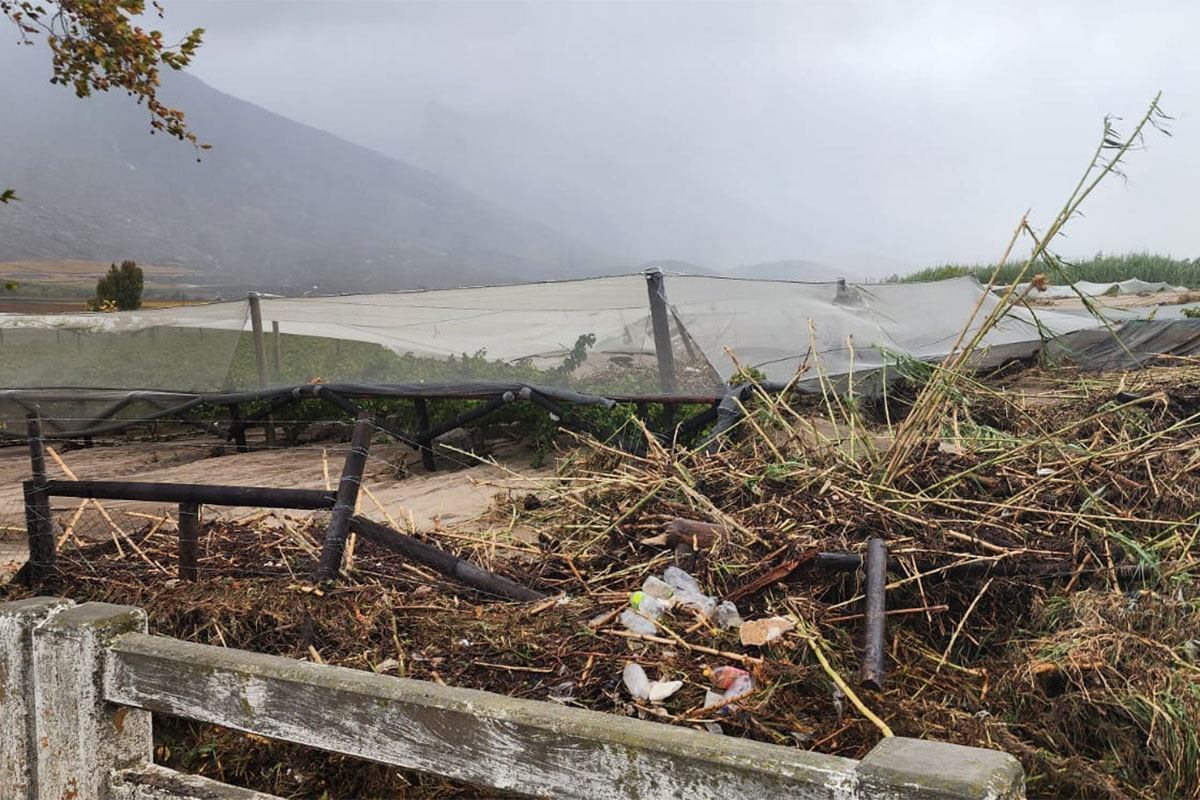
De Wet noted that the floods have had a severe impact on agricultural operations: “Across many affected areas, farmers have lost water pumps and [other] critical water infrastructure, while also suffering extensive damage to orchards, tunnels, houses, and farm buildings such as cellars and barns.
“For citrus producers in the West Coast District, the timing of the floods has been particularly devastating, coinciding with the peak harvesting period. Flooded roads and damaged infrastructure have made it impossible for many farmers to harvest or transport their citrus produce. Furthermore, some farmers are completely cut off from towns due to flooded or damaged roads.”
Citrus farmer Gerrit van der Merwe, managing director of ALG Estates in Citrusdal and Clanwilliam and chairperson of the Citrus Growers’ Association of Southern Africa, said the flooding “hit us badly again.” It is the fourth consecutive year that the area has experienced major flooding.
“We’ve had the highest flood levels in history, and our farming operations were hurt. We definitely lost fruit, but we don’t yet know how much,” he said.
Van der Merwe said the work done by the Western Cape Government to clear the river and repair damaged roads after the last flooding incidents helped save lives this time around.
“The river-cleaning project launched by [Minister of Agriculture, Economic Development and Tourism] Dr Ivan Meyer’s department helped. The road did not break; it definitely saved lives and a lot of infrastructure,” he explained.
Record rainfall
Hannelee Doubell, Communications Manager at the South African Weather Service (SAWS), said the service cannot yet confirm that the May floods are the worst in 100 years, as many farmers and others have claimed.
“What can be confirmed is that the recent event was a significant severe weather system that affected large parts of the province, with substantial rainfall accumulations recorded in some areas and widespread impacts reported, including flooding, infrastructure damage, and disruption to communities and transport networks,” she added.
The Garden Route District, which currently has the most road closures in place, faced two periods of heavy rain, first from 5 to 7 May and then from 9 to 11 May.
The rest of the province was impacted by the second storm. During these periods, areas across the province recorded between 70mm and 270mm of rain, according to the Western Cape Weather Station Portal, De Wet said.
“In some places like Beaufort West, George, Uniondale, Oudtshoorn, Worcester, and Klaarstroom, more than 100mm was recorded in a single day. Some reports state that in mountainous areas, between 150mm and 200mm was recorded.
“Official reports must still be released, but preliminary statistics show that for most areas, this was the highest 24-hour rainfall on record,” De Wet noted.
Doubell added that while the SAWS cannot verify rainfall figures or reports that did not originate from its own observations and verification processes, its observational data point to record rainfall in May.
“Preliminary analysis of SAWS observational data indicates that some stations in the affected areas recorded exceptionally high rainfall totals, with certain stations potentially recording their highest 24-hour rainfall for May based on available historical records,” she said.
Hundreds of millions in losses
The Western Cape Department of Agriculture (WCDoA) is currently assessing the extent of total damage and losses in the province, with preliminary results from 1 400 respondents indicating estimated losses of R520 million.
Last week, Meyer noted in a media release that storm damage would run into billions of rands. The WCDoA is still awaiting responses from other affected producers to complete the damage assessment survey.
Doubell added that the SAWS’s Seasonal Climate Watch forecast for May to September 2026 shows below-average rainfall.
“The current winter seasonal forecast indicates a likelihood of below-normal rainfall until September. However, this does not mean that extreme events are not possible,” she said.