

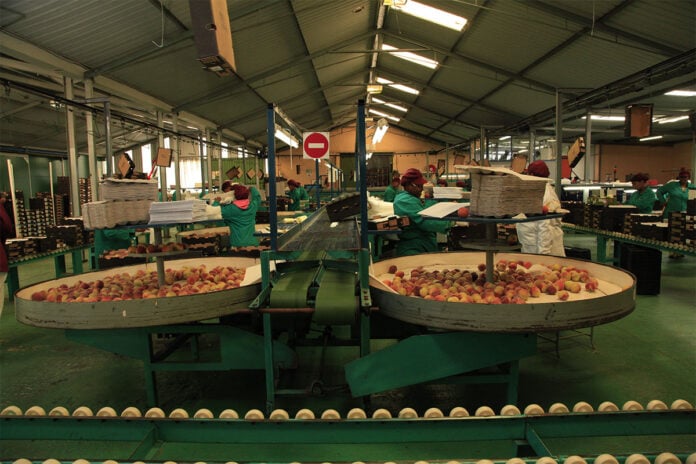
This warning emerged from Minister of Agriculture Willie Aucamp’s address and an economists’ panel discussion at the Packhouse Trade, Tariffs & Investment Conference, held in Paarl from 26 to 27 November.
For farmers, failures along the route to market can mean losing both the harvested crop and the resources invested in producing it. Aucamp said post-harvest losses wasted water, energy, money, and labour, with smallholder farmers particularly vulnerable.
The cost of these losses, and the investment needed to prevent them, brought the conference theme – ‘Beyond the Packhouse: Redefining Performance and Profitability’ – into focus. Speakers examined how decisions on farms, in packing facilities, and across transport networks ultimately affect export returns.
Protecting value after harvest
Aucamp said packhouses occupied a critical position between production and the market. Their handling of a crop determines whether the quality achieved on the farm is preserved for the buyer.
“The quality of agricultural production must be matched by the quality of the post-harvest handling of our products,” he said.
Without adequate packing infrastructure, cold chains, logistics, and quality assurance, even high-quality produce could lose its premium value before reaching its destination.
For the farmer, this loss comes after the costs of production have already been incurred. Water, energy, and other inputs are used to bring the crop to harvest, but damaged or spoiled produce can no longer earn the income needed to recover that expenditure.
“These losses represent wasted production, wasted water, wasted energy, and lost income,” Aucamp said.
He identified post-harvest losses as a particular challenge for smallholders. Improving access to effective handling infrastructure is therefore important to economic inclusion as well as the sector’s overall competitiveness.
Aucamp argued that packhouses should consequently be recognised as strategic economic infrastructure. Beyond sorting, grading, and packing, they support value addition, technology transfer, and skills development.
Their capacity also needs to keep pace with production. Expanding output on farms will deliver limited benefits if the sector can neither handle the additional crop nor find buyers for it.
“We can have the largest agricultural production in the world, but if we don’t have proper packhouses and proper markets for those products, there’s nothing that will come from it,” Aucamp said.
Opening markets and developing demand
Aucamp said expanding these markets required government and industry to fulfil connected roles. Government needs to negotiate export protocols that create access, while businesses must market their products and turn that access into commercial opportunities.
He pointed to the signing of a protocol allowing South African cherries into China, saying that he expects to return to China early in 2027 to sign a blueberry export protocol. He added that South Africa had also signed export protocols with Egypt for red meat products.
Alongside these opportunities, Aucamp encouraged giving greater attention to neighbouring countries, as South Africa had not fully developed the potential of markets on its doorstep.
The work required after securing access to these countries was explored further during a panel discussion moderated by Dr Francois Knowles, registrar of the Agricultural Produce Agents Council.
Speaking during the discussion, Paul Makube, senior agricultural economist at FNB, said exporters needed detailed knowledge of the markets they intended to serve.
“We need to know what happens on the other side,” he said.
This means understanding consumption patterns, the businesses operating within a market, and the differences in demand between regions and cities.
China illustrates the importance of this research. Its large population offers potential, but identifying commercial opportunities requires a closer examination of where purchasing power and demand are concentrated.
Such information could help exporters identify suitable buyers and position their products more effectively. It could also guide decisions further back along the chain, including which varieties farmers plant and how produce is handled and marketed.
Makube said research into changing consumer preferences therefore needed to develop alongside investment in production and packing.
Investing to meet market requirements
Meeting buyers’ requirements has substantial implications for a sector heavily dependent on exports. Makube said more than 60% of locally produced horticultural output went to international markets, making export performance central to growers’ prospects and rural employment.
He said the expansion of orchards had reinforced the importance of packhouses as strategic infrastructure. Increased production needs to be matched by the capacity to handle fruit efficiently and deliver it to market in the required condition.
At the same time, investment in packing facilities needs to be aligned with the volumes expected to pass through them. Whether a packhouse forms part of a farming operation or serves several growers, sufficient throughput is essential to sustaining the investment.
Planning this capacity is complicated by uncertainty in export markets. Orchards represent long-term commitments, and producers cannot quickly change their crops when tariffs or market access shift. They therefore need packing and marketing operations capable of responding to changing conditions.
Makube said this required continuous improvement across the value chain.
“Innovation has to happen everywhere,” he said.
Better use of technology and data could help businesses track produce, identify delays, and make informed decisions as fruit moves from the farm towards the buyer. The priorities will differ between packhouses, according to their products, operating requirements, and target markets.
These improvements also need to connect with the performance of the wider export system. As Knowles put it, “Agricultural exports do not begin at the port.”
He described a chain extending from production through packing, regulatory compliance, and logistics to market access. Investment in one part will have limited impact if inefficiencies elsewhere continue to delay deliveries or compromise quality.
Removing delays and improving efficiency
Buhlebemvelo Dube, an agricultural economist at the National Agricultural Marketing Council, identified roads and ports as priorities for addressing these inefficiencies.
Poor roads hamper the movement of produce from farms, while port delays could compromise delivery commitments. Investment in growing and packing a quality crop could consequently be undermined by failures in getting it to the buyer.
“The road must be efficient,” Dube said.
He said South Africa needed to address these domestic constraints while adapting to changes in international trade. New agreements could introduce competitors into established markets and create opportunities elsewhere, requiring exporters to monitor developments and identify alternative outlets.
The pressure to remain competitive also makes efficiency within packhouses increasingly important. Dube said South African facilities already had strong capabilities, but further investment was needed to keep pace with competitors.
“We just need to be more efficient,” he added.
Dube identified artificial intelligence (AI) as a potentially significant influence on this performance, particularly where it reduced handling times and helped produce reach markets sooner.
If competitors can complete comparable operations substantially faster, businesses using slower systems risk falling behind. Dube urged the sector to investigate practical applications of AI and draw on young people’s skills to support its adoption.
“We have to be ahead of the curve,” he said.
Aucamp similarly urged operators to continue modernising through advanced sorting and grading technologies. He said government and industry needed to coordinate their efforts as rising input costs, disease outbreaks, and climate pressures placed additional demands on the sector.
His concern returned to the investment already made on farms: increasing production and opening markets would yield their full benefit only if the crop retained its quality and value throughout the journey to the buyer.