

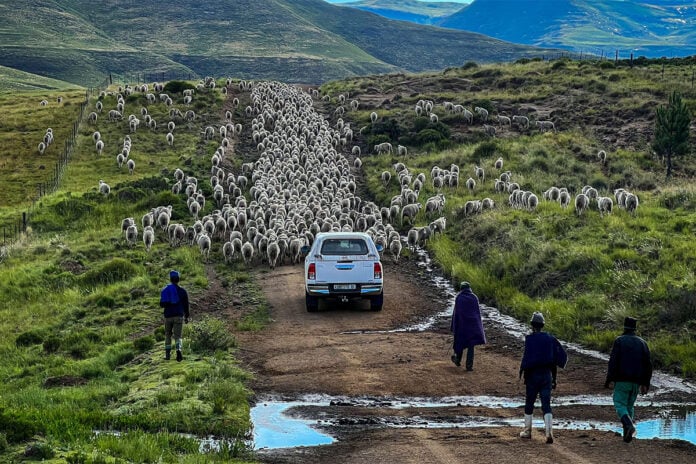
Speaking to Farmer’s Weekly at the World Wide Fund for Nature South Africa’s (WWF-SA) 58th annual general meeting (AGM) in Cape Town on 14 November, Moosa said Grasslands National Park is an example of how commercial farming, communal agriculture, and conservation can coexist within the same landscape.
“It’s an extremely exciting time because in the past, nature conservation and agriculture were seen as two mutually exclusive areas. For the first time, we are now seeing this as being a truly organic integration together,” he said.
Farming continues inside the park
The park was officially declared on 9 October by Minister of Forestry, Fisheries and the Environment David Maynier. It covers 10 225ha between Nqanqarhu (formerly Maclear) and Rhodes in the Eastern Cape Highlands.
It is South Africa’s first national park established primarily through biodiversity stewardship. Participating landowners retain ownership of their farms and may continue conservation-compatible agricultural activities.
“It’s a national park in which farmers will continue doing their farming, while local traditional communities continue living on communal land and doing their communal farming,” Moosa said.
Thembanani Nsibande, WWF-SA’s landscape manager for the Drakensberg/Eastern Cape, said the organisation had spent more than a decade working with commercial, emerging, and communal farmers to combine agricultural production with grassland conservation.
The landscape supports cattle and sheep farming, wool enterprises, and community vegetable production. WWF-SA’s work includes improving rangeland management and protecting grasslands and water resources while keeping farms productive.
“What’s exciting is that when [the farmers] bring land into conservation, they continue to own their properties and continue to produce agricultural products like livestock and vegetables,” Nsibande told Farmer’s Weekly.
He added that this park differs from the conventional model.
“When you visit the park, you won’t meet a ranger or someone at reception, but you’ll meet a farmer. You’ll meet a community member,” he explained.
Visitors will also see cattle and sheep rather than lions and elephants, with farming managed to conserve the grassland landscape.
Water security starts in the landscape
Silindile Mtshali, senior freshwater technical specialist at WWF-SA based in KwaZulu-Natal, said strategic water source areas comprise about 10% of South Africa’s land but generate around 50% of its river flow. They also contribute almost 70% of the water used by irrigated agriculture.
“These areas are incredibly important for our water security,” she said.
WWF-SA works in more than half of South Africa’s 22 strategic water-source areas, partnering with farmers, water-user associations, and government agencies to clear invasive alien plants, improve land management, and attract investment.
Mtshali said these partnerships could keep farms productive while ensuring landscapes continued supplying water to farms and downstream users.
A vision of one million hectares
Nsibande said commercial farmers had already helped secure more than 10 000ha within the new park. WWF-SA and its partners were now working towards expanding it to more than 80 000ha while keeping farms productive and farmers central to conservation.
Beyond the park, Nsibande’s AGM presentation showed that WWF-SA currently has 55 702ha secured, with another 136 453ha in the pipeline. Securing this land would expand the organisation’s conservation footprint by 71% to 192 155ha.
This forms part of the organisation’s 2045 vision of securing one million hectares of priority landscapes across the country through partnerships with farmers, communities, landowners, and government.
“It’s time now for agriculture and conservation to coexist. Without conservation, there is no farming, and without farming, there is no food security,” Nsibande said.