

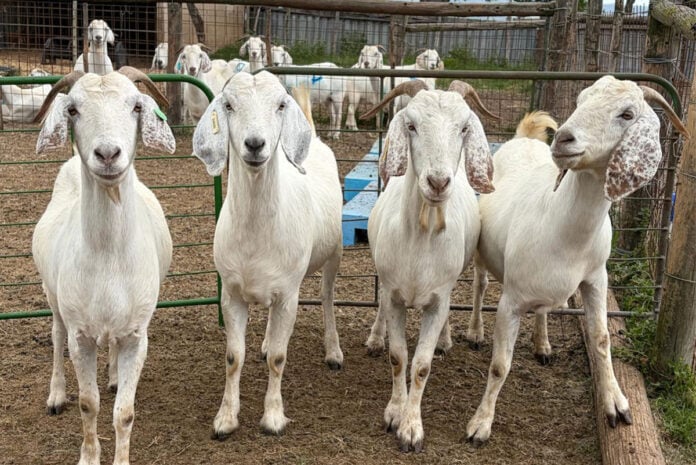
Held at Glenrose Farm in Nanaga, Eastern Cape, from 12 to 13 November, the course focused on Savanna breeding, breed standards, livestock management, and animal selection. With a maximum of 15 participants, the programme allowed for closer interaction with experienced breeders and more opportunities for hands-on learning.
Making practical knowledge accessible
Michelle De Wet, co-owner of Swart en De Wet Savannas, said the initiative was about more than teaching participants the fundamentals of Savanna goat production. It was about making specialised agricultural knowledge accessible to farmers, particularly those from rural communities who often have limited opportunities to attend practical training courses.
“My aim with the course is to make practical knowledge accessible to [emerging] farmers in the Eastern Cape, who often don’t have access to training like this,” she told Farmer’s Weekly.
De Wet said she wanted participants to leave with a better understanding of their goats, greater confidence in selecting and breeding quality animals, and practical skills they could use to improve their flocks and livelihoods.
“For me, this is about more than a certificate. It’s about building relationships, sharing knowledge, and growing a community where farmers can continue learning from and supporting one another. My hope is that this course will be the beginning of something lasting.”
Developing future breed judges
Course instructor Stephanus Malan, a Boer goat farmer from Adelaide in the Eastern Cape and a judge of Boer goats, Kalahari Reds, and Savannas, said the junior course taught participants how to assess Savannas according to the breed standards and distinguish between animals suitable for stud breeding, commercial production, and culling.
The course also included an examination, which participants needed to pass before progressing to the senior judging programme, where they are required to attend two additional courses. Depending on their performance, they may eventually go on to qualify as judges of Boer goats, Kalahari Reds, and Savannas.
Malan said he enjoyed sharing his knowledge and was encouraged by the participation of young and emerging commercial farmers.
Strengthening Eastern Cape livestock production
Among those who participated in the course was Dr Dabane Magandana, an animal production scientist at the Eastern Cape Department of Agriculture.
He said the training provided valuable practical knowledge that could be transferred to farmers throughout the province, adding that it would also enable agricultural officials to provide farmers with more informed guidance, particularly when it came to purchasing livestock.
“Farmers will now be able to trust us with the information we give them, because we are coming with knowledge that will benefit them, particularly when it comes to selecting good-quality animals,” he Magandana.
He also noted the growing interest in Savannas in the Eastern Cape, which presented opportunities to expand awareness of the breed and its potential within local livestock production systems.
Magandana believes that increased access to training and technical information will encourage more farmers to consider Savanna goat production.